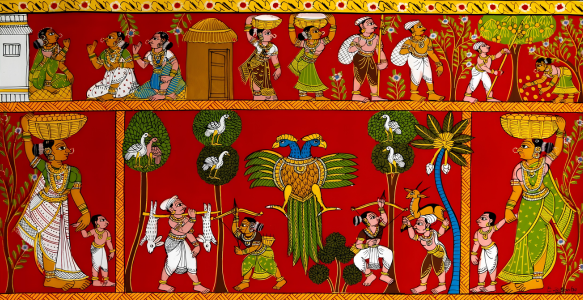
On a humid evening in a Telangana village, a storyteller once stood beneath a dim oil lamp, slowly unfurling a long painted cloth. The red of the background caught the flame first, then the blues and yellows of gods, the pink of farmers, the deep browns of demons. As he sang episodes from the Ramayana and Mahabharata, each panel of the scroll lit up like a frame of early cinema – a moving, hand-painted archive of memory, caste histories, and devotion.
Cheriyal scroll paintings belong to this world of oral storytelling, where image, song, and performance are inseparable. Today, the scrolls are shorter, often framed for walls rather than tied to bamboo poles, yet the core visual language remains surprisingly intact. At a time when many folk traditions have been folded into a generic “craft” label, Cheriyal speaks in the accents of Telangana’s villages, even when it hangs in an urban home.
Spending time with Cheriyal is less about asking what is cheriyal painting in a textbook sense and more about learning to read a community’s layered memory system – episode by episode, panel by panel, colour by colour.
What is Cheriyal Paintings?
Cheriyal scroll paintings are narrative scrolls on cloth or canvas, painted in a set of horizontal panels that unfold like a film reel or comic strip, each panel carrying a self-contained yet connected scene. This Cheriyal art form evolved within the storytelling traditions of Telangana, where bards and performers used scrolls as visual scripts while singing epics, puranic tales, and local legends.
Originating in Cheriyal, a small town in the present-day Siddipet district, it represents a localized, Deccani inflection of the wider Indian scroll traditions that we also glimpse in Pattachitra or Rajasthani pata art. Unlike courtly miniature painting, these works are deliberately bold and legible from a distance, meant to be “read” in a crowded village square.
Figures are stylised and frontal, with large eyes, rhythmic gestures, and an almost theatrical sense of staging, making even small panels feel like miniature stages. In a sense, any primer about cheriyal painting must hold together at least three strands – image, performance, and community – because the scroll was never meant to function as a painting alone.
History and Origin of Cheriyal Painting
The Cheriyal painting origin is often described as “about 400 years ago,” but the scroll tradition itself likely draws from older Deccani visual and temple arts that predate the 17th century. Some sources trace early painted scrolls in the Telangana region to around 1625, under the Qutb Shahi rulers of Golconda, while stylistic echoes connect Cheriyal to Kakatiya murals and Kalamkari scrolls. The word “Nakashi” – from which the older name “Nakashi art” is derived – links the practice to artisans known for fine, linear drawing.
Historically, scrolls were commissioned by specific communities – toddy tappers, shepherds, leather workers, weavers – each with its own heroes, moral codes, and caste myths that needed to be visually “programmed” into the scroll. Itinerant storytellers, called Patrots or Bhagats, travelled from village to village carrying these scrolls, unfurling them panel by panel as they narrated stories from the Ramayana, Mahabharata, Markandeya Purana, and a dense archive of localized ballads.
The modern Cheriyal painting history is also a story of adaptation and survival. With the decline of traditional storytelling in the late twentieth century – television doing what the village bard once did – artists shifted from 40–50 metre scrolls to smaller scrolls, framed panels, masks, and everyday objects. Recognition as a handicraft in the 1970s and the GI tag in the 2000s gave the tradition a certain institutional visibility, but economically and socially it remains tied to a handful of Nakashi families in Telangana.
For those asking “Cheriyal scroll painting belongs to which state?”, the answer is deceptively simple – Telangana – but the visual language we see in this scroll painting in Telangana is really the accumulated sediment of multiple regional histories and migrations.
When we map Cheriyal alongside other folk paintings in India, the scrolls show us how local traditions quietly updated themselves – changing formats, colour sources, and patronage models.
Themes and Subjects in Cheriyal Art
Cheriyal scroll art is, at heart, a narrative system. Its panels carry stories that range from cosmic battles to very ordinary moments – a woman grinding grain, a potter at his wheel, children playing in the courtyard. In that sense, they sit in conversation with spiritual paintings across India, but have a distinct Telangana accent in costume, architecture, and body language.
1. Hindu Epics like Ramayana and Mahabharata
Many scrolls devote entire vertical compositions to sequences from the Ramayana and Mahabharata – Ram’s exile, Sita’s abduction, the Kurukshetra war, Draupadi’s humiliation – each episode occupying its own panel, separated by floral borders. Artists often compress time, showing multiple moments in a single frame, so that viewers “read” the painting as they would a recited verse.
Stories from Markandeya Purana, Shiva Purana, Garuda Purana, and Krishna Leela are central, especially episodes featuring Krishna’s childhood mischief or Shiva’s fierce forms. In this, Cheriyal shares a thematic universe with Krishna paintings and radha krishna paintings, but treats them less as individual devotional icons and more as scenes within a larger social drama.
2. Mythological Figures
Cheriyal painters populate their scrolls with a full cast of gods, goddesses, sages, demons, and celestial beings – each coded through colour, posture, and attribute. Blue-skinned Vishnu, yellow-toned goddesses, brown or black demons, and pink-bodied humans appear repeatedly, that viewers learn to decode almost instinctively.
Local folk deities, village goddesses, and caste-specific protectors also find their way into the panels, sometimes sitting in the same space as pan-Hindu figures, sometimes occupying their own narrative tracks. This coexistence of canonical and local divine figures is one of the most striking aspects of the Cheriyal painting techniques of storytelling.
3. Festivals
Beyond epics, Cheriyal artists revel in depicting processions, harvest rituals, temple festivals, and domestic ceremonies. Panels teem with drummers, dancers, musicians, animals wearing garlands, and crowds moving toward shrines or village centres. The social choreography of a festival – who stands where, who carries what – becomes as important as the main deity being worshipped.
4. Nature And Animals
Trees, rivers, hills, and stylised clouds weave through the narrative, acting as visual anchors between one panel and the next. Animals – cows, horses, elephants, birds – serve both as symbolic markers (royalty, fertility, auspiciousness) and as everyday presences in agrarian life. Even when rendered simply, they carry a surprising tenderness: a cow licks her calf, a horse arches its neck mid-gallop.
5. Colour Symbolism
Thematically, colour functions almost like a parallel script. Red backgrounds signal not only drama and intensity but also the heat and dust of the Deccan landscape. Blue, yellow, pink, brown, and green do more than fill space – they encode divinity, gender, moral status, and the vegetal world in ways viewers quickly learn to read.
If one thinks of the scroll as an early “graphic novel”, the brilliance of Cheriyal lies in how it refuses to separate the sacred and the mundane. Gods descend into village courtyards, and village stories climb into epic space, all within the same red field.
Significance of Colours Used in Cheriyal Paintings
Cheriyal colour palettes are simple, mostly primary hues yet they carry a dense web of symbolic associations. Red dominates the background, creating a warm, non-glossy field against which figures appear almost backlit. The pigments historically came from natural sources: red from stones like inglikam, yellow from pevadi stones, blue from indigo, white from ground seashells, black from lamp soot.
1. Blue
Blue is the colour of divinity in Cheriyal – especially for male gods like Vishnu or Krishna. Against the red ground, blue figures pull the eye instantly, marking them as central protagonists in the unfolding drama.
2. Yellow
Yellow, often used for goddesses, suggests luminosity, abundance, and auspicious presence. When paired with red garments and green surroundings, yellow bodies sit at the intersection of prosperity and protection in the Cheriyal visual vocabulary.
3. Black
Black and darker browns are typically reserved for demons or morally ambiguous figures, signalling danger, aggression, or otherness. Yet black also appears in hair, outlines, and decorative motifs, anchoring compositions and giving them graphic clarity.
4. Green
Green enters as the colour of the vegetal world – trees, foliage, sometimes garments – and, in some readings, stands for fertility and the regenerative cycles of nature. Set against red, green offers a cooling counterpoint, making the scroll feel more breathable despite its dense crowding of figures.
The Process of Creating Cheriyal Paintings
Traditional Cheriyal painting techniques emphasise hand-made surfaces, natural binders, and an almost disciplined sequencing of stages.
1. Preparing the base
Khadi cotton cloth is stretched and coated with a thick paste made from rice starch, white mud or clay, boiled tamarind seed paste, and natural gum. This mixture is applied in two or three coats, with each layer thoroughly dried – often in the sun – before the next is added, producing a stiff yet flexible canvas.
2. Sketching the narrative scenes
Once the base is ready, the artist lightly sketches the layout, sometimes in graphite, sometimes directly with a fine brush, marking out panels, figures, and key architectural elements. The narrative flow – which episode appears where, how characters recur across panels – is decided at this stage, drawing on oral knowledge as much as on any written script.
3. Applying base colors
Artists traditionally lay in the background colour first – almost always a strong red – followed by flat areas of blue, yellow, green, pink, and brown for bodies, garments, and landscape. Natural pigments, sometimes mixed with commercial colours today, are bound with gum and applied in opaque, even coats using brushes made from squirrel hair or other fine fibres.
4. Adding intricate details
After the base colours dry, artists return to add ornaments, facial features, textile patterns, and miniature objects – bangles, pots, weapons, foliage – that thicken the narrative. Black outlines sharpen forms, while white highlights from ground shells bring a subtle, chalky brightness to jewellery and eyes.
5. Step 5 – Final finishing and preservation
Finally, floral and foliate borders are painted along the edges and between panels, visually separating episodes and framing the story. A protective layer of gum water may be applied to increase durability, particularly when the scroll is meant to be rolled, travelled with, and unrolled repeatedly. In that sense, every Cheriyal scroll painting is both artwork and performance tool, built for hard use.
Famous Artists Creating Cheriyal Paintings
Today, the Cheriyal painting of Telangana survives primarily through a small network of interrelated families and a few younger practitioners who have apprenticed with them. Their studios hold multi-generational memories: recipes for primers, songs for specific scrolls, anecdotes of patrons and performances.
1. Mallesham Cheriyal
Pasula Mallesham is frequently cited as one of the key keepers of the tradition, a state award–winning artist based in or near Cheriyal village. Along with his family, he continues to produce scrolls and panels that retain the classic red-ground, multi-panel format, while also adapting motifs to contemporary scales.
2. Narayan Rao Cheriyal
References to “Narayan Rao” in Cheriyal contexts often appear in scholarly work documenting ballads and narratives associated with the scroll tradition rather than as widely profiled studio practice. This underlines a larger truth about Cheriyal: its ecosystem includes not only painters but also singers, storytellers, and writers who have helped keep its stories in circulation.
3. Vinay Kumar
D. Vinay Kumar’s work – including Cheriyal depictions of Lord Ganesha – exemplifies how younger-generation artists retain traditional iconography while tightening composition for single-panel works. His paintings often foreground a central deity surrounded by dense patterning, compressing the scroll’s narrative energy into a square or rectangular frame.
4. Sai Kiran Dhanalakota
Dhanalakota Sai Kiran and his family have become important voices in giving a “new spin” to the 400-year-old art form, experimenting with masks, keychains, and smaller narrative pieces while staying rooted in traditional methods. Their practice, recognized in state-level forums, demonstrates how Cheriyal can travel into new formats without losing its core storytelling impulse.
5. D. Padma
State award–winning artist D. Padma, often mentioned alongside her husband Nageshwar, has been central to both preserving classical scroll formats and exploring utility objects painted in Cheriyal style. Recent exhibitions such as “Vama – The Strength Within” at Bikaner House have highlighted her role in bringing Cheriyal into contemporary art spaces while retaining its narrative density.
6. Nagila Ganesh & Vanaja
Nagilla Ganesh is described as one of the few remaining Cheriyal scroll painters based in the village itself, continuing to paint tales of valour and war on long khadi scrolls. Vanaja, featured alongside D. Padma in the “Vama” exhibition, extends this legacy, foregrounding women’s labour within the tradition and reframing the scroll as a vessel for gendered histories as well.
FAQs About Cheriyal Painting
Where did Cheriyal paintings originate?
Cheriyal paintings originated in Cheriyal village in present-day Telangana and have been practiced for centuries as a storytelling tradition.
What are the main themes in Cheriyal art?
Cheriyal paintings depict stories from the Ramayana, Mahabharata, Puranas, folk tales, and everyday village life.
What materials are used in Cheriyal paintings?
Artists use khadi cloth, natural pigments, rice starch, tamarind seed paste, and handmade brushes.
What are the characteristics of Cheriyal painting?
Cheriyal paintings are known for bright red backgrounds, bold outlines, expressive figures, and narrative storytelling panels.
What stories are depicted in Cheriyal paintings?
Cheriyal paintings portray mythological stories, local legends, folk traditions, and scenes from rural life.
