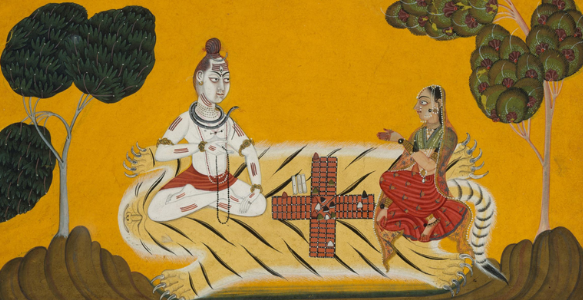
Shiva and Parvati are playing chaupar. A gesture holds the scene together, while colour and ornament give it an intensity that survives the small scale of the paper. The Metropolitan Museum of Art dates Devidasa’s folio to 1694–95 and identifies its materials as opaque watercolour, ink, silver and gold. Here is Basohli painting of Jammu and Kashmir at the scale of a single sheet. Its date puts us near the end of the seventeenth century; its subject draws us into a much older literary and devotional world.
The picture belongs to an illustrated Rasamanjari series. Looking at it means moving between a painted encounter and a literary text, between the material surface and the emotions a figure’s posture can suggest. Such works were made within the courtly culture of the Himalayan hill states. They were not designed as interchangeable examples of regional decoration.
There are also Basohli painters working today. Their workshops and exhibitions belong to a different setting from the courts that supported the early manuscripts. The name connects these practices, but it does not make their circumstances identical. A newly painted Krishna may recall an older composition; its paper, patron and route to a viewer have their own history. With that in mind, we can move between the surviving folios and the people continuing the practice.
What is Basohli Painting?
Basohli is an important early centre of Pahari miniature painting, associated with the town now in Kathua district, Jammu and Kashmir. Its characteristic intensity comes from emphatic outlines, concentrated colour fields, stylised faces and richly worked ornament. These are starting points for recognising a work, not a substitute for its attribution.
Among the characteristics of Basohli painting, colour is especially conspicuous. A strong ground can press figures forward without constructing a deep landscape behind them. Gesture and the relation between figures then carry much of the narrative. The Basohli art of Jammu and Kashmir also includes later developments and contemporary adaptations; one early manner cannot describe them all.
History and Origins of Basohli Art
For Basohli painting history, the dates attached to individual sheets are especially helpful. They let us place a work beside a ruler’s reign, and sometimes reveal why a familiar attribution needs another look. Artists also travelled: the name of a school may tell us little about where a painter was born.
1. Meaning and Origin of the Word "Basohli"
Basohli painting meaning begins with a place-name. The town’s court gave the school its familiar designation. District accounts preserve the older name Vishwasthali and a local tradition connecting Basohli with Basu or Vasu Rana. Those accounts belong to regional history and memory; they should not be mistaken for a securely demonstrated linguistic derivation.
2. Why It Is Called the Founding School of Pahari Painting
Basohli is often called the founding school because it was a formative centre of early Pahari painting. Major illustrated series gave that early idiom a recognisable courtly form. The description should leave room for other hill centres, including Mankot, Nurpur and Chamba, and for artists moving between them. A style developed through exchanges, not inside a sealed boundary.
3. Royal Patronage Under Raja Kirpal Pal and Other Rulers
Official craft accounts associate Basohli’s development with Sangram Pal and Kirpal Pal. Patronage supported the making of poetic and devotional series. Precise chronology matters, however: Devidasa’s celebrated 1694–95 folios should not automatically be assigned to a ruler whose reign is given as ending in 1693. Courtly conditions and the completion of a particular manuscript are different questions.
4. Where is Basohli Painting Practiced?
For “basohli painting which state,” the present-day answer is Jammu and Kashmir, specifically Kathua district. The wider artistic geography crosses modern boundaries. Devidasa is identified with Nurpur; Nainsukh was born in Guler. Both places connect the story with present-day Himachal Pradesh, without relocating Basohli itself. Contemporary practice continues through artisans and institutions in the Basohli region.
4. Royal Patronage and Early Development
Court support made sustained manuscript projects possible. Painters worked with literary subjects that required several emotional situations, recurring figures and a coherent visual language across separate folios. A sequence could invite comparison between gestures or encounters. Studying one detached sheet is valuable, but its place within a series can alter how the scene is understood.
Materials Used in Basohli Painting
In traditional Basohli paintings, a jewel may have a raised surface or a metallic glint. On paper, these small differences carry considerable visual weight. A flat reproduction can show their placement while giving only a partial sense of their texture.
1. Handmade Wasli/Sialkoti Paper
Official craft documentation identifies handmade Wasli or Sialkoti paper among the supports. Preparation and burnishing provide a surface for fine drawing and controlled paint application. A folio therefore begins before its figures are outlined. The support is part of the object’s construction, not a neutral sheet that can be ignored when discussing technique.
2. Natural Mineral and Vegetable Pigments
Craft accounts describe plant, mineral and earth colours. For a specific folio, however, the museum may list only opaque watercolour and the metallic media. That leaves the ingredients of a particular red or yellow unsettled. Colour names and pigment names answer different questions. Identifying an ingredient requires evidence from the object, not just a close look at a photograph.
3. Gold, Silver Foils and Beetle-Wing Fragments
Metallic ornament is documented in specific works. Some Basohli surfaces also use raised white details and green beetle-wing fragments to suggest jewels. These additions make ornament physically different from the surrounding paint. They are associated with particular examples and periods, rather than being a compulsory feature of every Basohli miniature painting.
4. Traditional Brushes
Look along the edge of a face or at the small marks of ornament. These are places where the painter’s control becomes visible. The brush has to carry an outline and also serve much smaller details. Its precise construction is another matter: the available craft and collection records do not establish a single brush-hair recipe for all Basohli work.
Common Motifs and Themes in Basohli Paintings
What is happening in a Basohli art painting? The answer may lie in a poem, a deity’s attributes or the identity of a sitter. A vivid red ground can appear in quite different kinds of scenes. Subject and colour need to be read together.
1. Radha-Krishna and Krishna Leela
Krishna’s presence does not by itself identify the story. Radha and the gopis appear in literary as well as devotional settings, and a meeting between lovers may illustrate a poem’s emotional situation. Notice who faces whom and how close the figures stand. Then consult the folio’s title or inscription: the literary setting can change the meaning of a seemingly familiar encounter.
2. Scenes from Rasamanjari
Bhanudatta’s Rasamanjari classifies situations and emotions of lovers. Basohli painters translated those distinctions into encounters that can be read through posture, setting and colour. A famous Basohli painting such as Devidasa’s chaupar scene belongs to this larger manuscript context. The series should not be treated simply as a collection of unrelated romantic pictures.
3. Gita Govinda and Ragamala Series
Jayadeva’s Gita Govinda offered another major poetic subject. The National Museum records a 1730 folio of Jayadeva worshipping Radha and Krishna with Manaku named as artist. Ragamala works concern musical modes personified through figures and situations. The two traditions can share devotional imagery without illustrating the same text or organising emotion in the same way.
4. Royal Portraits and Court Life
Portraits complicate the idea that Basohli art is exclusively mythological. A ruler or courtly encounter belongs to a different field of identification. Cleveland Museum’s painting of an amorous couple is described as probably Raja Mahendra Pal with a favourite queen. The word “probably” is part of that attribution and should remain when the work is discussed.
5. Tantric and Devi Imagery
Goddess images can have a force quite unlike an intimate encounter between lovers. The Met’s Bhadrakali from the Tantric Devi series connects image and Sanskrit text with private meditation. Here, identifying the deity and the work’s textual setting prevents a fierce figure from becoming merely an example of dramatic colour or an anonymous decorative motif.
Famous Artists Practicing Basohli Art
Historic painters and contemporary practitioners require different kinds of evidence. A signed or attributed folio, a workshop record and a modern exhibition catalogue do not establish the same claims.
1. Devidasa
Devidasa of Nurpur is associated with the dated Rasamanjari series represented at the Met. The name itself is a reminder that Basohli style need not mean a Basohli birthplace. His folios provide a concrete basis for discussing colour, spatial arrangement and gesture. In the chaupar scene, the game places the figures in relation to one another: attention passes between their faces, hands and the board. Looking at those relationships slows the reading of an image that might initially seem dominated by its bright surface.
2. Manaku
Manaku is associated with the Guler painting family and the Gita Govinda cycle of around 1730. The National Museum’s Jayadeva folio supplies a direct institutional attribution. His connection with Basohli-labelled work should be understood within the mobile world of the hill courts. It does not justify describing him simply as a painter born in Basohli.
3. Nainsukh
Nainsukh’s career reaches across Guler, Jasrota and Basohli. Princeton records him as born in Guler and dying in Basohli; an attributed portrait of Mian Hadala Pal is dated around 1763–75. These dates bring us well beyond Devidasa’s Rasamanjari sheets. Nainsukh’s more naturalistic approach asks to be considered within that later moment in Pahari painting, even where a Basohli connection is recorded.
4. Sohan Singh Billawaria
Sohan Singh is listed in official contemporary craft records, while institutional exhibition material uses the surname Billawria, a spelling variant of this heading. Museo Camera’s 2023 Basohli exhibition presented his work. Those records support discussion of a contemporary practitioner without making him the endpoint of an assumed hereditary line from the early court painters.
5. Antima Manhas
Antima Manhas appears in an official trade-promotion catalogue as a contemporary Basohli practitioner. The available documentation supports that limited identification. It does not establish a detailed biography, a sequence of major works or an award history. Those distinctions matter when a name is introduced alongside artists with extensive museum documentation.
6. Contemporary Basohli Artisans
Contemporary Basohli paintings emerge from an active regional craft setting. District Kathua records individual artisans, cooperative societies, training centres and Karkhandar units. The Basohli painting GI tag was registered in 2023. It recognises a regional craft identity; it is not a certificate authenticating every old painting described as Basohli. Revival, teaching and historical attribution remain separate matters.
Modern makers can study the earlier Basohli style of painting while working in another social setting. Their patrons, materials and exhibition opportunities need not resemble those of a court atelier. This difference is part of the continuing history of Basohli artworks, rather than evidence that contemporary practice is somehow outside the tradition.
FAQs About Basohli Artworks
When looking at a reproduction, begin with the collection record beside it. Title, date, attribution and materials establish what is known about that particular sheet. Then return to the image: notice where a figure looks, what separates the figures and how the background holds them together. This keeps the historical information connected with the act of looking.
What is Basohli painting famous for?
The strongest answer to what is basohli painting includes early Pahari manuscript series, saturated colour, emphatic line, stylised faces and carefully worked ornament. Rasamanjari and Gita Govinda subjects are especially important. Those features describe a historical field; they do not prove the date or authorship of an individual painting.
Is Basohli painting from Himachal Pradesh or Jammu & Kashmir?
For “basohli painting belongs to which state,” the present-day answer is Jammu and Kashmir. The phrase “basohli painting himachal pradesh” needs qualification: artist origins and older museum classifications can cross present-day boundaries. They do not change the location of Basohli town in Kathua district.
What are the main colours used in Basohli paintings?
Strong reds and yellows are particularly conspicuous, alongside blue, green, white and dark outlines, with metallic details in some works. For reliable Basohli painting information, distinguish this visible palette from an identified pigment recipe. A colour’s appearance alone cannot establish its ingredients.
What is Rasamanjari in Basohli painting?
It is Bhanudatta’s Sanskrit text on lovers and their emotional situations, illustrated in several celebrated painting series. In Basohli examples, gesture, colour and the relation between figures turn literary distinctions into images. Devidasa’s dated folios are important surviving evidence of that work.
