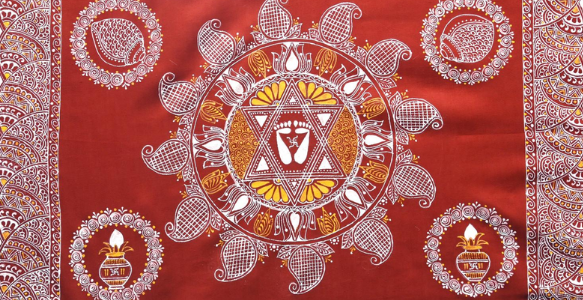
Project FUEL’s documentation of Aipan describes a practice that begins and ends with a dot. Lines and patterns develop around that small mark, understood in the account as a centre of the universe. The materials are modest: white rice paste and a red ground. The drawing’s setting gives them another significance. A floor or a low seat is being prepared for something to happen there.
The familiar red and white are important, but colour alone does not explain the practice. A named chowki has a purpose; a footprint has a place within a ritual arrangement. The drawing belongs to the household and to what is about to happen there. Viewed only as a pattern, it loses part of that setting.
Aipan art of Uttarakhand also travels onto wood, cloth and other objects. Namita Tiwari’s Cheli Aipan, established in 2015, provides a documented example of teaching and adapting the practice. Other makers work from different towns and family experiences. The durable object and the temporary drawing now coexist. Following them requires attention to what has changed as well as what remains recognisable. This guide moves through materials, named designs and occasions before turning to contemporary practitioners. Where an origin account or artist identity remains uncertain, that uncertainty is kept visible.
What is Aipan Art?
Aipan is a ritual drawing and painting tradition associated especially with Kumaon in Uttarakhand. White rice-paste designs are traditionally made on a red geru ground. Floors, thresholds, worship spaces and low seats can become its surfaces. Within Indian paintings, its temporary domestic forms deserve attention alongside objects made to last.
History and Origins of Aipan Art
For Aipan art history, written records describe knowledge that also survives in people’s hands. Observation, repetition and ritual use carry designs between generations. The history of Aipan art is therefore broader than a dynastic origin claim. Recent documentation disagrees over Chand and Katyuri connections, leaving a precise founding period unsettled.
1. Meaning and Origin of the Word "Aipan"
India’s intangible-cultural-heritage inventory connects the name with “Alpena,” explaining it through the execution of floor designs. Popular accounts also associate it with offering. The ritual connection is clear; a single universally settled linguistic derivation is less secure.
2. Why It Is Called Ritualistic Folk Art
A wedding, a naming ceremony or a household puja needs a prepared place. The drawing can mark a seat and organise the space around it. This is why Aipan folk art is described as ritualistic: the pattern accompanies an occasion, with signs chosen for that setting.
3. Where is Aipan Painting Practiced?
Kumaon is the principal cultural region, with Almora, Nainital-Haldwani and Pithoragarh among documented centres. The GI Registry gives Uttarakhand as the geographical area. Aipan painting of Uttarakhand has also travelled through migration, teaching and contemporary craft practice; no single town accounts for all its present forms.
Key Features of Aipan Painting
For Aipan art information, look at the line as well as the overall shape. White dots and strokes sit against an earthy red field. A border may enclose a named central design, connecting the visible arrangement with its ritual function.
1. Freehand Finger Painting (No Brushes Used)
Traditional Aipan art is finger-led. Paste is carried and released directly by the hand. Contemporary practitioners may use brushes and paints on durable objects.
2. Red and White Color Contrast
The white of biswar sits clearly against geru’s red. Across a floor or a low seat, separate dots and thin lines remain legible. This familiar contrast comes from the two materials themselves, before any wider symbolic reading is added.
3. Symmetrical Geometric and Floral Patterns
The pattern can move outwards from a centre through repeated petals, dots or angular forms. A border then contains it. In a ritual chowki, this order defines the place prepared for a deity or participant. The geometry belongs to the function of the seat.
Materials Used in Aipan Painting
Rice paste and geru are the starting materials in traditional documentation. Modern paint on a wooden panel can preserve related imagery, but the resulting object has a different material life from a temporary floor drawing.
1. Geru (Red Ochre/Clay)
The red field comes first. Geru, described in craft records as red ochre or red clay, spreads across the selected surface. Once the white marks are added, this field remains visible between them. It helps hold a pattern of separate dots and strokes together.
2. Biswar (Rice Paste)
Rice paste makes the white line. Its name appears as biswar or bisvar in documentation. The material is perishable, so an older design may survive as something remembered and made again, rather than as an original object. This is one reason photographic and drawn records are valuable.
3. Traditional Fingers and Tools Used
The hand carries paste to the surface. Accounts also record cotton wads, and some describe several fingers used together. What remains consistent is direct control of the white line, with different tools appearing in contemporary painted objects.
How Aipan Painting Is Made
A mud floor, a wall and a low seat present different surfaces to the maker. The preparation changes accordingly. Across traditional accounts, the red ground comes before the white pattern; contemporary objects adapt that order to their supports and paints.
Step 1 - Surface Cleaning with Cow Dung
Cow dung appears among materials in official craft documentation. In older mud-floor settings, it could form part of preparing and smoothing the surface. This is a traditional context, not an obligatory step for modern interiors or a claim of medical or hygienic benefit.
Step 2 - Applying the Geru Base Coat
Applying geru sets out the area for the drawing. On a floor, that red area becomes distinct from the space around it. Its boundaries give the maker room to place a central arrangement, leave intervals and add an enclosing border.
Step 3 - Drawing Motifs with Biswar Paste
A central dot or floral form can provide the starting point. The hand develops the white pattern across the red, adding lines, petals and borders. The maker also needs to know what the occasion calls for: a named chowki is more specific than an attractive freehand arrangement.
Step 4 - Final Detailing and Finishing
Dotted borders, creepers, footprints and other details complete the design. A traditional temporary drawing need not receive a permanent coating. Durable painted objects require finishing appropriate to their own materials; no universal sealant is established by the sources used here.
Common Motifs in Aipan Paintings
Other traditional paintings in India offer points of comparison. Here, dots, geometry and familiar natural signs belong to named designs and Kumaoni occasions. The setting helps distinguish a ritual drawing from a superficially similar pattern.
1. Geometric and Floral Patterns
Dots, dashes, circles, squares, triangles, petals and creepers recur in documentation. Repetition allows a small element to structure a larger area.
2. Religious Symbols
Lotuses, conch forms, tridents, auspicious swastika signs and deity footprints appear among recorded motifs. Unlike many mythical paintings, a ritual drawing need not narrate an episode. A sign or seat can establish its devotional purpose.
3. Chowki Designs
A chowki is a seat or platform, and its design can mark a place for a deity or a ritual participant. Its identity depends on purpose as well as shape.
4. Nature-Inspired Elements
Flowers, leaves, creepers, birds, fish and other natural forms occur within the vocabulary. They participate in an organised ritual image rather than simply filling leftover space.
Different Types of Aipan Chowki Designs
1. Saraswati Chowki
Saraswati Chowki is a documented name associated with the goddess’s ritual seat. Learning and the arts provide its devotional context. Identifying an actual example requires its design and use, not the goddess’s name alone.
2. Lakshmi Chowki
For Diwali, craft documentation records a seat prepared for Lakshmi. Footprints and auspicious motifs help give the drawing its setting. The work is part of welcoming and worship, with a purpose more specific than making the room festive.
3. Nav Durga Chowki
Nav Durga Chowki belongs to the recorded Durga-related vocabulary. The name refers to the goddess and her forms. The documentation checked confirms the named design, while leaving variations in layout and occasion to more specific records.
4. Shivarchan Peeth
Shivarchan Peeth is listed within the traditional vocabulary and is associated with Shiva worship. A peeth functions as a ritual seat or place.
5. Acharya Chowki
An acharya is a teacher or ritual officiant. The named chowki belongs to that role in customary interpretation. Design documentation lists it, but the exact drawing and occasion need to be established from a particular household or recorded example.
6. Chamunda Hast Chowki
Chamunda Hast Chowki is listed among traditional goddess-related designs. The name connects it with Chamunda, but does not by itself settle the exact pattern. A documented example would be needed for a closer description of its hand forms and arrangement.
7. Jyoti Patta
Jyoti or Jyonti Patta belongs to the wider ritual figure-pattern vocabulary. It should not be assumed to function exactly like a low wooden chowki merely because it appears in the same list. Documentation and household use help distinguish related forms.
Symbolism in Aipan Art
1. Purity and Prosperity
Rice paste, an auspicious prepared space and Lakshmi-related motifs support associations with purity and prosperity. Red geru is also linked with fertility and good fortune in craft accounts. These meanings belong to cultural interpretation and ritual belief.
2. Protection Against Evil
A threshold is a boundary within the household, and a prepared seat has its own ritual importance. Sources describe the drawing as protective, understood to ward off evil. That belief belongs to the purpose for which the pattern is made.
3. Invoking Deities and Positive Energy
A deity’s seat or footprints give the drawing a particular devotional setting. The space has been made ready for worship. “Positive energy” is a broad phrase for this; the named deity and the occasion tell us more precisely what is being invoked.
4. Fertility and Good Fortune
At a naming ceremony or wedding, auspicious intentions accompany a change in household life. The drawing participates in that welcome. Fertility and good fortune are meanings understood within the ritual, expressed through a familiar prepared space and pattern.
Famous Artists Practicing Aipan Art
1. Minakshi Khati
Profiles document Minakshi Khati’s Minakriti: The Aipan Project, launched in 2019. Her work links Aipan with women’s livelihoods and painted household objects.
2. Ruchi Nainwal
Ruchi Nainwal’s MeMeraki profile describes learning through her mother and aunt, followed by her own practice. It is a contemporary example of family transmission in Kumaon. That platform account supports a limited introduction; award claims need separate confirmation.
3. Namita Tiwari
Namita Tiwari established Cheli Aipan in 2015, according to Project FUEL and development-sector documentation. The latter also records training engagements at IIT Roorkee in 2015 and NIFT New Delhi in 2019. Here transmission has a public setting as well as a domestic one: workshops bring learners together, while designs move onto clothing and other objects.
4. Preeti Rautela
Preeti Rautela appears in Aipankari’s practitioner profiles, identified with Almora and training in drawing and painting. Independent career documentation remains limited; the profile supports this basic identification.
5. Kiran (Ranikhet)
Kiran’s Aipankari profile gives Ranikhet as her locality and describes learning through observation and practice. A fuller public identity is not established by the material checked. The brief’s short name is therefore retained.
Occasions and Rituals Where Aipan Is Used
1. Weddings and Naming Ceremonies
Marriage and naming rites are documented settings. A chowki may prepare a seat or welcome a participant, while the surrounding space becomes part of the ceremony.
2. Diwali and Festivals
Lakshmi Chowki is specifically associated with Diwali in design documentation. Footprints and other auspicious motifs can mark welcome and worship.
3. Janeu and Other Sacred Rituals
Upanayan or Yagyopaveet, the sacred-thread ceremony, is one of the rites recorded alongside named Aipan forms. Weddings, pujas and naming ceremonies supply other settings. Aipan folk art of Uttarakhand accompanies these changes and observances through the household’s ritual life.
FAQs on Aipan Art of Uttarakhand
What does the word "Aipan" mean?
Heritage inventory material connects it with floor-design execution and the term Alpena. Popular explanations link it with offering. For a guide about Aipan art, it is safer to distinguish those accounts than present one as a settled linguistic fact.
Which region of Uttarakhand is Aipan art from?
It is especially associated with Kumaon, including documented practice in Almora, Nainital-Haldwani and Pithoragarh. The GI geographical area is Uttarakhand. Contemporary teaching and migration extend its present reach.
Who traditionally makes Aipan paintings?
Women in Kumaoni households have traditionally passed the practice through observation and making. Contemporary workshops and practitioners add further routes of learning. Household transmission remains central to understanding its history.
What is the difference between Aipan and Rangoli/Alpana?
They belong to a wider family of ritual floor arts. Aipan’s Kumaoni setting, rice-paste white on geru red, and named ritual designs give it a specific identity. Shared purposes do not make regional forms interchangeable.
Where did Aipan art originate?
Documentation especially associates it with Kumaon and Almora. Sources disagree over Chand and Katyuri dynastic connections, so a precise founding period is not established here. The stronger continuity is the household ritual practice itself.
Which colours are traditionally used in Aipan art?
White biswar rice paste is drawn over a red geru ground. Modern adaptations may use other paints and supports, but the red-white relationship remains the tradition’s most recognisable visual feature.
