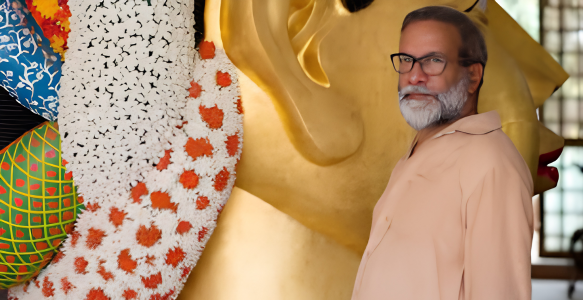
In the hushed lobby of Bengaluru’s RMZ Ecoworld, a giant golden head greets visitors with lotus-shaped eyes and a serene smile. This is Ravinder Reddy’s Devi – one of his iconic monumental busts that feel both ancient and modern at once. At 15 feet tall with bright crimson lips and a jasmine-decked bun, the sculpture could pass for a Hindu goddess in a contemporary avatar. Over four decades, artist Ravinder Reddy has made a career out of “celebrating the female form,” as he puts it, with works that are unmistakable in scale, color and style. This guide explores who he is, where he comes from, and how his colossal fiberglass heads and bodies carry the bold lineage of Indian Yakshis and goddesses into the 21st century.
These sculptural “heroines of India” look outward at us with unapologetic dignity – they are at once bold and familiar, a bit of goddess and a bit of aunty next door. His legacy is measured not just in museums, but in how boldly the next generation dares to portray “real” India on a gigantic scale and as one of the most recognisable names in Indian sculpture art.
Who is Artist Ravinder Reddy?
G. Ravinder Reddy is a contemporary Indian sculptor renowned for his monumental female forms. Born in 1956 in the village of Suryapet, Andhra Pradesh, he studied sculpture at the Maharaja Sayajirao University, Baroda, and later won a British Council scholarship to study in London. Over the past four decades he has become “one of South Asia’s biggest artists,” famous for “big, bold, beautiful – and brilliant” busts of women. Today he lives and works in Hyderabad (earlier in Visakhapatnam), where he builds giant fiberglass sculptures by hand.
He began with clay and plaster, but found fibreglass essential for his vision. His subjects are everyday Indian women – from students to street vendors – often painted gold or deep red. He’s a familiar name to collectors – his works are in the V&A (London) and even airport lobbies.
Reddy’s persona – quiet, almost monkish – contrasts with the bombast of his art. He’s an “anti-celebrity”: he balks at PR, once quipping he “never felt the need” for a website. But the roar of his images fills that silence. Ravinder Reddy occupies a unique position within Indian contemporary art paintings and sculpture discourse.
Quick Facts About Ravinder Reddy
- Date of Birth: 1956
- Place of Birth: Suryapet, Andhra Pradesh, India
- Education: BFA & MFA in Sculpture, M.S. University, Baroda; later studies at Goldsmiths and RCA, London
- Known For: Monumental sculptures of women (especially disembodied heads), using fiberglass with gilded and vivid surfaces
- Parents: (Not publicly documented)
- Spouse: (Not publicly documented)
- Date of Death: Reddy is alive and active in the mid-2020s
Early Life and Background of Ravinder Reddy
1. How Ravinder Reddy’s Roots Shaped His Artistic Vision
Ravinder Reddy’s childhood in a small Andhra town immersed him in India’s visual culture. Temple courtyards and roadside posters of gods surrounded him, planting early images of divine women. Decades later he recalls the “massive cutouts” of Indian deities he saw growing up. These inspired the benign, larger-than-life quality of his sculptures. Art scholar Rewati Rao notes that Reddy was influenced by the famed Didarganj Yakshi (an ancient fertility statue), and he admits he drew from Gupta, Maurya and Chola dynasties. He chose subjects everyone understands – ordinary women. Street scenes and market women would later become his muse.
His first sculptures were modest: in 1981 he made a trio of life-sized Relief figures, fully clothed and rooted in real life. That same year, he did early Mother Goddess and terracotta head pieces. Each had painstaking detail – hair braids, jewelry, hands on hips – mimicking the attention one pays to actual people.
2. Shift from Figurative to Monumental Forms
In the 1980s, Reddy’s figures were life-size and figurative; by the 1990s and beyond, they grew larger than life. In 1995, during a New York exhibit, he unveiled a three-foot-tall fiberglass head titled Devi. Critics noticed that swelling personality – Reddy’s push to inflate scale. Reddy explains: “The head is the immediate recognizable form… so I said, why not do the head?”. The seed for this idea was planted earlier, during studies in London: he’d seen West African Benin Bronzes – small yet powerful royal heads – and thought, “these are potent images”.
This shift mirrored a larger artistic metamorphosis. He began working freehand – no drawings – building massive steel armatures to hold the clay masses. He gradually replaced stone and bronze with fiberglass, a material that let him dodge weight and tradition. Fiberglass is “colourless and can take any shape,” he said, allowing the form to speak without material fuss. By the 2000s, all his figures – heads or full bodies – had transcended human scale. Museums and even airports sought them out; the shock of their scale is part of the message.
3. Development of Signature Style
What gives Ravinder Reddy’s art style its unmistakable voice? It’s the combo of symmetry, color and surface. Reddy describes himself as “a modeller” rather than a conceptualist. The symmetry of his forms is pure eye-judgment: he molds faces until their left and right mirror each other, finding harmony with a hand-spinning motion.
Reddy paints his fiberglass heads in shiny gold, deep red, yellow and blue – colors rooted in Indian tradition. Gold, in particular, is his signature “skin color” – “rich” and spiritual, like the turmeric-hued deities of Hindu lore. The giant faces are often covered with gold leaf or resin paint, so that they gleam in gallery light as if divine. Even the hair is attention-getting: buns decked in resin jasmine flowers, or pastel plaits, combining typical South Indian hair adornments with pop-art flair.
Whether the head is nude or clothed, the eyes “always looking straight, bold, pliant, sensual and demanding”. They are alternately mesmerizing and intimidating. One sculpture named Krishnaveni features thick, black-lined eyes (a nod to temple murals) that pierce your spirit. Reddy fully embraces it: he has said Indians have a rich visual language, “why should we discard it and look to the West?”.
Key Themes in Ravinder Reddy’s Work
1. Representation of Women
Women are Ravinder Reddy’s constant theme. Whether in towering busts or intimate 1980s figures, Reddy presents the female form as bold and sacred. As one observer notes, his “giant heads and voluptuous sculptures… celebrate women”. He never idealized them as distant divas; instead he honored their everyday poise. Art scholar R. Siva Kumar comments that in Reddy’s work “the women fall short of showcasing themselves as objects of desire” – their unblinking eyes turn them into “formidable apparitions or comic spectacle,” blending parody and grandeur. His work shares important concerns with figurative art, particularly the depiction of the human form.
The Smithsonian exhibition text emphasizes that his subjects included everyone from tribal laborers to household maids – “prostitutes, bonded laborers, untouchables, and women from tribal communities” – and Reddy’s art “made [them] precious” through scale and gold. His nudes and clothed figures alike carry themselves with a proud dignity. The evolution is clear: in interviews Reddy himself said his early work was “perhaps more sexual,” whereas now “the figures are more relaxed… larger, more graceful and fluid.” Yet even the early works have a controlled sensuality; there is vulnerability but also self-possession. In a 2017 retrospective, Reddy pointed out that Southern Indian society may consider sexuality taboo, and his bare-breasted busts directly challenge that stigma.
2. Cultural Identity and Indian Heritage
Ravinder Reddy’s sculpture is deeply rooted in Indian visual traditions. He openly draws from ancient iconography and temple forms. The Deccan Chronicle notes Reddy’s women have “wide eyes, golden skin and crimson lips” – a palette straight out of classical South Indian carvings and temple murals. He cites the Yakshi figures of ancient Mathura and Kushan sculpture as ancestors to his work. One can see it in the rounded, full cheeks and calm smile – hallmarks of India’s goddess statues. The Christie's catalog essay notes how Reddy is “contemporizing images of traditional Indian goddesses” by super-sizing them.
He also mixes in folk motifs. Sometimes his heads have elaborate earrings or jewelry patterns taken from tribal art. His surfaces shimmer with designs reminiscent of temple facades. Indeed, his work is a kind of cultural collage: Gupta dynasty facial geometry meets the pop culture of gender equality.
3. Spiritual and Symbolic Elements
Alongside cultural identity, spirituality permeates Reddy’s figures. The very names he chooses – Yakshi, Devi – invoke divinity. His golden women seem like temple gods on vacation. Yet these are spiritual icons reimagined: the lotus-eyes of Devi, for instance, recall Hindu mother-goddess images.
Symbolic textures appear too. Some pieces feature chain links or armor-like patterns, hinting at strength and protection. According to Reddy, the head contains identity – “why not do the head?” he mused. By magnifying it, he makes identity and emotion palpable. The gold skin color is directly symbolic – gold is associated with the divine and the auspicious (closely tied to turmeric and holy rituals).
Famous Sculptures and Works by Ravinder Reddy
1. Yakshi Series
Ravinder Reddy’s oeuvre is vast, but certain series and pieces are especially emblematic. His Yakshi series features female busts with curvaceous forms and goddess-like serenity. These heads – often titled simply Yakshi I, II, III, etc. – have lotus-shaped eyes and broad smiles, echoing ancient fertility icons. The 2001 Asian Art Museum exhibition featured Devi, a Yakshi-head in bright pink and gold. Each sculpture blends heavy South Indian jewelry patterns with a sunburst palette.
2. Devi Sculptures
The Devi sculptures are among his most celebrated. Devi (meaning “goddess”) appears in several iterations; the Bangalore Devi (2017) alone stands almost 15 feet high. This golden-faced sculpture has crimson lips and a jasmine-bud bun – very literal goddess iconography. A Smithsonian exhibit text explains that “Reddy transforms an ordinary woman into a monumental, richly colored sculpture of the great goddess.”. These Devi heads fuse Reddy’s spirituality theme with his fascination for scale.
3. Woman of Kapulapadu
“Woman of Kapulapadu” (2000) is a notable full-figure work. Named after a village in Andhra, it is a life-size sculptural portrait of a local woman. Executed in polyester resin fiberglass and standing over 5 feet tall, it captures detail: the draped sari, the curving posture, and the same commanding gaze. Christie's notes it traveled with Reddy’s shows (e.g. Andy Warhol Museum, 2001). The Woman of Kapulapadu II is striking for its realism and texture.
4. Full-Body Nudes & Figures
His Full-Body Nudes & Figures deserve mention too. Early works like Relief I, II, III (1981) are three-dimensional street scenes of everyday women. Later, he created larger nude figures such as Black Eyed Woman (1987) and Woman Tying Hair (1993), up to contemporary pieces in the SOMA collection. These often depict intimate gestures – tying hair, holding a child – but on a heroic scale.
5. Migrant
Even Migrant (2010) is a full-bodied fiberglass piece, showing the theme of labor and movement. (In Migrant, a woman stands firmly, symbolizing resilience.) Reddy’s figures, clothed or nude, always have sculptural boldness – large heads, broad hips, capacious limbs – as if carved from a single mythical mold.
Key Exhibitions and Achievements of Ravinder Reddy
Ravinder Reddy’s career includes a slew of notable exhibitions and awards. In 2001, his first major solo show in India was in Delhi at the Apeejay Media Gallery; that same year he also made waves in the U.S. with solo shows at Deitch Projects (NY) and the Andy Warhol Museum (Pittsburgh). These were historic: he was among the first Indian contemporary sculptors to gain significant American attention. Throughout the 2000s and 2010s he exhibited widely – Grosvenor Vadehra (London), Sakshi Gallery (Mumbai), Vadehra Art (New Delhi) – often in group shows alongside India’s modern giants. Notably, “Heads and Bodies: Icons and Idols” in 2017 was his first solo exhibition in India in over a decade, held at Bengaluru’s RMZ Ecoworld.
In 2020, Vadehra Gallery mounted SOMA: The Body as Elixir, a large retrospective in New Delhi, covering Reddy’s work from the 1980s onward. It paired with his participation in the India Art Fair (multiple booths) that year – a homecoming of sorts. His art has also appeared in museum shows like Contemporary Art in Asia (New York, 1996) and Asia Society (NYC). Reddy’s works were even part of the Smithsonian Sackler exhibition “Temples and Tigers” (2001), where Devi greeted visitors.
As for accolades, Reddy won India’s coveted National Academy Award in Sculpture from the Lalit Kala Akademi, as well as the Sanskriti Award in Arts. Several works have fetched high prices at auctions (e.g. Woman of Kapulapadu II sold at Christie’s). His pieces are in permanent collections of major institutions: the Victoria & Albert Museum (London), Peabody Essex (USA), Fukuoka Asian Art Museum (Japan), and Queensland Art Gallery (Australia).
Today, Ravinder Reddy remains an important voice in modern Indian paintings and sculpture conversations, even though his primary medium is three-dimensional form.
FAQs About Ravinder Reddy
1. What is Ravinder Reddy known for?
Ravinder Reddy is known for his monumental fibreglass sculptures of women that blend Indian tradition with contemporary art.
2. What is unique about Ravinder Reddy’s sculptures?
His sculptures are distinguished by their large scale, vibrant colours, and fusion of mythological and modern influences.
3. What materials does Ravinder Reddy use in his sculptures?
Ravinder Reddy primarily works with fibreglass, resin, paint, and gold leaf to create his large-scale sculptures.
