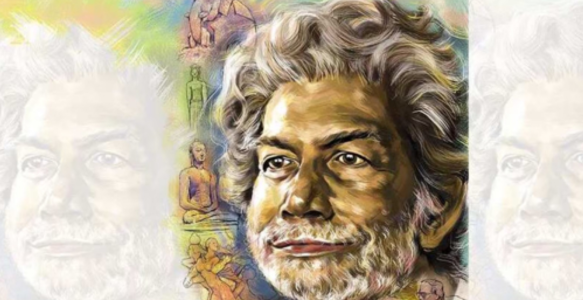
He arrived in Santiniketan as a teenager from Bankura, carrying little more than a restless eye and a stubborn confidence in his own hands. The campus was still taking shape in the 1920s, its red earth and open skies unlike any conventional art school. Here, under the trees of Kala Bhavana, Ramkinkar Baij began to model clay and cement into forms no one in India had quite seen before.
By the late 1930s, a new presence had appeared in the landscape: a tribal family in motion, hewn from cement and laterite, striding across the open grounds of Visva-Bharati. The Santhal Family did not stand on a plinth; it walked across it. This single sculpture of Ramkinkar Baij changed the expectations of what public art in India could be. It was modern, yet rooted; monumental, yet about ordinary people.
Any thoughtful Ramkinkar Baij biography has to start here, with this sense of rupture. He was not only shaping figures, but rethinking the very language of sculpture in India - materials, scale, subject, where it could stand and whom it could address. And it is worth noting that his paintings were never just a side practice; they formed a parallel, experimental field in which he tested gesture, light, and abstraction.
When people search for Ramkinkar Baij, looking for reliable Ramkinkar Baij information, they often find a list of dates, awards, and commissions. To understand why he is called a pioneer of modern Indian sculpture, one has to follow both the sculptures in concrete and the quick, restless lines on paper - the full arc of Ramkinkar Baij works that still feel uncannily contemporary today.
Who Was Ramkinkar Baij?
Ramkinkar Baij (1906–1980) was an Indian sculptor, painter and printmaker, widely regarded as one of the first truly modern voices in indian sculpture. Born in Bankura, in what is now West Bengal, he grew up amid folk performance, clay idol-making and rural theatre, all of which would later seep into his art.
He is called a pioneer of modern Indian sculpture for several intertwined reasons. First, he introduced outdoor, secular public sculptures on an ambitious scale at Santiniketan - Santhal Family (1938) and Mill Call (1956) are often described as India’s earliest modernist public sculptures. Second, he worked with unorthodox materials such as cement, laterite and concrete at a time when studio sculpture still leaned heavily on plaster, stone or bronze. Finally, his subjects were not kings, gods or colonial officials, but workers, tribal communities, singers, women carrying loads - people whose presence in monumental art had been rare, almost unthinkable.
What distinguishes Ramkinkar Baij is his belief that sculpture could speak to the modern Indian experience - not despite its traditionalism, but through it.
For emerging collectors and students of modern art, his works stand precisely at this hinge: between folk and avant-garde, between nationalist aspiration and individual, even eccentric, experimentation.
Artistic Background of Ramkinkar Baij
For readers seeking clarity about Ramkinkar Baij, the story begins not with accolades, but with the radical choices he made at Santiniketan.
1. Journey to Santiniketan and Kala Bhavana
Ramkinkar’s talent was noticed early by journalist and editor Ramananda Chatterjee, who encouraged him and eventually steered him towards Santiniketan in 1925. At Kala Bhavana, the art school of Visva-Bharati, the young artist found a setting that was both disciplined and radically open. Classes took place under trees, models were drawn from the local Santhal community, and the boundary between “life” and “art” was deliberately blurred.
Under this atmosphere, he moved quickly from illustration and painting to clay modelling and then to large-scale structures. He was not trained as a sculptor in any strict academic sense; in fact, the lack of rigid academic instruction is exactly what allowed his idiosyncratic approach to emerge. Soon after his studies, he joined the faculty of Kala Bhavana and, in time, led its sculpture department, anchoring Santiniketan’s reputation as a crucible of modern Indian art.
2. Influence of Nandalal Bose on Ramkinkar Baij
If Santiniketan provided the soil, artist Nandalal Bose shaped the climate in which Ramkinkar grew. Bose, first principal of Kala Bhavana and a leading figure of the Bengal School, advocated an art practice grounded in observation, craft traditions and a living connection to India’s visual past.
For Ramkinkar, this meant learning to honour folk forms and mural traditions while also testing their limits. Bose’s emphasis on drawing from nature, on rhythms of everyday life, gave Ramkinkar a rigorous base from which he could depart. It’s remarkable that a student so willful and unconventional remained deeply respectful of his teacher, even as he pushed far beyond the stylistic boundaries of the Bengal School into a rougher, more experimental terrain.
3. Experiments in Forms and Techniques
What’s remarkable is how quickly Ramkinkar began to improvise with both medium and form. He adapted techniques from clay idol makers he had watched in Bankura, combined them with carving methods, and then scaled them up into outdoor sculpture. He treated cement and laterite not as poor substitutes, but as expressive materials in their own right - capable of capturing weight, movement and the grain of labour.
In painting, he absorbed Western modernist currents - expressionism, cubism, abstraction - filtered through his own temperament. For viewers familiar with expressionist paintings or cubism art paintings, the fractured planes, charged brushwork and compressed bodies in a typical Ramkinkar Baij artwork feel at once local and globally conversant.
He often painted with improvised tools, used Santhal shawls as supports, and was known to draw with shoe brushes on silk. The truth is, he seems less interested in stylistic purity than in sheer intensity - pushing materials until they matched the force of what he saw and felt.
Iconic Ramkinkar Baij Paintings
1. Portraits of National Leaders
Among the most discussed Ramkinkar Baij paintings are his portraits of national figures - Rabindranath Tagore, Mahatma Gandhi and others connected to the freedom movement. Whether in painting or sculpture, he refused the smooth, idealised image. His Tagore heads, for instance, are often gaunt, brooding, almost eroded, emphasising weariness and inwardness instead of reverence. Each painting of Ramkinkar Baij in this mode probes character rather than mere likeness, locating leaders within a fully human, vulnerable frame.
2. Rural Laborers
Rural labourers, particularly Santhal men and women, appear across Ramkinkar Baij works in drawing, painting and sculpture. He depicts them hoeing fields, carrying loads, resting between tasks. These are not sentimental scenes of “village life”; bodies are strained, sometimes awkward, always specific. In many Ramkinkar Baij famous paintings, the workers’ silhouettes are broken into angular planes, suggesting both the dignity of labour and the pressures of a changing economy.
3. Study of Light and Shadows
Throughout his career, Ramkinkar used paint to chase light - across faces, foliage, dusty village roads, even distant hills. His mountain studies from travels in the late 1940s, for example, distil ridges and ravines into broad tonal contrasts that verge on abstraction. In such works, the subject almost recedes; what holds the eye is how shadow slashes across a form, or how a single bright plane can tip the painting into an unsettled mood.
4. The Bauls of Bengal
The Bauls - wandering minstrels of Bengal - offered Ramkinkar a subject in which music, movement and mysticism converged. In his Baul-themed paintings, figures twist and sway, limbs exaggerating the arc of song. Backgrounds are often minimal; it is the swinging torso or raised arm that carries the composition. These images echo the rhythm of his sculpture as well, creating a bridge between his paintings and the three-dimensional work.
5. Binodini
“Binodini”, an oil on gunny cloth now in the NGMA collection, is among the most powerful of Ramkinkar Baij famous paintings. The young woman’s face is caught mid-thought, tense and uncertain, her features slightly stylised yet piercingly alive. It is worth noting that Ramkinkar painted Binodini multiple times and also sculpted her head, returning to her image as if to a difficult question. The portrait is less a likeness than a study of interior conflict.
6. Women in Paddy Fields
In Women in Paddy Fields, stooped figures work along the wet, glimmering expanse of a rice field - bodies bent almost into arcs, merging with the land they cultivate. Here, the painting of Ramkinkar Baij becomes a quiet meditation on repetition and endurance: similar gestures, day after day, under a vast, indifferent sky. The looseness of the brushwork mirrors the instability of the ground itself.
7. Atomica
Atomica (sometimes referenced in discussions of his post-war work) suggests Ramkinkar’s response to the age of the atom bomb - the new, terrifying scale of human-made destruction. Forms fracture, edges sharpen; the composition tightens into a dense, almost explosive cluster. In this context, the work extends beyond the village and the campus into global anxieties, absorbing newsreel horrors into his own vocabulary.
8. Harvester
Harvester gathers several of his recurring motifs into a single image: the worker, the tool, the field as both livelihood and burden. Limbs are elongated, muscles knotted, yet the figure seems caught mid-stride, not frozen. Among his paintings, this work stands out for its compressed energy - the sense that the figure could step right out of the frame. Collectively, these canvases, from portraits to Atomica, form a continuum of Ramkinkar Baij works that equal the ambition of his sculpture.
Most Famous Sculptures of Ramkinkar Baij
1. Santhal Family Sculpture (1938)
Santhal Family (1938) is often described as the first fully modern public sculpture of Ramkinkar Baij and a landmark in Indian modernism. A man, woman, child and dog stride forward, carrying their possessions - caught in perpetual migration across the Santiniketan campus. Modeled in cement and laterite mortar, the work rejects polished finish in favour of rough, tactile surfaces that echo the harshness of their journey. Santhal Family is frequently cited as Ramkinkar Baij’s famous sculpture, a touchstone for generations of artists.
2. Mill Call (1956)
Completed in 1956, Mill Call - sometimes titled Call of the Mill - depicts women workers responding to the siren of a factory. The figures lean forward, torsos pitched into haste, drapery whipping around them as if in wind. Again cast in concrete and laterite, this sculpture turns industrial sound into visual rhythm, linking rural bodies to the machinery of modern industry. It is both celebration and critique: progress measured in human footsteps.
3. Yaksha and Yakshi (1955–1967)
Commissioned for the Reserve Bank of India in New Delhi, the monumental Yaksha and Yakshi (1955–67) bring ancient guardian figures into a modern, financial context. Here, Ramkinkar draws on classical Indian sculpture - the heavy stance, stylised ornament - yet gives each figure a slightly off-balance vitality. Standing at the entrance of a key state institution, these works mark the moment when a Ramkinkar Baij sculpture became part of the new republic’s official iconography.
4. Sujata (1935)
Sujata (c. 1935) looks back to the Buddhist narrative: the young woman who offers a bowl of milk-rice to the fasting Siddhartha. Ramkinkar focuses less on religious piety and more on the quiet gesture of offering - the tilt of the head, the curve of arms around the bowl. Compared with his later, rougher outdoor pieces, Sujata is more contained, but the sense of concentrated emotion is already clear. For those tracing Ramkinkar Baij’s biography through his sculptures, this work marks an important early step.
5. Lamp Stand (1940)
Lamp Stand (1940), also at Santiniketan, is often called India’s first abstract sculpture. Suggestive of a figure yet resolutely non-representational, it stacks and twists forms into a vertical rhythm that functions both as object and as a bearer of light. In the practice of the artist,, Lamp Stand is the quiet radical: a work that proves he was not only a figurative sculptor of the people, but also an artist thinking deeply about pure form and structure.
As contemporary artists reimagine materials and scale, each new outdoor installation or socially charged artwork, it extends a conversation he began. The question that lingers is simple: when we look at today’s sculptural experiments, how much of Ramkinkar’s audacity - his willingness to let concrete speak for the rhythms of modern life - can we still hear?
FAQs About Ramkinkar Baij
1. Who is the father of sculpture in India?
Within modern art history, Ramkinkar Baij is widely hailed as the “father of modern Indian sculpture”. The phrase acknowledges how decisively he transformed both the content and the language of sculpture in the 20th century - bringing ordinary people into monumental art, using new materials, and installing large works in open public settings.
2. What awards did Ramkinkar Baij receive?
Ramkinkar Baij received several major honours in his lifetime. He was awarded the Padma Bhushan by the Government of India in 1970, recognising his outstanding contribution to art. He was made a Fellow of the Lalit Kala Akademi and received Visva-Bharati’s Desikottama (honorary doctorate), as well as an honorary D.Litt. from Rabindra Bharati University in 1979. It’s worth noting that these awards came relatively late, after decades of quietly experimental work at Santiniketan.
3. What are the names of two famous sculptures of Ramkinkar Baij?
Two of the most famous sculptures of Ramkinkar Baij are Santhal Family (1938) and Mill Call (1956). Santhal Family is regarded as a breakthrough in modern public sculpture, while Mill Call extends his interest in labour and movement into an industrial setting. One might also add Yaksha and Yakshi at the Reserve Bank of India as a third, equally emblematic work.
4. What was Ramkinkar Baij famous for?
Ramkinkar Baij was famous for pioneering modern public sculpture in India and for his fiercely original paintings and drawings. He merged rural subjects, folk vitality and modernist experimentation, refusing both academic realism and easy nostalgia. His legacy spans paintings, sculptures in major public spaces, and countless held in museums and collections around the world. His work is a living reference point for how art in India can remain restless, open and socially attuned
