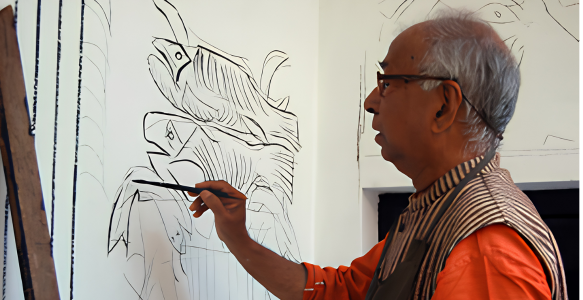
On a warm Santiniketan afternoon, the design block at Kala Bhavana seems to ripple in black and white. From a distance, it looks almost like hand-drawn cinema with walls wrapped in dense, graphic line-work, painted decades ago by K. G. Subramanyan and his students, turning an academic façade into a living mural. Step closer and you sense what made “Mani da” different from so many of his contemporaries: his refusal to separate art from life, studio from street, mural from memory.
For younger viewers who stumble on him through a search for “who is K. G. Subramanyan,” the story can seem improbable. He shaped what modern Indian art could be - through paintings, terracotta reliefs, toys, picture-books, and teaching. Where S. H. Raza and F. N. Souza pushed Indian modernism towards bold abstraction and angst, Subramanyan folded in folk humour, children’s-book mischief, and a deep trust in handcraft.
He was less a solitary “genius” and more a weaver of conversations - between myths and news headlines, between indian art paintings and bazaar toys, between Picasso’s cubist fractures and the painted walls of rural India.
Who Was K. G. Subramanyan?
Any serious K. G. Subramanyan biography begins in Kuthuparamba, a small town in north Kerala, where he was born in 1924 into a Tamil Brahmin family. As a young economics student at Presidency College, Madras, he joined the Quit India movement, was imprisoned, and then barred from all government colleges.
In 1944, a letter to Rabindranath Tagore’s university changed everything. He was admitted to Kala Bhavana, Santiniketan, where he studied under Nandalal Bose, Benode Behari Mukherjee and Ramkinkar Baij. Over time he would become a painter, muralist, printmaker, toy-maker, designer, writer, poet and theorist - a true polymath in Indian art.
His friends and students remember envelopes arriving by post with hand-drawn greeting cards, small sketches that carried his wit and warmth long after formal openings were done. His trajectory - from Kerala and South Indian art roots to Santiniketan and Baroda - maps a wider story of post-Independence India searching for an artistic language that felt modern without mimicking the West.
He was awarded the Padma Shri (1975), Kalidas Samman (1981) and the Padma Vibhushan (2012), and ended up shaping several generations of artists.
Artistic Journey of K. G. Subramanyan
His journey can be read as a series of experiments where he kept returning to the same questions: how do stories travel across mediums, and how can art remain porous to the textures of ordinary life?
1. Education at Kala Bhavana, Santiniketan
Arriving at Santiniketan in 1944, he entered a campus where walls carried murals, courtyards turned into studios, and the line between “fine art” and craft had already been blurred. Guided by Nandalal Bose’s sensitivity to indigenous traditions and Ramkinkar Baij’s radical sculptural experiments, he learnt to see village toys, patachitra scrolls and temple friezes as part of the same visual universe.
His student years included debates on what a non-colonial art education could look like, and he absorbed that critical, questioning atmosphere deeply.
2. Teaching Career and Influence in Baroda
In 1951, he joined the newly founded Faculty of Fine Arts at M. S. University, Baroda, becoming one of the first Santiniketan-trained artists to seed its now-famous “Baroda School.” Students recall him drawing out compositional problems on the floor in chalk, inviting them to walk around a structure rather than stare at it from a single point of view. He wanted craftspeople to be invited in as teachers, that looms, pots and toys enter the classroom as live resources for form, colour and rhythm. Through these decades he was as much a designer and theorist as a studio painter, working with the Weavers’ Service Centre and All India Handloom Board, and helping to build institutions like the Crafts Council of India.
3. International Exposure and Exhibitions
A British Council scholarship took him to the Slade School of Art in London in 1956, where he engaged directly with European modernism while retaining a sceptical distance from its more rigid ideologies. In 1966, a Rockefeller Fellowship brought him to New York, exposing him to Pop & Minimalism, experiences that deepened his sense of art as social commentary without pushing him into overt mimicry.
Later, in 2017 - after his death - major works like The War of the Relics and Anatomy Lesson were shown at Documenta 14 in Kassel, introduced to an international audience as complex meditations on violence, belief and modernity. In one remembered conversation, after looking at exhibition plans, he reportedly quipped, “So where does the circus go next?”
Major Themes in K. G. Subramanyan's Art
The K G Subramanyan art style is a moving constellation of themes: mythology, domestic life, political satire, animals and nature, stitched together through a unique narrative sensibility.
1. Indian Mythology and Folklore
He constantly returned to gods, demons and folk figures, but never as pure illustration. In many works, a monkey might mirror Hanuman, or a contemporary young woman stands opposite Durga, the two locked in a reflective, uneasy dialogue. These juxtapositions create layered allegories about courage, vulnerability and the divinities we carry within ourselves.
His murals and paintings draw on a deep reservoir of folk and classical sources - from Kerala murals and Bengali pattachitras to temple sculpture. For viewers used to spiritual and mythological paintings as devotional images, his work opens up myth as a living, argumentative text.
2. Everyday Life and Human Relationships
From the 1960s still lifes to the Terrace series of the 1970s, ordinary rooms and rooftops become stages for desire, boredom, envy and quiet tenderness. Woman in the Blue Room (1981), shows a seated woman enveloped by patterned walls and objects, a deep blue atmosphere that suggests both containment and introspection.
Early works like Untitled (Girl with Sunflower) already hint at this concern with interior worlds - the girl is at once specific and emblematic, anchored in a post-Independence India negotiating new roles for women.
3. Social and Political Commentary
Even when rendered in buoyant colours, his art never stayed untouched by politics. His terracotta relief Generals and Trophies (1971) and the later painting The City Is Not for Burning (1993) respond to war, militarism and communal conflict, compressing history into dense, almost theatrical tableaux. During the Emergency, he fashioned a maimed hemp peacock as a protest piece - a wounded national bird standing in for a wounded democracy.
His children’s books are perhaps his most subversive political works. When God First Made the Animals He Made Them All Alike (1985) grew out of his response to the 1969 communal riots in Gujarat, using a seemingly simple animal fable to question the logic of division. The Tale of the Talking Face offers a darkly comic parable of an autocratic princess whose promise of progress masks deepening authoritarianism.
4. Nature, Animals, and Symbolism
From village animals in murals to fantastical beasts in books, his creatures carry temperaments, fears and sly commentaries on human behaviour. In When God First Made the Animals… each species becomes a vehicle for thinking about sameness and difference, power and vulnerability.
Land, trees and skies in his work rarely appear as a neutral backdrop. They lean, crowd or recede like characters, echoing the spiritual charge we see in Raza’s landscapes or in contemporary paintings of nature, but filtered through his own graphic, storybook sensibility. Even the black-and-white murals at Kala Bhavana, with their plants, birds and hybrid forms, feel like a compressed ecology of modern Indian life.
Famous Paintings & Artworks by K.G Subramanyan
Across archives and exhibitions, the list of K. G Subramanyan’s famous paintings and projects, a few works consistently surface as crucial to understanding his range.
1. The King of the Dark Chamber
This terracotta mural, created around 1962–63 for Rabindralaya, a performing arts centre, reimagines Tagore’s play as a frieze-like sequence of figures and architectural frames. The title role, the unseen king, becomes an exercise in staging absence - shadows, thresholds and gestures stand in for a body that never fully appears.
2. Black and White Mural, Kala Bhavan
On the exterior of the design department at Kala Bhavana, he and his students painted an expansive black-and-white mural that wraps around the building like an enormous drawing. Figures, animals, plants and abstract patterns flow into one another, turning the campus itself into a kind of open book.
3. The War of the Relics
Completed in 2013, this nine-foot-high, thirty-six-foot-long mural - comprising sixteen panels - was his last major mural work. Shown at Documenta 14 in 2017, it brings together motifs from mythology, ornament and contemporary conflict to depict a theatre of violence where relics and symbols have lost their ethical charge.
4. Woman in the Blue Room
Made in 1981 as a painted-glass work, Woman in the Blue Room shows a solitary female figure in a richly patterned interior, rendered in deep blues and sharp graphic lines. Housed today at the Museum of Art & Photography in Bengaluru, it has often been shown alongside a Matisse interior, as a way of thinking about women, domestic space and modernity across continents.
5. Untitled (Girl with Sunflower)
This 1952 painting is frequently used by scholars to read his early post-Santiniketan phase. A young girl stands with a sunflower - part portrait, part emblem of the new, fragile optimism of the early 1950s. The composition still carries traces of his teachers’ influence, but the psychological charge is his own.
6. The Terrace Series
In the 1970s, he shifted from still lifes to rooftop and terrace scenes, using bold black lines, luminous colour and skewed perspectives to stage encounters between couples, neighbours and onlookers. Works such as Couple on Terrace (1992) continue this exploration, with figures caught mid-gesture against a backdrop of parapets and night skies.
7. The City Is Not for Burning
Painted in 1993, this oil on canvas has become shorthand for his political conscience. Responding to rising communal tensions in Bombay and Gujarat, it presents a densely packed cityscape where flames, buildings and bodies interlock in a kind of visual knot. The title itself is a plea and a protest: cities, he suggests, are built for living, not for being sacrificed at the altar of ideology.
8. Anatomy Lesson
Anatomy Lesson (2008), a terracotta relief later shown at Documenta 14 and held in the Kiran Nadar Museum of Art, presents fragmented limbs and bodies, as though violence has been mapped directly onto the human form. The title nods to European art history while reversing its gaze - from scientific curiosity to ethical indictment. Here, terracotta becomes a medium for thinking about the consequences of conflict, echoing the themes of The War of the Relics.
9. Generals and Trophies
This 1971 terracotta relief gathers military figures and their spoils into a tightly choreographed scene, often cited as an early articulation of his anti-war stance. Armour, medals and bodies blur into a grotesque display of pride and damage.
10. When God First Made the Animals He Made Them All Alike
Published by Seagull Books in 1985, this illustrated book uses an apparently simple creation story - animals initially made identical, then differentiated - to probe the absurdity of discrimination. It emerged, in part, from his response to the 1969 Gujarat communal riots, translating anger into a form accessible to children and adults alike.
11. The Tale of the Talking Face
In The Tale of the Talking Face, he narrates and illustrates the story of a princess whose rhetoric of progress gradually masks a slide into autocracy. Written against the backdrop of the political dramas of 1970s India, it has been described as a thinly veiled satire on the crisis of democracy and the threat of totalitarianism.
FAQs About KG Subramanyan
What is K. G. Subramanyan famous for?
K. G. Subramanyan is known for blending folk traditions, mythology, and modern art into a distinctive visual language. He was also an influential artist, writer, and educator.
What style of art did K. G. Subramanyan create?
His art combined figurative imagery, folk traditions, craft influences, mural art, and modernist experimentation. His style is known for its playful, narrative quality.
Why is K. G. Subramanyan important in Indian art history?
K. G. Subramanyan helped shape modern Indian art through his artworks, writing, and teaching. His ideas influenced generations of artists and designers across India.
