In Sudhir Patwardhan’s Fall (1998), now in The Metropolitan Museum of Art, a construction worker has plunged from bamboo scaffolding. Behind him, the building remains unfinished. The museum connects the work with redevelopment and the closure of Mumbai’s textile mills. The figure’s vulnerability belongs within that larger account of a changing city. For a Sudhir Patwardhan artist guide, this is a concrete starting point: a documented picture in which an individual body meets the larger conditions of urban life.
Born in Pune in 1949, trained as a doctor, and employed for decades as a radiologist in Thane, Patwardhan built an artistic life alongside a medical one. The medical career is a biographical fact, but it does not supply a complete explanation for the paintings. Their bodies occupy streets and workplaces, with the surrounding city shaping the encounter. Mumbai and Thane matter as inhabited places, where access to work, shelter and movement can be uneven.
A Sudhir Patwardhan biography spans more than half a century of exhibition-making and painting. Early figures, large urban landscapes and recent canvases approach the city at different scales. The phrase “Sudhir Patwardhan famous paintings” can bring them together, but looking across the decades reveals important differences. Street Play and Pokharan, for example, offer different kinds of encounter with people and place. Following those differences helps keep an individual work in view within the larger career.
Who Is Artist Sudhir Patwardhan?
Who is Sudhir Patwardhan? Born in Pune in 1949, he trained in medicine at the Armed Forces Medical College and graduated in 1972. He then spent thirty years practising radiology in Thane, from 1975 to 2005. Painting developed alongside that work; his first solo exhibitions came well before he left medicine.
Sudhir Patwardhan artist biographies describe urban realist and figurative paintings of ordinary metropolitan life: workers, commuters, construction sites, streets, bridges, railway stations, and changing neighbourhoods. Current gallery records describe him as living and working in Thane.
Quick Facts About Sudhir Patwardhan
- Date of Birth: 1949
- Place of Birth: Pune, Maharashtra, India
- Education: Medicine, Armed Forces Medical College, Pune; graduated 1972
- Known For: Urban realist and figurative paintings of Mumbai-Thane life, labour, commuting, and city transformation
- Parents: Not documented in retrieved institutional sources
- Date of Death: Not applicable; current sources describe him as living and working in Thane
Accounts about Sudhir Patwardhan describe him as self-taught. That refers to his artistic training, alongside the formal medical education. It does not mean his work developed without other paintings, exhibitions or conversations around it.
Artistic Journey of Sudhir Patwardhan
His exhibition record starts well before his medical practice ended. The chronology helps distinguish early recognition, years of parallel work and the later period devoted fully to art.
1. Self-Taught Beginnings in the 1970s
The Guild’s chronology records Bombay Art Society exhibitions at Jehangir in 1974,1975 and 1976. This gives concrete early markers for a self-taught painter. He was taking part in the city’s exhibition life while developing his work. The formal medical qualification and informal artistic education followed different routes.
2. Balancing Radiology and Painting (1975–2005)
Radiology remained his profession from 1975 until 2005. During those years came early solo exhibitions, Place for People and works including Fall. A Sudhir Patwardhan artist profile thus follows two working lives in parallel. Thane supplied a setting for both, with Mumbai close by. The dates establish that coexistence without claiming that one profession mechanically produced the other.
3. Becoming a Full-Time Artist After 2005
In 2005 he ended his radiology practice. Later exhibition projects include Route Maps, the retrospective Walking Through Soul City and Cities: Built, Broken. The city remains present across those projects, while their formats and particular concerns differ. Full-time painting gave an existing artistic practice another phase, rather than marking its beginning.
4. First Solo Show and Early Recognition
Art Heritage in Delhi and Jehangir Art Gallery in Bombay hosted his first solo exhibitions in 1979. Place for People followed in 1981. Patwardhan appeared with five other artists, including Khakhar, Malani and Sundaram, in an exhibition that became an important reference for narrative figuration. The group show should not be mistaken for his solo debut.
Artistic Style in Sudhir Patwardhan's Paintings
Sudhir Patwardhan paintings are realist, but not documentary in a narrow sense.
1. Urban Realism and Figurative Painting
Urban realism in Patwardhan’s work begins with the figure inside the city’s machinery. Workers stand near scaffolds, commuters cross bridges, porters and pedestrians inhabit tense public space. In a painting of Sudhir Patwardhan, the relation between a body and the surrounding construction can become the central problem. The setting gives the figure a social location.
2. Expressionistic Influences
Expressionistic tendencies provide one way to discuss the force of the early figures. The term should lead back to their construction, rather than become a description of the whole career. Accounts also connect his spatial thinking with Indian miniatures and Chinese landscapes, in which the eye can move between viewpoints.
3. Empathy, Scale, and Emotional Distance
In his statement for Place for People, Patwardhan considered how close to, or distant from, his figures he should be. He connected restraint with allowing a figure some autonomy from the artist’s private impulses. That is a specific working question behind the broader idea of empathy. Distance can be a considered choice, rather than a failure to care.
4. Comparison to Edward Hopper and Cézanne
Hopper offers one comparison for the solitary figure in an urban interior. Cézanne offers another for the construction of space. Neither is a complete explanation of Patwardhan’s work. His own subjects and the conditions around Mumbai and Thane matter just as much; Thinking of Leger provides an explicit early reference to a different modernist.
Recurring Themes in Sudhir Patwardhan's Artwork
In Sudhir Patwardhan artwork, the city is a setting for people and their relationships. Buildings become part of how those relationships are organised.
1. Mumbai as a Central Muse
Mumbai, and its adjoining Thane world, forms Patwardhan’s central field of attention. His city is not reduced to skyline or nostalgia. It is made of railway platforms, overbridges, old industrial neighbourhoods, Irani cafés, construction sites, and suburban routes. These settings raise questions about who can occupy and move through the city.
2. Working-Class Life and Labour
The worker in Fall brings the risks of construction into view. Elsewhere, commuters and people moving through public space connect working life with time spent travelling or waiting. A person’s position in the city is shaped by more than the job itself; the surrounding routes and structures also matter.
3. Urban Change, Migration, and Alienation
An old mill district can be seen through what occupies it now and through what has disappeared. Lower Parel gives that question a named location. Later flyovers and building projects enter the work too. Routes for commuting, work and habitation keep changing, providing a setting for the dislocation that urban growth can bring.
4. Socio-Political Commentary Without Overt Activism
Street Play makes the heading’s qualification important. A theatre protest belongs to its documented setting, and the artist’s 1981 statement addressed ideological commitment. Social and political questions are present, even where a painting does not advance a simple slogan. The relation between observation and participation remains an open question within the work.
Famous Paintings by Artist Sudhir Patwardhan
The following works are central to discussions of Sudhir Patwardhan famous paintings, though some early titles require careful qualification where publication records remain incomplete.
1. Thinking of Leger (1975)
Market records list Thinking of Leger as an oil on canvas from 1975. Its title identifies a reference to Fernand Léger. That is a useful early marker, though a secure image and fuller object record are needed before attaching a detailed account of its figures or handling to this particular work.
2. Five Figures (1976)
Five Figures belongs to Patwardhan’s early figurative phase, when the human body was already becoming his central subject. Christie’s recorded the 1976 painting at $756,000 in March 2025, then a world auction record for the artist.
3. Accident on May Day (1981)
The institutional credits identify Accident on May Day as acrylic on canvas,1981. Its title brings labour’s commemorative day into a picture of bodily vulnerability. This relation between a public occasion and an individual situation helps explain the work’s place in discussions of Patwardhan’s socially engaged figuration.
4. Street Play (1981)
The institutional image credits for MAP Academy’s course record Street Play as a 1981 oil on canvas. The Guild’s exhibition essay describes an arcade, theatre activists and a textile mill within its setting. The street is a place of ideological argument as well as movement. Vadehra’s later reproduction listing should be kept separate from the original object record.
5. Ceremony (1984)
Peabody Essex Museum holds Ceremony, an oil on canvas from 1984, through the Herwitz Collection. The museum record provides a direct date, medium and collection reference. It also places this work within a larger history of collecting South Asian modern art, alongside a career still developing in Bombay and Thane.
6. Pokharan (1992)
Peabody Essex Museum records Pokharan as an acrylic on canvas dated 1992, received through the Herwitz Collection in 2001. The width is approximately246 centimetres. This is a substantial landscape-format object, not merely an unverified title. Patwardhan’s documented Pokharan activity belongs to Thane; the name should not automatically be connected with Rajasthan’s nuclear-test site.
7. Lower Parel (2001)
Iniva’s Social Fabric exhibition guide documents Lower Parel of 2001 alongside a preparatory photograph. It connects Patwardhan’s return to the former mill district with the area’s transformation. The preparatory image also makes the working method tangible: photography helps develop a painting, without making the finished canvas a neutral photographic record.
8. Bylanes Saga (2007)
MAP Academy’s institutional credits identify Bylanes Saga,2007, as an acrylic-on-canvas diptych, approximately183 by 244 centimetres overall. That gives an original-work reference distinct from the later print listed by Vadehra. The two-part format and substantial scale belong in an account of the work, even before a close visual interpretation is attempted.
9. Cities: Built, Broken (2024)
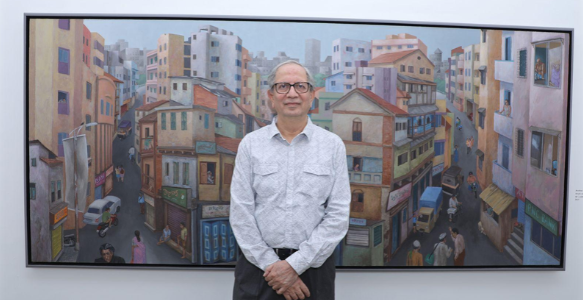
Cities: Built, Broken is best understood as a recent body of work and exhibition project rather than a single painting, though related titled works exist. Presented in London in 2024, it studies contemporary urban life through flyovers, congestion, construction, and alienated pedestrians. The phrase captures Patwardhan’s late vision of growth as fracture.
10. Under a Clear Blue Sky (2024)
Under a Clear Blue Sky, listed by Vadehra Art Gallery as a 2024 oil on canvas, belongs to the Cities: Built, Broken context. The exhibition places it alongside works titled Bus Stop, Built and Broken and Irani Café and the War Elsewhere. The titles establish the range of the project without supplying a detailed visual description of this individual canvas.
Art Catalogues and Monographs By Sudhir Patwardhan
A catalogue can place a drawing beside a finished canvas or give an earlier work a new exhibition context. The publications below connect different parts of Patwardhan’s career, though the exact bibliographic details need to be distinguished from exhibition dates.
1. Walking Through Soul City (2022)
The Guild records Walking Through Soul City as a publication made with NGMA Mumbai. It brings together essays by Nancy Adajania and other writers in connection with the 2019–20 retrospective she curated. The heading’s 2022 publication date remains unconfirmed by the record checked; it should not be confused with the dates of the exhibition.
2. Cities: Built, Broken (2025)
Cities: Built, Broken identifies an exhibition project shown across venues in 2024–25. Vadehra documents recent works and exhibition iterations, but a standalone 2025 monograph was not established here. These are related kinds of record, not interchangeable ones: the exhibition title is secure, while a book needs its own publication information.
Legacy and Influence on Contemporary Indian Art
His career gives sustained attention to the relation between a person and the changing city. The early figures, later urban panoramas and recent exhibition projects offer different ways into that concern. Within Indian narrative figuration, the Thane-Mumbai setting gives the work a particular continuity across decades.
Museums and collections, including The Metropolitan Museum of Art and Peabody Essex Museum, now hold important works. These holdings allow his work to be encountered within broader museum histories of modern and contemporary art.
FAQs About Sudhir Patwardhan Painter
The Sudhir Patwardhan painter's record brings together medicine, exhibition history and a sustained engagement with the city.
What is Sudhir Patwardhan famous for?
Sudhir Patwardhan is famous for figurative urban paintings of Mumbai and Thane, especially workers, commuters, construction sites, public spaces, and the social tensions of a changing city.
What art style does Sudhir Patwardhan use?
He uses urban realism, narrative figuration, and socially observant figurative painting. His work is realist but constructed, often shaped by memory, multiple viewpoints, and expressionistic pressure.
What is the highest auction price for a Sudhir Patwardhan painting?
Christie’s recorded $756,000 for Five Figures (1976) in March 2025 and marked it as an artist record at that sale. This is a verified dated result, rather than a claim that no subsequent auction has exceeded it.
Which museums have Sudhir Patwardhan's paintings?
Direct collection records identify Fall (1998) at the Met and Ceremony (1984) at Peabody Essex Museum. Other collection lists should be checked against individual holdings before attaching a particular work to an institution.
Is Sudhir Patwardhan still painting today?
Gallery records describe him as living and working in Thane. The 2025 exhibition documentation includes paintings made in 2023 and 2024. These dated works provide firmer evidence of recent practice than an undated general biography alone.
