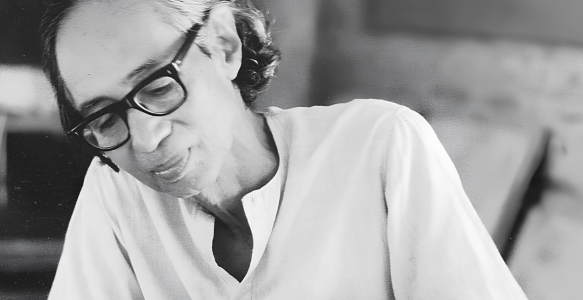
Somnath Hore (1921–2006) was an Indian sculptor and printmaker whose raw, socially engaged work has become emblematic of modern Indian art. Trained at the Government College of Art & Craft in Calcutta, Hore mastered lithography and intaglio. Yet unlike many contemporaries (the bold abstractions of Raza, Souza or the lyrical figuration of Tyeb Mehta), his palette remained muted, his lines raw. One critic noted: he “was not one to paint the blue of the skies,” preferring instead the “helpless tremble of a hand, a frail body struck by hunger”. His themes – famine, war, displacement – align him globally with the social realists like Käthe Kollwitz or Picasso’s Guernica, yet his context is distinctly Bengali.
Any discussion of Somnath Hore’s biography reveals why his legacy remains central to modern Indian art. His aura is both austere and deeply human. Unlike artists driven by market acclaim, he rejected easy popularity; late in life he lamented that nobody in an auction “understood these victims”. To us, his lonely figure of an emaciated child is a question he poses to history itself – as if asking why we forgot. His legacy is a moral bracing for Indian art: an insistence that images bear witness.
Artistic Journey of Somnath Hore
Somnath Hore’s path was entwined with politics and history. In the early 1940s he joined underground communist cells in Calcutta. By night he painted slogans (“Land to the tiller!”) on walls, by day he sketched the hungry. In 1943, under CPI propaganda leader Chittaprosad Bhattacharya, he went village to village during the Bengal famine, making raw field notes in ink. One survivor story has Hore waking at dawn to draw emaciated mothers huddled on mud floors. That year etched an obsession: he later said, “I did not meet death; death met me.”.
Hore emerged from famine reportage into the Tebhaga movement (1946–47), witnessing peasants sharecroppers demanding two-thirds of their crops back. These experiences galvanized his art as social realism. Unlike purely didactic state art elsewhere, Hore’s work did not glorify; it bore naked truth. While many collectors first encounter a Somnath Hore painting, his practice extended well beyond painting into printmaking and sculpture. His 1950s prints document tea garden labor, rail strikes and refugee camps – as KNMA notes, “heart-rending documentation of the Bengal Famine and Tebhaga…captured horror of hunger and poverty”. During this time he also formalized his craft: learning lithography and intaglio at art college, then setting up the print department at Delhi Polytechnic and later at Santiniketan. By the 1950s he was prized as India’s best printmaker, innovating techniques from aquatint to his signature pulp-pour method for the Wounds series.
By the 1970s, the sky of paper felt too small. Hore shifted to sculpture, modeling in wax then casting in bronze. His first bronzes – Mothers, standing figures, famine specters – translated his 2D anguish into 3D presence. These raw-bronze figures, at half-human scale, began to circulate in exhibitions, cementing his reputation as a sculptor as well as printmaker.
Key Themes in Somnath Hore’s Artwork
Somnath Hore’s painting style can be summed up by Social Realism and the human condition. His art refuses nostalgia or myth – it shows the raw flesh of reality. As an AstaGuru essay notes, his figures carry “skeleton shapes with attenuated limbs” embodying collective trauma.
1. Social Realism
Hore was a consummate social realist. He painted not gods but the struggles of the downtrodden. Publications like Jannayuddha printed his famine drawings as propaganda, but Hore’s own style was more personal than propaganda, more witness than hero.
In print and clay he captured the rhythms of Bengal: grieving mothers wrapped in muslin, bent peasant women (as in his Woman and Child motif), or a lone village procession under a tattered banner. His compositions – like Tebhaga Movement – Michil (Woodcut, 1967) – look like news photographs, stark tableaux of real life. This affinity with real events aligns Hore with global documentary artists: one might compare him to a regional equivalent of Francisco Goya or German expressionist Käthe Kollwitz. But unlike them, Hore’s images are often minimalist – white paper, black lines, gestural shading – which made his social commentary all the more haunting.
2. Human Suffering and Resilience
Many works center on suffering and endurance. The enduring motifs of famine-born skeletal women and clutching children celebrate both helplessness and hope. In his Wounds prints (see below), Hore cut through paper as if addressing invisible scars. His Mother and Child figures (in print and bronze) exemplify this: the child may starve, but the mother holds on. Even his later, more abstract Standing Figure – a defiant upright pose – can be read as “strength in the face of adversity”.
3. War and Famine
The Bengal Famine (1943) was Hore’s original muse of horror. It haunted him so deeply that even an exhibition curator observed “the Bengal Famine and Tebhaga peasants’ movement acquired archetypal significance in his vision”. Later, international events also found him: his sculptures on Hiroshima represent nuclear horror, while Mother and Child (Vietnamese Mother) memorializes Vietnam War suffering. In each theme, though the subject differs, the language remains the same: jagged lines, deep voids and cracked surfaces as the vocabulary of anguish.
Notable Artworks by Somnath Hore
Somnath Hore’s artworks include several landmark series and pieces spanning his career. These works are emblematic of his style and subject.
1. Wounds Series
The Wounds (Hindi: Khot) series of the 1970s is Hore’s signature print cycle. Here he invented a unique paper-pulp etching method: thick handmade paper is cast and its surface deeply incised or gouged to create scars. The resulting prints look like plaster casts of lacerated skin – stark white fields marked by ragged slits. Conceptually, Wounds translates famine and war trauma into abstract form. Each print merges minimalism with raw emotion: jagged lines and torn edges speak of collective pain. This series won critical acclaim for making suffering itself a tangible presence.
2. Mother and Child
Often called the Vietnamese Mother, this is Hore’s largest sculpture (completed 1977). In bronze, a seated woman holds her child; her chest is visibly damaged – a gash through flesh. According to accounts, Hore worked on it after Saigon fell, viewing a photo of a wounded Vietnamese mother as inspiration. The sculpture was immediately stolen from Santiniketan after completion, becoming a mystery. Though the piece is now lost, descriptions tell us it symbolized hope amidst ruin – the woman’s steady grip on her child despite her own wounds. Art historians highlight it as an early example of Hore’s later focus on female figures and international solidarity.
3. Tebhaga Series
In the late 1940s and early ’50s, Hore produced prints on the Tebhaga (sharecroppers’) struggle. Not a single titled series is as famous as Tebhaga, but works like Tebhaga Movement – Michil (c.1967, woodcut) depict communist processions with workers carrying flags. These gritty urban/rural scenes capture organizing meetings and riots. The style is gestural and dark. For example, one engraving shows women with pens and books for agricultural reform. These images document history rather than embellish it, akin to a social reportage.
Renowned Sculptures By Somnath Hore
In the 1970s–90s, Somnath Hore’s sculptures became celebrated testaments to his themes. Though he never abandoned prints, bronze gave him new power of form. Five of his most famous sculptural subjects are:
1. The Bengal Famine Series
Hore created numerous small bronze figures in the 1980s explicitly evoking the 1943 famine. Each is emaciated and crouching, ribs and joints sharply defined. Faces are hollowed; mouths gaping. These works look like living corpses frozen in agony. The raw casting – he often left rough edges and casting sprues – heightens the sense of decay. The Bengal Famine series is perhaps Hore’s best-known sculpture group; it was shown in Kolkata and New Delhi as a collective narrative of hunger. These are the closest he came to creating “monuments of atrocity,” but on a human, personal scale.
2. The Hiroshima Series
In response to nuclear war, Hore made abstracted bronze pieces known as the Hiroshima Series. Unlike his famine figures, these are less figurative: imagine a flayed shape of a person torn by blast, or a torso that’s been blown apart. They evoke disintegration (arms melting away, backs bent unnaturally). Art historians note these as his engagement with global trauma – showing that the scars of Hiroshima and Nagasaki transcended place. In texture and form these pieces recall the work of Alberto Giacometti or Henry Moore, but with deeper fissures – literally, Hore cut them open.
3. The Khajani Player
In 1995 Hore surprised many by making a cultural subject: a bronze man playing a khajani (a folk drum). This life-size sculpture (about 125×96 cm) shows a seated musician in a loose shirt, eyes closed, absorbed in music. Unlike his famine figures, the Khajani Player’s posture is relaxed, almost serene. Yet the bronze is textured and rough, reminding viewers of its earthy context. This sculpture hints at daily life and heritage: even as the world suffers, the beat goes on. It underscores Hore’s empathy – not only for pain, but for the sustenance (music, ritual) that helps people endure.
4. Standing Figure
Another notable work is a nearly vertical Standing Figure. This abstraction shows a person upright but emaciated, with head slightly down. Limbs may be truncated – it has no one face or detail. The focus is on posture. Many interpret it as resilience incarnate: despite being “contorted” (Hore’s word) by fate, the figure refuses to kneel. This piece is often exhibited as a universal symbol, beyond any specific event.
5. Seated Woman
Lastly, there is a small but poignant bronze commonly called Seated Woman (c.1988). The British Museum holds this example, where a woman sits cross-legged, arms hugging her knees. It’s a quiet, compact form: simple, meditative. Her eyes downcast, she radiates both vulnerability and stoicism. In texture and finish it’s akin to a small stone carving. The curator’s notes in London emphasize how it “conveys introspection and emotional depth”. It contrasts with Hore’s larger pieces by being intimate – like a person caught in repose. Yet even here, subtle scars and rough edges betray pain hidden within.
His contribution to Indian sculpture art remains as significant as his achievements in printmaking.
Significant Prints By Somnath Hore
Hore’s lasting renown also rests on key prints and drawings. Besides the Wounds series, these four works are often cited in collections and catalogs:
1. Birth of a White Rose (1961)
This colored etching (on paper pulp) is famous for winning the National Award in graphics, 1962. Unusually optimistic for Hore, it depicts a delicate white rose blooming against a dark, textured background. The Hopp Museum notes that “instead of suffering, it depicts the birth of beauty”. Many see it as symbolizing hope amid desolation – a sublimation of tragedy. It’s widely held as an emblem of Hore’s deeper empathy: even in famine art, he allowed a moment of grace.
2. Uprooted
(Details scarce, c.1970s) This etching’s title and composition make its theme clear: famished villagers forced from their land. Sharp, bold lines outline frail human figures carrying bundles or children on their backs. There is a stark emptiness around them – no horizon, no sky – only the burden they bear. In Uprooted, Hore distills famine into silhouette and contrast: simple black figures on white paper, the starkness underscoring their isolation.
3. The Rogue Speared (1995)
A late, unique etching (hand-signed, c.17½×25 inches). We know little of its origin story, but even without context, the title suggests horror: one imagines a lone victim pierced by a lance. The print shows a bent human form, contorted with the look of agony. Perhaps it refers to political outrages of the 1970s–90s (internal insurgencies or communal violence). The title itself – Rogue – implies an outsider killed. It stands among his Wounds as evidence that Hore’s concern for suffering remained constant up to his final decade.
4. Brothers
(c.1960s) Another etching, Brothers portrays two young, emaciated figures side by side. They might be siblings bracing each other through despair. The lines are spare but the emotional charge is heavy: the two share an almost indistinguishable contour, leaning into each other for support. Unlike the war prints, this is intimate: Hunger and trauma often came in family units, and Brothers acknowledges that kinship.
FAQs About Somnath Hore
1. Who is Somnath Hore?
Somnath Hore was an Indian sculptor and printmaker known for artworks exploring suffering, conflict, and human resilience.
2. What is unique about his printmaking?
Somnath Hore’s prints are known for their innovative pulp prints, which combined printmaking with sculptural textures and relief-like surfaces.
3. What themes did Hore explore in his art?
His work explored themes of famine, war, social injustice, human suffering, and survival.
4. What is Somnath Hore’s legacy?
Somnath Hore is regarded as a pioneer of socially engaged modern Indian art and contemporary printmaking.
5. What materials did Somnath Hore use?
He worked with printmaking techniques such as etching, woodcut, and pulp printing, as well as bronze sculpture.
