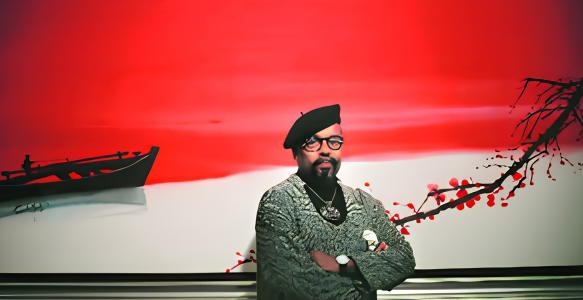
On certain winter evenings in Delhi, if you happen to walk past Terminal 3, the building itself feels like it’s humming with colour. Just beyond the usual airport choreography of trolleys and announcements, an 800‑foot river of images runs along the wall – fragments of festivals, silhouettes of monuments, a blur of trains and boats stitched together into one continuous mural. The Indian Odyssey, is often where many people first meet artist Paresh Maity, without even realising it.
It’s an encounter that tells you the scale of his ambition, his refusal to separate the intimate from the spectacular, and his instinct to turn everyday Indian life into a kind of cinematic scroll. Before this monumental painting of Paresh Maity appeared at the Delhi airport, he was already known in art circles as a master of watercolour.
Instead of moving only toward pure abstraction or angst‑ridden figuration, he insists on light, travel, and luminous storytelling as serious artistic material. In the shifting language of contemporary indian artworks, he belongs to the lineage of post‑Independence Indian painting, but his sensibility is insistently global – canals of Venice, ghats of Varanasi, deserts of Rajasthan, often in the same visual vocabulary.
Who is Artist Paresh Maity?
Born in 1965 in Tamluk, a historic town in West Bengal with a strong terracotta tradition, Paresh grew up surrounded by rivers, ponds, and the soft clay of local idol‑making. As a schoolboy, he modelled clay images of gods and goddesses and sold them to help support his education – a small but telling detail in the larger Paresh Maity biography. Those early experiences with earth, water and ritual mark the beginning of what we might call Paresh Maity history: an artist shaped as much by material necessity as by aesthetic curiosity.
Over nearly five decades, he has moved restlessly across mediums – watercolour, oil, acrylic, mixed media, sculpture, photography and even film – while remaining best known for his luminous, travel‑inflected paintings.
If you ask “who is Paresh Maity?” within the ecosystem of contemporary Indian art, the answer often begins with his status as a “watercolour star” who refused to remain confined to small paper works. Beginning with atmospheric landscapes, he gradually shifted toward bold, graphic compositions with strong colour blocks and unusual cropping, often featuring human figures, boat forms or architectural silhouettes. Recognition followed quickly: more than 70–80 solo exhibitions across India and abroad, major works in the British Museum and the National Gallery of Modern Art, and the Padma Shri in 2014 for his contribution to art.
Artistic Journey of Paresh Maity
1. Early Life and Education
The arc from a small town in Bengal to large‑scale international projects is not as linear as it looks on paper. In Tamluk, Maity’s childhood near rivers and the Bay of Bengal gave him an early, bodily understanding of water – its moods, reflections, and dangers. While still at school he painted river scenes in watercolour, then moved to oil as his technical confidence grew.
Formal training in Kolkata exposed him to the legacies of Bengal modernism, from Jamini Roy’s folk-derived forms to the monumental sculptures of Ramkinkar Baij, even as he honed his handling of oil and academic drawing. When he moved to Delhi for his MFA, he entered a different art conversation – more national, more plugged into global currents, closer to the institutional hubs that had already canonised artists like Raza and Tyeb Mehta. The result is an artist who carries both provincial intimacy and metropolitan ambition in the same frame.
2. Watercolor Mastery as a Contemporary Medium
“Water‑colours are my heart & soul,” he has said in interviews, and the work bears this out. Maity began working seriously in watercolour around the age of ten, and over four decades has pushed the medium far beyond its stereotype as a delicate or minor category. Exhibitions devoted to his watercolours – from riverine landscapes to complex cityscapes – have underlined just how muscular, saturated and contemporary the medium can be in the right hands.
In one video, he stands before what is described as the largest watercolour artwork in the world, comparing the process to a battleground; if you hesitate, he suggests, the water dries before the colour lands, and the moment is lost. This combination of risk and control – closer to what we associate with J.M.W. Turner’s late storms or contemporary abstractionists – keeps Paresh Maity paintings firmly in the present tense rather than as nostalgic souvenirs.
3. Venice Series and the Influence of European Travels
As his career expanded, Maity’s itinerary widened: from the sand dunes of Rajasthan and the backwaters of Kerala to the canals of Venice and the lake of Geneva. The so‑called “Venice” works transplant his literacy with Indian light onto European waterways – gondolas and facades rendered in oranges and blues that feel closer to a Rajasthani evening than a misty Venetian postcard.
European travels also opened up opportunities to show alongside or in dialogue with global peers, and to exhibit in venues like Venice again through sculpture, as with his bronze Genesis in the Marinaressa Gardens.
Characteristics of Paresh Maity's Painting Style
1. Vibrant Color Palette
The first thing that strikes you in a Paresh Maity artwork is colour that feels almost over‑saturated, yet somehow balanced. Rajasthan, he has said, was a turning point: the ochre deserts, turbans and saris pushed his palette into a more explosive register from which there was “no looking back.” From the sand dunes to the blue ghats of Varanasi, his works sit comfortably next to the chromatic intensity we associate with S.H. Raza, but rooted in specific geographies rather than pure geometry.
2. Watercolor Mastery
Technically, Maity uses watercolour in dense, confident layers rather than in timid, single washes. Exhibitions like World of Watercolours underline how fully he has mastered the medium’s unpredictability, turning blooms, drips and back‑runs into compositional tools rather than accidents.
His line work remains fluid, often sketch-like, which keeps figures and architecture from feeling over‑determined. This looseness allows him to move between intimate works and ambitious series like Shesh Lekha – his tribute in watercolour to Rabindranath Tagore’s last poems – without losing coherence.
3. Layering and Texture
As he moved into acrylics, oils and mixed media art, Maity began to incorporate thicker surfaces, collage-like elements and graphic textures. In many canvases, we see a dialogue between transparent watercolour habits and the opacity of oil or acrylic; thin glazes sit next to impasto strokes, echoing the density of urban facades or festival crowds.
4. Influence of Travel on His Art
From the ghats of Varanasi to Himalayan villages and then on to London, Venice, China and Japan, Maity has painted his way along his travel routes. Series devoted to cities like Varanasi – with their glowing steps and flickering lamps – fold devotional atmospheres into almost abstract arrangements of verticals and diagonals.
For viewers exploring watercolour paintings or landscape paintings, Maity’s work often acts as a gateway – it shows that landscape in Indian art can be both descriptive and structurally adventurous, operating somewhere between Ram Kumar’s abstractions and a travel diary.
Famous Paintings of Artist Paresh Maity
1. The Indian Odyssey
The Indian Odyssey is Maity’s most widely known work: an approximately 800–850‑foot mural in 53 panels at Delhi’s Indira Gandhi International Airport, completed in 2010. It weaves together Indian landscapes, festivals and everyday scenes into a single, continuous journey, making it one of the largest public art projects in the country.
2. The Mystic City Series
The Mystic City suite brings his fascination with urban spirituality into focus. Auction records and exhibition notes describe it as a series in oil, mixed media and watercolour, featuring both landscapes and figurative images that explore the layered life of the city. In some works, architectural grids seem to dissolve into veils of colour, as if the city were both concrete and mirage.
3. Venice Impression
Under titles associated with Venice, Maity’s recurring subject is water meeting architecture: reflections of facades, gondolas, narrow canals. Here, his Indian eye for saturated light meets European forms, resulting in what feels like an “Indian Impressionism” rather than a direct homage to Monet or Turner.
4. Rajasthan Series
In his Rajasthan series, deserts, forts and human figures all become sites for colour experiments. Curators often point back to these works when explaining why Paresh Maity’s art took such a decisive turn toward high chroma – the state’s textiles, architecture and light recalibrated his palette in a way that continues to echo through later canvases.
5. The Boatman
Across many decades, the image of a lone boatman recurs in his work – sometimes in Kerala backwaters, sometimes on the Ganga, sometimes in more imagined settings. It’s not always titled The Boatman on paper, but as a motif it functions almost like a self‑portrait: a figure steering through shifting waters, caught between shorelines.
6. Festival of Colors
Holi imagery surfaces repeatedly in Maity’s paintings and projections, where plumes of pigment and crowds become compositional devices. Rather than literal depictions of the festival, many works use the idea of a “festival of colours” as a way to think about human proximity, chaos and renewal.
7. The Golden Flute
Works titled The Golden Flute – documented in catalogues as acrylic (sometimes with charcoal or oil) on canvas – often pick up the Krishna iconography of the flute‑player, but filtered through Maity’s vocabulary of expressive faces and dense colour fields. Here, spiritual paintings are less about didactic storytelling and more about mood: longing, playfulness, the shimmer of music made visible.
8. Midnight Dream
Under titles like Midnight Dream, he turns down the chroma slightly: deep blues, small constellations of lit windows or lamps, solitary figures. These works sit closer to the nocturnes of European painters yet remain grounded in Indian urban and riverine settings.
9. Shesh Lekha
Shesh Lekha – The Last Poems of Rabindranath Tagore is a landmark exhibition and body of work in watercolour, created to mark the 150th birth anniversary of Tagore. Maity translated fifteen late poems into visual form, showing them at the National Gallery of Modern Art in Delhi and Mumbai in 2011 – an encounter between two Bengali sensibilities across time.travellingcamera+3
Notable Sculptures of Paresh Maity
1. The Force (The Bull)
In recent years, Maity’s sculptures have become as ambitious as his paintings. A widely discussed work is a charging bull sculpture reportedly crafted from thousands of temple bells, its surface vibrating with sound even when still. The Force (The Bull), extends his interest in markets, energy and ritual into three dimensions – a counterpart to bronze bulls in global financial districts, but tuned to Indian sonic memory.
2. Urbanscape (The Giant Jackfruit)
Urbanscape is a monumental bronze jackfruit sculpture, weighing around 7000 kg, created for the inaugural Bengal Biennale and now installed at Victoria Memorial Hall in Kolkata. Maity uses this everyday fruit as a metaphor for city life: the spiked exterior stands in for concrete walls, while the seeds and pulp inside allude to tightly knit communities hidden within. The work has been described as one of the largest single‑piece bronze sculptures in India.
3. The Bankura Horse
The terracotta Bankura horse is an emblem of Bengal’s craft history, and contemporary sculptors have long reinterpreted it. Given Maity’s roots in a region renowned for terracotta and his longstanding engagement with equine and folk motifs, his sculptural homages to the Bankura horse sit somewhere between tribute and reinvention – translating a vernacular form into the language of contemporary sculpture art.
4. Genesis
Genesis is a towering bronze sculpture (around 246 x 90 x 36 inches), exhibited in Venice and later shown in India, where it has been read as a symbol of inner strength and dynamism. The work’s vertical thrust and faceted surfaces echo his painted architectures, but in sculptural form they become almost totemic.
5. The Life's Journey (I & II)
At Delhi Airport’s Terminal 1, Maity’s installation Life’s Journey consists of a pair of white elephant forms in oil and acrylic on fiberglass, each roughly 7 x 9.25 x 2.75 feet. Commentators describe the elephants as embodiments of human emotions – love, harmony, closeness – inspired by the mythic Airavata and functioning as metaphors for peace amidst the churn of travel.
FAQs About Paresh Maity
1. What is Paresh Maity famous for?
Paresh Maity is known for his vibrant watercolours, contemporary landscapes, and the monumental mural The Indian Odyssey.
2. What is the longest painting of Paresh Maity?
The Indian Odyssey at Delhi's Indira Gandhi International Airport is Paresh Maity's longest and most famous mural.
3. What type of art does Paresh Maity create?
Paresh Maity works in watercolour, oil, acrylic, mixed media, sculpture, and installation art. placing him firmly within the broad field of contemporary Indian oil paintings and beyond.
4. What inspires Paresh Maity's artwork?
His work is inspired by travel, nature, Indian cities, festivals, and everyday life.
5. Has Paresh Maity won any awards?
Yes, Paresh Maity has received several honours, including the Padma Shri in 2014 for his contribution to Indian art.
