Artist NS Bendre - Biography, Paintings, Art Style and Legacy
Thorn comes with an unusually instructive catalogue record. The National Gallery of Modern Art records N. S. Bendre’s Thorn as a 1955 work, associates it with that year’s Lalit Kala Akademi National Award, and identifies its medium as oil on board. Its inscription field, however, transcribes a different date. Before deciding what its date tells us about Bendre’s development, we have to notice that discrepancy. The physical painting and the information accompanying it deserve equally close attention.
Artist NS Bendre worked across landscape, portraiture, still life and abstraction. Travel and teaching punctuated his working life. So did changes of technique: the later flecks of colour can look far removed from an early academic landscape. People remain, though, along with the places they inhabit. Pointillism is one way into this career, not its entire extent.
There is another part of the story in Baroda’s classrooms. Painting there involved practice, discussion and opportunities to exhibit. Students encountered a teacher who had already worked in Indore, Kashmir, Bombay and Santiniketan, and who continued to explore new approaches himself. This NS Bendre biography follows those connections alongside the paintings. Where a supplied title or date remains uncertain, the uncertainty is retained rather than filled with an imagined scene or an unsupported story about its making.
Who Was NS Bendre?
Narayan Shridhar Bendre was an Indian painter and teacher, born in Indore in 1910. He studied at the State Art School there under D. D. Deolalikar and received an art diploma from Bombay in the early 1930s. He died in February 1992.
For artist NS Bendre, painting was neither one subject nor one settled manner. Early landscapes and figures led into experiments with Cubism, Expressionism, abstraction and, later, pointillism. His teaching at the Faculty of Fine Arts, Maharaja Sayajirao University of Baroda, placed that openness within an institution whose influence extended far beyond his own studio.
Quick Facts About NS Bendre
The initials stand for Narayan Shridhar. Born in 1910 in Indore, Bendre trained there before establishing a career that took him to several parts of India. Baroda became a long commitment: he arrived to lead its Painting Department in 1950, later became Dean, and remained until 1966.
In 1956, the Baroda Group of Artists added collective exhibitions to that setting. Among Bendre’s honours were the National Award connected with Thorn, Padma Shri in 1969 and Padma Bhushan, notified in 1991. Oil, gouache, watercolour and drawing all occur in his practice. For an N S Bendre history, dates provide a framework; the differences between the works give it substance.
Artistic Journey of Artist NS Bendre
1. Early Influences from the Indore School
At Indore’s State Art School, Bendre studied with D. D. Deolalikar. Early landscapes and portraits required him to work out proportions, light and the placing of figures.
2. Time at Santiniketan and Meeting Nandalal Bose
Bendre stayed at Santiniketan in the mid-1940s, where he encountered Nandalal Bose, Benode Behari Mukherjee and Ramkinkar Baij. A memorial lecture preserved by Asia Art Archive recalls his eagerness to learn unfamiliar processes despite his established reputation.
4. Joining the Progressive Artists' Group (PAG)
NGMA records Bendre joining the Bombay Progressive Artists’ Group in 1948. He was not one of its six founders. He returned from travel abroad to a Bombay art world in which the direction of painting was being actively debated. His own experiments belong to that moment, though they followed the concerns of a painter with an already established career.
1. Formation of the Baroda Group in 1956
The Baroda Group of Artists brought staff and students together in 1956. Exhibiting gave their work a setting beyond the classroom; Bendre helped establish that shared platform while leading the Painting Department. The resulting community contained different practices, with room for students to make choices that did not simply repeat Bendre’s own.
Style and Techniques Used in NS Bendre Paintings
1. Landscape and Portrait Painting
Village life, workers and everyday encounters recur among his subjects. During his Kashmir years, Bendre had opportunities to sketch and paint in a new landscape; in portraits, attention moved towards the individual figure. When looking at an NS Bendre painting, notice how these interests meet.
2. Cubism, Expressionism, and Abstraction
Cubist experiments gave Bendre ways of dividing a subject into planes; expressionist colour and abstraction offered other possibilities. He tried these approaches without staying within one movement. For NS Bendre art style, a comparison across decades is more useful than a fixed definition. A still life can reveal how he reorganises shapes; a figure painting can show how much of an observed body survives that process.
3. His Distinct Version of Pointillism
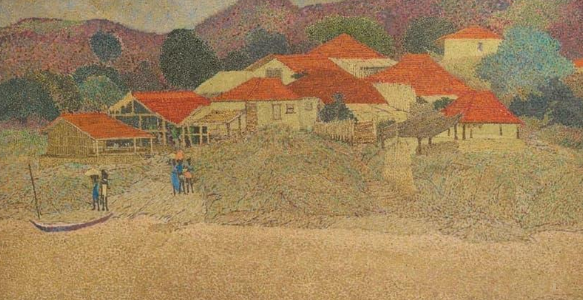
Move close to a later Bendre and the surface separates into small touches. Step back and a person or a tree gathers out of them. This movement between mark and image is central to his pointillism. Bendre’s use of broken colour needs to be followed in the works themselves, across different subjects and dates.
4. Use of Oils, Gouache, Charcoal, and Watercolour
Oil on board and canvas, gouache and watercolour are documented across his career; drawing was also part of his practice. A medium changes what a mark can do. Gouache can offer an opaque, matte area, while watercolour can leave the light of the paper active. For charcoal, as for any medium, check the individual object record before assigning it to a particular work.
Famous Artworks by NS Bendre
An NS Bendre artwork may appear under a descriptive title in one catalogue and a shorter name elsewhere. Sometimes the record is secure; sometimes only a later list supplies it. The entries below keep those differences visible. Where the requested title cannot yet be matched to a documented object, the gap is acknowledged.
1. Thorn (1955)
Among NS Bendre famous paintings, Thorn has a substantial institutional record. NGMA connects it with the National Award of 1955 and describes its Cubist approach. But there is a problem with the date: the catalogue heading gives 1955, while the inscription field transcribes 1944. That discrepancy remains open.
2. The Sunflower / Sunflowers (1955)
Yellow Sunflowers appears in The Arts Trust catalogue as an oil on board of circa 1955. The brief’s The Sunflower and Sunflowers could be title variants, but that identification has not been settled. The documented exhibition entry gives us a firmer starting point. It also places a flower subject beside the figurative and abstract experiments of Bendre’s mid-career years.
3. Gossip (1988)
Untitled (The Gossip), dated 1988, appears in a market index. That is a lead, not a complete collection record for the Gossip named here. Before reproducing it, we still need to establish that the image belongs to the same work and confirm its medium and provenance. Describing a generic late Bendre canvas would not answer those questions.
4. The Return Journey
The Return Journey has not yet been matched to a reliable object record. Homeward Bound is recorded separately by The Arts Trust, with a 1954 date. Until a catalogue cross-reference or collection record connects them, the two titles need to remain separate.
5. Bhil Couple (1980)
The title and 1980 date require further catalogue confirmation. A documented Bhil Family appears in The Arts Trust’s exhibition catalogue under 1957; it must not be silently substituted for Bhil Couple. Bendre’s engagement with Adivasi subjects belongs to his wider figurative practice. It does not resolve which work this title identifies.
6. Pratiksha (Waiting)
No reliable object entry for Pratiksha was established in the records checked. Waiting, its English rendering, is an evocative word, but it cannot tell us what is on the canvas. A collection reference or a dated exhibition catalogue is needed before the painting can be described. For now, the title is retained as an unresolved part of the requested list.
7. Vagabond (1933)
Vagabond is associated with Bendre’s early Bombay Art Society recognition. Accounts differ between 1933 and 1934, so the early 1930s is the safer chronological description. Its place in the story is clear even with that date unsettled: Bendre had gained public recognition well before his Baroda teaching years and the later experiments for which he is often remembered.
8. The Parrot and the Chameleon
Art historian Ratan Parimoo discusses this still life in relation to Bendre’s Cubist experiments. The title brings together living creatures and a constructed arrangement; the art-historical interest lies in how observed forms become pictorial structure. The complete catalogue and reproduction still need checking before a detailed account of the composition or a publication-ready caption can be supplied.
9. Entwined Form (1962)
Entwined Form is recorded by Tuli Research Centre as oil on board,1962, with Lalit Kala Akademi credited in its provenance or courtesy field. Here the title, date and support are documented. Its place among Bendre’s abstract works widens the picture of a painter often introduced through landscapes. This was also within his Baroda period, before he left university teaching in 1966.
10. Pointillist Paintings from the 1970s–1980s
Later NS Bendre artwork often brings figures and surroundings into a shared field of small colour marks. The boundary between a person and the setting can soften without the subject disappearing. A useful comparison is between the overall image and its close surface: the same marks that describe a scene also establish a rhythm across the canvas. Individual late works still need their own dates and medium records.
Awards and Recognitions of NS Bendre
1. Bombay Art Society Medals
Long before Baroda, Bombay Art Society medals brought Bendre recognition. Vagabond is linked with a silver medal in the early 1930s, and a gold medal is recorded in 1941. By the time he reached Santiniketan, he was already an established professional. Some later award chronologies disagree over individual years, so a detailed list still calls for comparison with the original records.
2. Padma Shri (1969)
The Padma Shri is recorded for 1969 by NGMA and other established art references. Bendre had left Baroda three years earlier. Behind him lay a long period of teaching as well as the paintings made during it; ahead lay further work in Bombay.
3. Padma Bhushan (1992)
Although 1992 appears in the brief and several art accounts, the Government of India notification naming Professor Narayan Shridhar Bendre for the Padma Bhushan is dated 26 January 1991. NGMA also gives 1991. The official notification year is therefore the firmer reference; the reason for the repeated 1992 date remains unresolved.
4. Kalidas Samman and Aban-Gagan Award
The Jehangir Nicholson Art Foundation records both the Kalidas Samman and the Aban-Gagan Award among Bendre’s honours. Their exact years vary in later accounts and need confirmation from the awarding institutions.
NS Bendre's Legacy and Influence on Indian Modern Art
Bendre helped make experimentation part of a working artistic education. The university’s own history names him among the teachers who nurtured Baroda’s Painting Department. Jyoti Bhatt studied under Bendre and K. G. Subramanyan, while the wider Baroda community developed through many individual contributions.
The paintings offer no tidy sequence in which each new approach erases an earlier one. Figures survive experiments with structure, and observation remains relevant to an abstracted surface. An early watercolour, Thorn and a late broken-colour canvas make a better introduction together than any one of them alone. They show how much the same painter was willing to try.
FAQs About Bendre Painter
Who was NS Bendre and why is he famous?
Born in Indore in 1910, Bendre became known as both a painter and a teacher. Landscapes, figures and experiments with modernist approaches formed a varied body of work. His Baroda years also helped shape a major centre of Indian art education.
What was N. S. Bendre's painting style?
There is no one answer across the decades. Early academic painting, Cubist and expressionist experiments, abstraction and later broken-colour surfaces all appear. Compare works from different periods before treating pointillism, or any other label, as his settled identity.
What is the Baroda Group of Artists founded by NS Bendre?
It brought staff and students together around the Faculty of Fine Arts in 1956. The group offered opportunities to exhibit collectively, taking work made in the university setting into a public conversation about contemporary painting.
Which awards did NS Bendre receive during his lifetime?
They include Bombay Art Society medals, the National Award associated with Thorn, Padma Shri, Padma Bhushan, Kalidas Samman and the Aban-Gagan Award. The Padma Bhushan was officially notified in 1991, despite the frequently repeated 1992 date.
What is the NS Bendre's most famous painting?
Thorn is among his best-documented and most frequently discussed works, held by NGMA and associated with the 1955 National Award. Calling it the uncontested most famous painting would be stronger than the evidence allows. Different periods of his practice invite different starting points.
