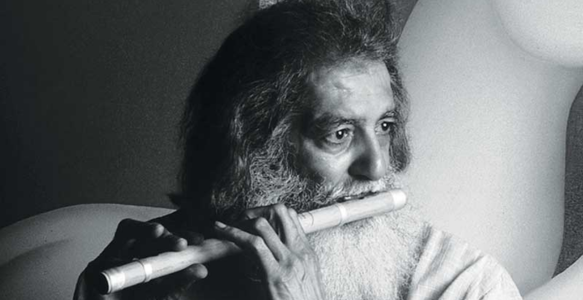
Who Is Artist Manjit Bawa?
For those wondering who is Manjit Bawa, his work offers the most direct answer - an artist deeply rooted in Indian philosophy yet visually unlike any of his contemporaries.. In this Manjit Bawa biography, we see how, in the 1960s and 70s, when much of modern Indian art had adopted muted palettes, Bawa introduced a radically different visual language of pinks, violets, saturated greens, and luminous reds. He was not rejecting the West through nationalism or performing tradition through decoration. He was building a visual language that felt unmistakably his own.
Bawa often said he had grown up like Krishna, playing with cows and drinking milk straight from their udders. Animals were never symbols to him; they were companions and part of everyday life. This closeness stayed with him and later became central to his paintings, where bulls, cows, goats, and dogs appear not as decorative motifs, but as equal presences.
He had also trained as a classical flautist under maestro Pannalal Ghosh, and music remained deeply tied to his visual language. Music and painting were never separate practices, they belonged to the same search for rhythm, stillness, and emotional truth.
He spent much of his later life between his studio in Dalhousie and New Delhi. In 1980, he received the National Award from the Lalit Kala Akademi. He was selected for the first Bharat Bhavan Biennale in Bhopal in 1986, and his work was exhibited internationally across Japan, Turkey, Cuba, Amsterdam, Singapore, and Paris.
Artistic Journey of Manjit Bawa Painter
1. Early Works and Experimentation
In his early years at the College of Art, Bawa was drawn to observation, long hours studying horses in tabelas (stables) and shelters where tongawalas rested. His teachers, particularly Abani Sen, pushed him not toward abstraction (the fashion of the moment) but deeper into figuration. This was unconventional. Bawa had to choose between what the art world was doing and what he felt drawn toward. He chose the latter, early.
During the 1970s, Bawa's paintings often carried narrative weight - hunting scenes in which humans and animals existed in a complex choreography of desire and dependency. These works showed his fascination with gesture, with the body in motion. But they were also searching. The palette was still finding itself. The forms had not yet achieved the weightlessness they would later possess. What remained consistent was his commitment to the human-animal relationship, not as anecdote, but as philosophical inquiry.
2. Evolution of His Visual Language
Something shifted in the late 1970s and early 1980s. The narratives began to simplify. Hunting gave way to coexistence. Multiple figures dissolved into singular presences. By the mid-1980s, the bovine motifs - the bull, the cow emerged as central. Bawa's childhood memory, his classical training, his spiritual beliefs, all converged in the image of the animal as a repository of something sacred and patient.
The colors deepened. Whereas earlier works had shown more modest tonality, now the reds sang against their grounds. The yellows seemed to emit their own light. The technique itself had evolved: Bawa was working from his serigraphy experience, understanding how flat color and luminosity could coexist. Forms acquired a sense of buoyancy, as if weight itself had been lifted from them. By the 1990s, especially in his later work, the figures appeared to float in color fields, surrounded not by landscape or context, but by pure, saturated tone.
Each element became more essential. The line became swifter, more assured. The background became a presence rather than a void. What emerged was a mature visual language - deceptively simple and charged with a kind of still devotion.
3. The London Years and Serigraphy
Bawa's eight years in London (1964–1971) were formally crucial. Working as a silkscreen printer, he mastered the technical vocabulary of flat color, bold form, and graphic clarity. Serigraphy is not a medium for hesitation; it demands decision. You commit to the image, and the image commits back. This discipline became lodged in his sensibility.
He also taught painting at the Institute of Adult Education in London, which meant articulating his ideas to others. He was not a theorist by nature, but he was clear about what mattered: color as a vehicle for presence, form as a carrier of emotion, simplicity as a doorway to depth. When he returned to India in 1971, ready to establish his identity as a painter rather than a printer, he carried this knowledge with him. Later, in 1977–1978, he would establish a silkscreen workshop at the Lalit Kala Akademi's Garhi Studios in New Delhi, passing this knowledge forward to a new generation.
Painting Styles & Techniques in Manjit Bawa's Art
1. Vibrant and Saturated Colors
Manjit Bawa artist is perhaps best known for a radical decision: to paint in colors that Indian art had largely abandoned. Where his predecessors had worked in ochres, greys, and browns, Bawa arrived with pinks, violets, sunflower yellows, and saturated greens. These were choices rooted in traditional Indian textiles, in Pahari miniature paintings, in folk traditions. But in the context of 1970s modernism, they felt revolutionary.
The colors seem to emit their own luminosity. This quality achieved partly through his understanding of serigraphy, partly through technique with oil and canvas, creates an effect of weightlessness. This is influenced by Sufi philosophy, which Bawa had studied deeply: the idea that divine presence emanates from inside, not imposed from outside.
His palette evolved over time. Earlier works show more complex color interactions. Later works feature simpler, more assertive color fields - a single red, a single yellow against which the figure floats. The effect is less atmospheric and more iconic. The painting becomes less about creating illusion and more about creating presence.
2. Mythological and Sufi Themes
Bawa's subject matter drew from multiple wells: Hindu mythology (Krishna, Shiva, Kali), Punjabi folk narrative (particularly Ranjha from the tragic ballad Heer Ranjha), and Sufi poetry. These were not scholarly interests. They were lived traditions. His classical training on the flute connected him directly to Krishna. His Punjabi heritage gave him access to Ranjha. His spiritual practice engaged Sufi thought.
What made his approach distinctive was his refusal to illustrate these traditions in conventional ways. Krishna appears not as a blue deity in elaborate garment, but as a simplified form, often accompanied by cows. Shiva emerges as pure form, distilled to essential curves. The Sufi influence meant that these divine figures were not distant or transcendent, but intimate, present, almost domestic in their proximity to the viewer.
This is figurative paintings at its most philosophical: form becomes a language for thinking about devotion, presence, and the sacred in everyday life.
3. Rounded, Bulging Figures
One of the most recognizable qualities of Manjit Bawa art is the form of his figures. Bodies are rounded, almost balloon-like. This stylization is deliberate and distinct from both classical anatomy and Western modernist distortion.
What's easy to miss in Manjit Bawa's work is how restraint and devotion coexist—the bold colour draws us in, but it's the stillness that holds us. These rounded forms carry a certain vulnerability, almost an innocence. The curves themselves whether of a bull's hump or a human knee suggest connection rather than hierarchy. In one of Bawa's observations, recorded by art restorer Rupika Chawla: "All living beings in existence were linked with one another through love and integration of identities."
This formal language extends across his figures, both animal and human. It creates a kind of equality of form, a sense that all beings share the same sculptural vocabulary.
4. Signature Visual Elements
Several elements recur across Bawa's oeuvre with such consistency that they become signatures, almost mantras. The flute is perhaps most prominent - appearing in numerous works, linking Krishna to Ranjha to Bawa himself. The bull (or cow, or calf) emerges especially in later work, painted in solitude or in contemplative proximity to human figures. Birds—often in silhouette or profile—suggest freedom and transcendence. The rounded form, whether human or animal, becomes a principle of visual organization.
Behind all these elements is a technique of negative space. The figure floats against a ground that is often monochromatic, sometimes subtly graded. The space around the figure becomes active, charged. It's what allows the form to sing.
Famous Paintings of Artist Manjit Bawa
Many of Manjit Bawa's famous paintings explore mythology, animals, and quiet moments of coexistence.
1. Krishna with Cow
Among the most iconic of Manjit Bawa painter's works, Krishna with Cow appears in multiple versions across his career. The subject is traditional, Krishna, the cowherd deity, in relation to the sacred cow. But Bawa's treatment strips away narrative and ornament. We see a simplified Krishna, often suggested through color and gesture alone, alongside a bovine presence. The interaction between the two is electric but serene. There is a kind of eternal companionship.
In 1998, a work titled Untitled (Krishna and Cow) sold at Christie's for $780,500 (₹ 5 Crores), and has remained among the most celebrated in his oeuvre. Even more remarkably, in December 2023, a 1992 untitled work depicting Krishna fetched Rs 25.11 crore at an AstaGuru auction—a staggering price that testifies to both the work's formal power and the market's recognition of Bawa's legacy.
2. Shiva with Bull
The deity Shiva appears frequently in Bawa's work, often accompanied by Nandi, the sacred bull. In a 1995 untitled work, Shiva is depicted in the posture of Dakshinamurti—the form of Shiva as teacher of yoga, music, and wisdom. The figure sits, one leg bent, in contemplation or instruction. The style is so abstracted that one must know the tradition to recognize it. Yet even without that knowledge, something is conveyed: a sense of inner stillness, of knowledge held in the body itself.
This work sold for $2.3 million (approximately Rs 20 crore) at Sotheby's London in October 2023, setting a record for the artist.
3. The Flute Player
References to the flute player run throughout Bawa's work, most notably in The Purple Piper (1978). The flute connects multiple traditions simultaneously: Krishna the divine cowherd, Ranjha the tragic lover, and Bawa himself, who had trained under classical maestro Pannalal Ghosh. The figure plays not in a landscape or context, but against a ground of color. The flute itself becomes a symbol of music, of longing, of the sacred arts.
In some renderings, the player is accompanied by animals. In others, the figure stands alone. What remains consistent is the sense of a voice that is both intimately personal and spiritually universal - a human gesture in communication with the divine.
4. Kali
Kali appears in Bawa's pantheon as one of the "icons of my country," to use his phrase. The fierce goddess, typically portrayed with multiple arms and a crown of skulls, becomes in Bawa's language simplified and distilled. Color and form carry what iconography traditionally conveys. There is ferocity, but it is rendered as intensity rather than aggression. The paintings embody what Bawa saw in Kali: the force that destroys illusion and attachment.
5. The Goat and Man
The goat holds a particular place in Bawa's visual mythology. Unlike the cow, which carries divine associations, the goat is an animal of labor, of dry-land agriculture. Yet in Bawa's hands, it becomes worthy of contemplation. In works like Bakri Aur Kaddu (Goat and Pumpkin), the animal reaches out of a kind of gentle reaching toward the world. It is elevated simply by being truly seen by the artist's gaze.
The presence of a man alongside the goat creates a tableau of coexistence, a world in which hierarchy dissolves. This is Bawa's constant theme: that all living beings participate in the same essential choreography.
6. Bird and Man
Birds recur throughout Bawa's work, sometimes as solitary presences, sometimes in relationship to human figures. The bird represents transcendence, freedom, the capacity to move between worlds. They share the canvas with human figures, and in that sharing, something about the human condition becomes visible: our kinship with other beings, our shared vulnerability and presence.
The birds are often rendered in silhouette or minimal line, which gives them a quality of essence, their birdness extracted and concentrated. Against the saturated color fields, they achieve a kind of lightness that seems to levitate them off the surface.
FAQs About Manjit Bawa Painter
1. What is Manjit Bawa's most expensive painting?
The highest price achieved for a Manjit Bawa painting to date is Rs 25.11 crore, paid for an untitled 1992 work featuring Krishna, sold at an AstaGuru online auction in December 2023. Prior records include the 1995 Untitled (Shiva) at $2.3 million (approximately Rs 20 crore) at Sotheby's London in October 2023, and a 2000 Untitled work (Vishnu reclining) that fetched Rs 7.78 crore in 2018.
2. What is the meaning of Manjit Bawa bull painting?
The bull in Manjit Bawa art carries multiple meanings. On one level, it connects to Krishna the cowherd deity of Hindu tradition. On another, it represents the sacred animal of Indian agriculture and rural life. But perhaps most fundamentally the bull in his paintings embodies what he sought to express: peaceful coexistence, devotion without hierarchy, the recognition that all living beings share a common presence.
3. What is Manjit Bawa known for?
Manjit Bawa is known for four defining contributions: introducing vibrant Indian colours into modern art instead of muted grey and brown tones, creating his signature style of floating rounded figures against bold backgrounds, blending figurative subjects with abstract art principles, and expressing peaceful coexistence between humans, animals, and mythology.
4. What is special about Manjit Bawa's painting style?
Manjit Bawa’s painting style is special for its precision, simplicity, and spiritual depth. He reduced figures to their essential forms, used flat luminous colours, and created calm, compressed spaces. Influenced by miniature painting and folk art, his rounded forms carry a strong devotional presence while blending with abstract art principles. His iconic bull paintings and shiva paintings turn familiar subjects into meditative, symbolic forms. His background in music, Sufi philosophy, and close connection with animals also shaped a style that feels both deeply personal and universally timeless.
