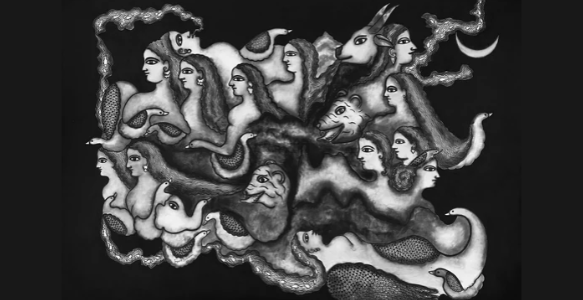
Jahnavi III is a large charcoal-and-acrylic canvas in Jayasri Burman’s River of Faith records. A bronze titled Jahnavi appears in the same body of work. The change of material is striking: a river-inspired presence can inhabit a drawn and painted surface, then take on a sculptural body. The series moves between these possibilities.
For Jayasri Burman artist studies, this is a useful place to begin. The titles refer us to an inherited sacred world, while the accompanying account speaks of Ganga’s pollution and restoration. Reverence for a river meets concern for its physical condition. Intricate imagery holds those concerns together; following a line across the surface takes time.
Born in Kolkata and trained at Santiniketan and in Kolkata, Burman later studied printmaking in Paris. Her work moves between watercolour, ink, acrylic, charcoal and sculpture. Following those changes helps avoid reducing her career to one bright palette or a single feminine symbol. A monochromatic work can be as important as a vivid one; a bronze can ask for a different kind of attention from a densely worked sheet. The guide below approaches her background through documented works and exhibitions, distinguishes inherited visual languages from historical movements, and keeps an unresolved series title visible rather than supplying an invented account of it.
Who is Jayasri Burman?
Jayasri Burman is a contemporary Indian artist, born in Kolkata in 1960 and based in New Delhi in the gallery records consulted. Women, mythic figures, animals and nature recur in her work. She draws on inherited stories while adapting them into a personal visual language.
The phrase “Jayasri Burman artist” can suggest a single fixed identity, but her practice crosses media and moods. Her figures may be maternal, divine, vulnerable or forceful.
Quick Facts About Jayasri Burman
Jayasri Burman is the spelling on her own website. Readers may search for Jayshree Burman or Jayashree Burman, but the artist’s documented name remains the reference. Her education took her from Kala Bhavana at Santiniketan to Kolkata’s Government College of Art and Craft; Paris printmaking study followed in 1984.
A National Award is recorded for 1985. Two later public markers are the 2007 International Women’s Day stamps featuring her work and the 2016 residency at Rashtrapati Bhavan. Between such dates lies the actual work: Jayasri Burman paintings, sheets of drawing and sculpture made for different projects over many years.
Artistic Journey of Jayasri Burman
For Jayasri Burman history and background, there are two useful kinds of record. Biographies establish her training; her own account points towards remembered stories, rituals and festivals.
1. Early Career and Bengal School Influence
Burman’s 1960 birth places her well after the early Bengal School movement. For Jayasri Burman history, Santiniketan is a direct educational connection; membership of that older movement is not. Her training offered ways of working with inherited forms within a modern artistic setting.
2. Academic Training and Artistic Foundation
Burman trained at Kala Bhavana and at Kolkata’s Government College of Art and Craft. Paris followed, with printmaking study recorded for 1984. The outline is consistent across the sources consulted. Degree names and the spelling of her Paris teacher’s name are less settled, so “trained at” is the firmer biographical description.
The drawings offer another kind of evidence. Follow a contour as it becomes a body or turns into an ornamental pattern. Then look at the colour around it. The line has a structural role even in a richly coloured image; printmaking provides a relevant part of her training in that context.
3. Evolution of Her Artistic Style
Watercolour and ink remain important, but they do not exhaust her materials. Acrylic canvases, charcoal-acrylic works and sculpture appear in documented bodies of work. The shift in support and scale changes how a viewer encounters the figure: a small sheet invites close reading, while a sculpture occupies shared physical space.
Changes in palette matter too. Dhara is associated with more restrained, often monochromatic work. Any definition of Jayasri Burman painting style that relies only on bright colour will therefore miss a substantial part of her practice.
4. Influence of Indian Mythology and Folk Traditions
Draupadi brings an epic history into the image; Ganga brings a sacred river. The stories already mean something to many viewers. Burman can draw on that recognition while making the figure carry a concern specific to the work or exhibition.
Aicon names Kalighat and Patachitra among her influences. Those references bring contour and narrative into the discussion alongside mythology. Burman works with that inheritance selectively, within pictures whose dense details and hybrid figures belong to her own imaginative world.
Art Style and Themes in Jayasri Burman Art
Jayasri Burman art often places a figure within a dense network of other forms. Birds, animals, plants and ornaments keep the surface active. Instead of treating each motif as a symbol with one fixed definition, look first at how it relates to the body and surrounding image.
1. Mythology and Hindu Iconography
Titles such as Divine Family, Ganesh Janani and Krishna Salila point to Hindu subjects. Draupadi and Krishna belong to another documented group of works. These titles provide a starting point, not a complete interpretation: a familiar figure can be recomposed to address a new concern.
In Born of Fire, Draupadi’s story becomes a way to consider agency and justice. The ancient narrative remains present, but the exhibition asks viewers to encounter it in their own time.
2. Feminine Forms and Goddess Imagery
Who is the woman in a particular image? A title may identify a goddess, a river being or a figure from an epic. Elsewhere, motherhood gives the work its setting. Those identities change the reading of a body that might otherwise be treated as a general symbol of femininity.
Dhara and the Draupadi works make different demands. One turns towards motherhood and nature; the other engages a woman’s place within a difficult epic narrative. Both give the female figure substantial emotional weight without making her an interchangeable emblem.
3. Nature, Birds and Symbolic Motifs
Birds, animals and plants inhabit the same pictorial world as the human figure. They can occupy the small spaces around a body or participate in its imaginative transformation. In River of Faith, water has an additional urgency: the artist’s account connects sacred associations with the actual river’s condition.
For an individual Jayasri Burman artwork, follow a motif through its immediate setting before assigning it a universal meaning. A bird can contribute to pattern, movement and narrative at once. Its presence does not require one identical explanation across every series.
4. Influence of Kalighat and Patachitra Folk Art
Kalighat’s nineteenth-century painters worked with bold outlines and subjects that expanded beyond devotional imagery. Patachitra supplies another narrative reference. Aicon names both in discussing Burman. The connection is a resource for reading her work, not a claim that a contemporary exhibition canvas is itself a traditional Kalighat sheet.
Her densely inhabited surfaces and personal mythic figures belong to contemporary art. Recognising an inherited contour or narrative device is useful; identifying the changes she makes to it is equally useful. Influence describes a relationship, not a complete classification.
Mediums and Techniques Used in Jayasri Burman Paintings
A search for “jayshree burman paintings” may return several materials under similar imagery. Check the object entry. Paper mounted on board is different from canvas, and a sculptural title can recur among painted river-inspired works. These distinctions affect both looking and the preparation of an accurate caption.
1. Watercolour and Ink
Watercolour, pen and ink appear together in numerous object entries. The medium description is worth pausing over. A viewer may first notice the overall coloured figure, then discover how much of its surface is articulated in small lines. Broad areas and close details keep drawing attention back to one another.
Miniature-like detail describes an effect of attention and scale. Some of Burman’s documented sheets are large, despite the close detail that invites viewers to lean towards them.
2. Charcoal and Acrylic
Jahnavi III is listed as charcoal and acrylic on canvas, six by nine feet, in 2021. The size alone complicates a casual description of Burman as a maker of miniatures. The work belongs to River of Faith, alongside quite different media. A series can hold that variety without every image having the same surface.
Charcoal and acrylic may share a surface; the catalogue alone does not reveal every sequence of drawing, covering and reworking.
3. Bronze Sculptures
Jahnavi is documented as a bronze. Unlike a sheet viewed from the front, it can be encountered from different sides. Its silhouette changes as the viewer moves. Looking at a sculptural work alongside a painting from River of Faith makes the continuity of the subject and the difference of medium easier to see.
Other works use fibreglass and gold leaf. They should not be labelled bronze merely because they belong to the same series or share a title.
Famous Series and Artworks by Jayasri Burman
“Famous” is used here for notable documented works and exhibitions, rather than a definitive ranking. Three bodies of work have clear exhibition or artist records. The first requested entry remains less securely established and is treated accordingly.
1. Kushmanda Series
The Kushmanda Series named in the brief remains unverified in the artist and exhibition records checked.
There is plenty of goddess imagery elsewhere in her work. That does not tell us which pictures the requested title identifies. A catalogue or artist statement carrying the name is needed before dates, media or interpretations can be attached to this supposed series.
2. Dhara Series
Art Musings records Dhara in 2023 and documents Utpatti as a 2022 watercolour, pen-and-ink work on paper mounted on board. Motherhood and nature meet within this body of work. Its more restrained palette also complicates the expectation that Burman’s paintings must always be intensely coloured.
Here the relation between a body and the natural world becomes intimate. Utpatti offers a documented point of entry, with its 2022 date and paper mounted on board. Start with that individual work before treating Dhara as a general statement about every image Burman makes.
3. Draupadi Series
In 2018, Aicon in New York presented Born of Fire: A Tale for Our Times. Draupadi provided its centre. The documented titles include Draupadi and Krishna and Draupadi and the Game of Dice, connecting different encounters within the epic to the exhibition’s contemporary reading.
This is a particularly clear example of mythology being brought into a contemporary conversation. Draupadi appears as a figure through whom agency, endurance and justice can be considered. She is not adequately described as a decorative heroine or only as a victim.
4. River of Faith / Ganga-Inspired Works
The artist’s River of Faith records paintings and sculptures, including works in watercolour and ink, charcoal-acrylic, bronze and other materials. The accompanying text links reverence for Ganga with concern about pollution and the need for restoration.
That context gives the river imagery a specific urgency. Sacred geography and ecological damage occupy the same body of work. The forms of a river-goddess can therefore carry devotion without separating it from the condition of the actual river.
Jayasri Burman's Impact on Contemporary Indian Art
Burman keeps inherited stories available for new questions. Draupadi, motherhood and Ganga are not simply a repeated inventory of subjects; they support distinct bodies of work with different moods and materials.
Public recognition includes the 1985 National Award recorded by her official biography, the 2007 stamp issue and the 2016 Rashtrapati Bhavan residency. To learn about Jayasri Burman, compare a work on paper with a charcoal-acrylic canvas and a sculpture. The shared vocabulary becomes clearer alongside the differences.
FAQs About Jayshree Burman Artist
Why is Jayasri Burman famous?
She is known for mythic female figures, intricate work in watercolour and ink, sculpture and documented bodies around Draupadi, Ganga and motherhood. “Jayasri Burman artist” is the canonical name form; “Jayshree Burman artist” is a search variant.
What is the artistic style of Jayasri Burman?
Her contemporary narrative idiom combines detailed line, mythological references, female forms and nature. Kalighat and Patachitra are acknowledged influences. Materials and colour vary, so one description should not erase the quieter or more tonal works.
Which are the most famous paintings by Jayasri Burman?
Documented examples include Born of Fire, Draupadi and Krishna, and works within Dhara and River of Faith. These provide useful starting points for Jayasri Burman information, rather than an uncontested list ranked by fame.
What awards has Jayasri Burman received?
Her official biography records a National Award in 1985. It also records later ICON and Devi recognitions. Commemorative stamps and the Rashtrapati Bhavan residency are other forms of recognition, distinct from an award for a particular painting.
What inspired Jayasri Burman's paintings?
Her stated sources include childhood memories, rituals and festivals. Mythology, folk-derived imagery and nature recur across the work. Documented series add more specific concerns: Draupadi and justice, Dhara and motherhood, and Ganga with ecological responsibility.
