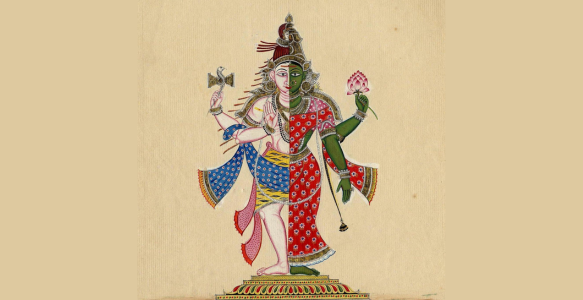
On certain days in the gallery, an Ardhanarishwar image can quietly rearrange the room. The light catches the line of division - half matted locks, half jeweled hair - and suddenly you’re aware of how much of your own life is split between seeming opposites: work and rest, solitude and relationship, fierceness and softness. Before you are half Shiva, half Parvati, asking a very simple question: what would it mean to be whole?
Every time we return to the ardhanarishvara art story, we’re struck by how contemporary it feels, despite its roots in early Indian temple sculpture and classical texts. From quiet tempera works by Nandalal Bose to the fractured, urgent canvases of M.F. Husain, artists keep circling back to this composite form as a way to talk about identity, power, and reconciliation.
We’ll move from mythology to studio, from Kushan and Gupta precedents to Mithila, Tanjore, Pattachitra, Pichwai, Kalamkari, miniature painting and contemporary practices. Think of it as a walk through different rooms of the same idea: the divine as both, and beyond.
What Is Ardhanarishwar?
Ardhanarishwar (or Ardhanarishvara) is the form of Shiva and Parvati embodied in a single body, usually split vertically - Shiva on the right, Parvati on the left. The name itself comes from Sanskrit: ardha (half), nari (woman), ishvara (lord), literally “the lord who is half woman.” Art historians trace the form to at least the 1st century CE, with richer sculptural and painted expressions emerging under the Gupta dynasty.
The Shiva half carries matted locks, rudraksha, tiger skin, serpent ornaments or the trishula, while the Parvati half shows coiffed hair, jewelry, breast, sari or skirt, lotus or mirror. When viewers today ask what is ardhanarishvara painting, they’re really asking how artists choose to choreograph this split - where the line falls, how sharply it is drawn, how much the two sides bleed into one another.
The image is anchored in Shaiva and Shakta myths: from stories where Shiva absorbs Parvati into himself to demonstrate the inseparability of masculine and feminine energies, to Puranic passages where this form makes cosmic creation itself possible. Because of this layered history, the phrase ardhanarishvara art history is less a linear timeline and more a constellation - sculpture, miniature, tribal, folk and modernist works all speaking to the same metaphysical puzzle across centuries.
Significance of Ardhanarishvara Paintings
The appeal of these works lies in the ardhanarishvara symbolism that is both philosophical and deeply personal. Artists don’t just paint a myth; they paint their own negotiations with duality - discipline and abandon, ego and dissolution, masculine and feminine.
1. The Union of Purusha and Prakriti
In classical thought, Shiva’s half is Purusha - the formless, witnessing consciousness - while Parvati is Prakriti, the ever-moving field of nature and energy. The painting becomes an image of their embrace: spine as axis, one side still, the other adorned and flowing. In some works, the line of division is razor sharp; in others, ornaments and drapery spill across it, suggesting that separation is more conceptual than real.
Narratives often describe Shiva manifesting as Ardhanarishvara when Brahma is unable to continue creation, to demonstrate that without Prakriti, Purusha is inert. In the studio, many painters translate this into visual choices - pairing earthy, ascetic tones with lush vermilions and gold leaf, or setting the figure against landscapes that oscillate between barren rock and fertile foliage.
2. Cosmic Harmony and Balance
Beyond gender, the form stands in for a long list of opposites: life and death, asceticism and householding, destruction and fertility. In miniature and mural traditions, the composite body may be surrounded by attendant figures, animals, or cosmic motifs that further underscore this harmony - sometimes river goddesses and ganas on one side, familial deities on the other.
Curiously, many modern painters resist making the balance too perfect. Husain’s dynamic canvases, for instance, use angularity and curve to create a tension that never fully resolves, as if to say that harmony is an activity, not a static state.
3. Spiritual Liberation
Philosophically, Ardhanarishvara points to a state beyond duality - “totality that lies beyond male and female,” as some scholars summarize it. To see oneself in that image is to momentarily step outside rigid identifications, an experience that many contemporary viewers - especially queer and non-binary audiences - have described as unexpectedly affirming.
Textual traditions tie this form to non-dualist (Advaita) insights: when Purusha and Prakriti are recognized as one, liberation follows. In paint, this often translates into luminous halos, mandala-like compositions, or dissolving contours - the figure not so much standing in space as radiating through it.
Ardhanarishwar Paintings by Famous Artists
In modern Indian painting, a small constellation of works has effectively become the canon of famous ardhanarishvara artworks - each one circling the same myth with a different visual language.
Ardhanarishvara paintings by Indian artists actually covers a wide range: from Bengal School tempera and Progressive modernism to contemporary figurative and folk practices in Mithila. The five artists below offer a useful cross-section of how this form has travelled through the 20th and 21st centuries.
1. Ardhanarishvara by Nandalal Bose
Nandalal Bose’s 1942 tempera Ardhanarishvara is a quiet masterclass in restraint. A leading figure of the Bengal School, Bose fused Ajanta-inspired line, wash techniques and nationalist sensibility to create images that feel both ancient and startlingly modern.
His Ardhanarishvara stands or sits in poised symmetry, the division between Shiva and Parvati marked by subtle differences in ornament and contour rather than theatrical contrast. The palette is muted - ochres, soft blues, gentle greens - allowing the viewer to focus on line and rhythm. Many curators read the work as a metaphor for social balance in a fraught pre-Independence moment: unity not as sameness, but as carefully held difference.
2. Ardhanarishvara by Anjolie Ela Menon
Anjolie Ela Menon approaches the form through introspection rather than spectacle. Known for her iconic, Byzantine-inflected portraits, Menon often builds surfaces through translucent glazes and textured grounds. Her Ardha Nareshwar, as described in critical writing, places an androgynous figure against a weathered, almost fresco-like background, with the split between male and female rendered as an emotional, not just anatomical, fault line.
Instead of heavy ornament, she relies on gaze and posture; the figure seems to inhabit a private interior world, more human than godlike. In the broader arc of her practice - concerned with memory, solitude, and spiritual yearning - Ardhanarishwar becomes a way to talk about the divided self, and the impossibility of fully resolving that division.
3. Ardhanarishvara by M.F. Husain
M.F. Husain’s take on the form is characteristically kinetic. In reproductions and auction literature, his Ardhanarishvara paintings show torsos twisting, limbs fragmenting, colours clashing in high-key reds, blues, blacks and yellows. The split body becomes almost cubist - planes interlocking rather than gently merging.
Husain rarely allows the two halves to settle into perfectly mirrored calm. Angular, fiery strokes on Shiva’s side and more sinuous lines on Parvati’s suggest a dynamic negotiation between destruction and nurture. Coming from an artist who treated mythology as a living political language - addressing questions of nation, secularism and identity - the image reads as both cosmic and urgently contemporary.
4. Ardhanarishvara by Shampa Sircar Das
Delhi-based artist Shampa Sircar Das has built an entire visual world around spiritual archetypes, sacred geometry and meditative pattern. Her Ardhanarishvara works often bathe the composite figure in luminous golds, lapis blues and crimson, encircled by mandala-like motifs, lotuses and yantras.
Texture matters here: stippling, fine linework and layered glazes echo the repetitive discipline of mantra and breath. Das’s bodies are less about anatomical accuracy and more about aura - fields of energy where the line between Shiva and Shakti is gently porous. These are paintings that reward slow looking; you don’t decode them so much as sit with them.
5. Ardhanarishwar by Baua Devi
National Award and Padma Shri–winning Mithila artist Baua Devi is renowned for her bold reworking of traditional Madhubani motifs, scaling them up for walls, paper and even international exhibitions. While her oeuvre ranges from local rituals to pan-Indian myths, she has, like many Mithila painters, engaged Shaivite subjects including Ardhanarishwar within the tight, patterned frameworks of the style.
Here, the split figure is nested inside dense borders of fish, flowers, serpents and geometric fillers, painted with flat, saturated colour and strong black outlines. The cosmic philosophy is filtered through village idioms - less about abstraction, more about bringing the deity into the textures of everyday rural life.
When we juxtapose Bose’s tempera, a Husain print and a Mithila work in the same curatorial narrative, visitors immediately sense that no single visual language can “own” this form. That elasticity is precisely what keeps it alive for artists across generations.
Ardhanarishwar Paintings in Indian Painting Traditions
Across regions, Ardhanarishwar slips easily into local vocabularies - sometimes opulent, sometimes austere, sometimes almost playful. This is where ardhanarishvara art becomes a kind of travelling archetype, wearing different textiles, pigments and drawing styles as it moves.
1. Ardhanarishwar in Madhubani / Mithila Art
In Mithila, the composite deity is rendered with flat colour fields, thick black outlines and dense patterning that leaves almost no negative space. Shiva’s side may carry the trident, crescent and tiger-skin motif, while Parvati’s half gleams with nose rings, bangles and ornate sari borders.
The figure is often framed by fish, birds, vines and border bands - symbols of fertility and continuity that echo the painting’s central message of generative union. Artists like Sita Devi, Ganga Devi and Baua Devi have helped move such images from mud walls and wedding chambers to paper, galleries and museums.
2. Ardhanarishwar in Tanjore Painting
Tanjore depictions place Ardhanarishwar in a world of high relief and gold. Painted on wooden panels, the composite deity is often seated on a throne framed by arches, flanked by attendants or guardians, embedded with semi-precious stones and 22k gold leaf.
Here, duality is expressed through opulence: two crowns, two sets of ornaments, mirrored yet slightly varied, catching the light differently as you move. The theological idea of completeness is thus translated into material abundance and temple-like grandeur.
3. Ardhanarishwar in Pichwai
While Pichwai is primarily associated with Krishna and Srinathji, contemporary workshops and digital-age ateliers have begun experimenting with Shaivite and composite deities within the Pichwai format - large cloth paintings crowded with lotuses, cows and architectural backdrops. In such works, Ardhanarishwar stands within ornate niches, borrowing the slow, devotional mood of Nathdwara yet speaking to Shaiva-Shakta ideas of balance.
4. Ardha Nareshwar in Pattachitra Painting
Odisha and Bengal Pattachitra traditions treat Ardha Nareshwar as part of a broader pantheon painted on cloth, palm leaf or walls. The figure is highly stylized: almond eyes, sharp profiles, elaborate borders, each contour picked out in steady, calligraphic line.
Natural pigments - stone, shell, plant-based colours - give these works a matte intensity. Shiva’s half may wear tiger skin and hold the trident; Parvati’s carries lotus and delicate jewelled patterns, yet both halves are bound within the same strict geometry of the pata.
5. Ardha Nareshwar in Kalamkari Painting
In Kalamkari, painted with a bamboo pen on cotton or silk using natural dyes, Ardhanarishwar usually appears as part of narrative cloths retelling Puranic stories. Flowing garments, elongated eyes and scrolling floral backgrounds carry the figure across the fabric, making the dual deity feel mobile rather than static.
Multiple dye baths, resist processes and hand-drawn lines create a layered surface where the split body must endure many stages of making - almost a ritual of balance in itself.
6. Ardha Nareshwar in Miniature Painting
Rajput and Pahari miniature schools occasionally include Ardhanarishwar in their Shaivite series, often placing the composite figure on a terrace, in a grove, or within an architectural frame. Fine brushes, powdered mineral colours and gold heighten the delicacy of the androgynous body.
These were often works for intimate viewing - held close to the face, read slowly like visual poetry - so the duality unfolds through tiny details: half a tilak, half a bindi, split earrings, two styles of drapery meeting at a razor-thin axis.
7. Ardhanarishwar in Contemporary Indian Art
From digital prints on metal to live-painting performances, contemporary ardhanarishvara paintings push the form into new media and conversations. Some artists use abstraction and colour fields to suggest the merging of energies; others explicitly engage gender fluidity, LGBTQ+ identities and body politics through this ancient icon.
Online, you’ll find the image reimagined in street art, graphic novels, tattoo designs and Instagram-ready canvases - sometimes clumsy, sometimes profound, but almost always emotionally charged. It is striking how easily the composite silhouette survives these translations, proving the resilience of the archetype.
FAQs About Famous Ardhanarishwar Paintings
1. What is the story behind Ardhanarishwar?
Ardhanarishwar represents the union of Shiva and Parvati in one form, symbolising the balance of masculine and feminine energies.
2. What is the meaning of Ardhanarishwar in painting?
Ardhanarishwar paintings symbolize harmony, duality, creation, and the unity of opposites within the universe.
3. Which side is Shiva and which is Parvati in an Ardhanarishwar painting?
In most traditional depictions, Shiva appears on the right side and Parvati on the left.
4. Is it auspicious to keep an Ardhanarishwar painting at home?
Yes, Ardhanarishwar paintings are considered auspicious and are associated with balance, harmony, and marital well-being.
5. What are the symbols depicted in an Ardhanarishwar painting?
Common symbols include Shiva's trident, crescent moon, and serpent, alongside Parvati's lotus, jewellery, and floral motifs.
6. How is Ardhanarishwar different from other Shiva paintings?
Unlike other Shiva depictions, Ardhanarishwar combines Shiva and Parvati in a single form to represent unity and balance.
