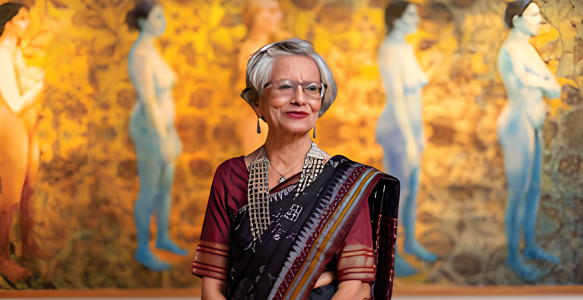
Nestled in a quiet lane of Delhi’s Mandi village is the modest studio of Anupam Sud. Sunlight slants through high windows onto shelves of inked metal plates and rough-hewn wooden blocks – tools of her chosen craft. Though petite in frame, Sud’s presence is commanding: she’s known as one of India’s foremost printmakers, a pioneer whose mastery of intaglio has made her a fixture of Indian contemporary art.
She spoke of art as an “ogre” you must master – a fitting image given the way each etching demands surrender of patience and control. In essence, Sud embodies her own history: the quiet strength of a young woman in 1960s India who insisted on her vision, stamp by stamp.
Anupam Sud’s biography is as understated as her prints. There’s no bold manifesto in her history – just a steadfast devotion to craft. She is above all an independent spirit. While many of her contemporaries chased bright colors or abstract forms, Sud stayed with the grayscale world of ink.
Quick Facts About Anupam Sud
- Date of Birth: 1944
- Place of Birth: Hoshiarpur, Punjab, India
- Education: Diploma in Painting, College of Art, Delhi (1962–67); Advanced Printmaking, Slade School, London (1971–72)
- Known For: Anupam Sud, the artist is know for pioneering intaglio printmaking and etching; expressive figurative prints exploring human relationships
- Parents: Father (bodybuilding enthusiast and theatre-lover) and Mother (classical music lover, reader of Upanishads) – both influenced her sensibility
- Spouse: – (Chose career over arranged marriage).
- Date of Death: – (As of 2026, she is alive and active).
Artistic Journey of Anupam Sud
1. Early Life Across Hoshiarpur, Shimla, and Delhi Shaping Her Art
Anupam Sud’s earliest years were split between Punjab’s plains and the foothills of Shimla. Born in Hoshiarpur in 1944, she grew up largely in the cool Shimla hills. Those mountain landscapes, and the cultural mix of her Punjabi family, quietly shaped her eye. Her father loved theatre and bodybuilding; her mother embraced music and spirituality. These contrasting influences – physical force and inner reflection – later surface in Sud’s celebrated figure paintings and print-based compositions. In 1960 her family settled in Delhi, where Sud enrolled in the Delhi Polytechnic (now College of Art) for painting. Under Jagmohan Chopra and Somnath Hore she discovered printmaking. By 1967, Sud became the youngest member of the new Group 8 collective of Delhi printmakers.
2. Impact of the Sino-Indian War on Her Early Practice
War and scarcity unexpectedly sped up Sud’s technical creativity. In the early 1960s, as she graduated art school, the Sino-Indian conflict broke out. Metals like zinc and copper (needed for etching plates) went “underground” – requisitioned for war efforts. With Chopra’s encouragement, Sud and classmates improvised. They turned to cardboard collagraphs, etching into mounting board and inking it much like metal plates. These makeshift experiments were a revelation – “quite titillating” she calls it.
3. Developing a Visual Language Through Chiaroscuro
Sud’s London sojourn further refined her visual vocabulary. At the Slade School (1971–72) she immersed herself in European print traditions, especially black-and-white intaglio. “If you go to France, they love colour. I was already working in colour, so in London I worked in black and white, their system of intaglio,” she explained. There she meticulously studied chiaroscuro masters, documenting every printing press and chemical to bring that knowledge back home, helped expand the visual language of modern Indian paintings and printmaking.
Anupam Sud’s Signature Style and Techniques
1. Mastery of Etching and Printmaking
At the core of Anupam Sud’s painting style is etching – a process she calls an “addiction”. It was a medium she once scorned for its mess (“hands and clothes stained black”), yet became her lifelong passion. Sud’s mastery lies in exploiting every nuance of the intaglio process. She works with fine needles and acids on zinc plates to incise images. Her prints bear textures that only etching can achieve – the rough grain of a block of wood, or the crystalline pattern of cracked earth. Sud experimented not only with etching but also sculptures, collagraphy, screen-printing and lithography.
2. Intaglio Techniques
Sud is best known for aquatint etching, a variant of intaglio that produces deep tonal fields. To achieve this, she dusts a metal plate with fine resin particles and lets acid bite around them, creating a mottled, film-like effect. This gives her backgrounds and shadows a dense, velvety appearance. Her figures then emerge from or sink into these tonal shadows, giving a sculptural feel.
Besides aquatint, Sud has used drypoint (scratching directly into the plate), collagraphy (adhering textured materials), and hand-applied watercolor in later prints. In recent years, the occasional Anupam Sud oil painting or charcoal drawing expanded her palette once physical etching became more strenuous.
3. Use of Texture and Tonal Depth
Texture is a signature of Sud’s work. Her prints are rich tapestries of crosshatching, stipple, and wash. For example, in one print a brick wall might be rendered with dense little dots; in another, shadows under a table are vast gradients. A worn stone floor implies hardship, a veil-like sky suggests uncertainty. Critic Gayatri Sinha wrote that Sud “always wanted [her] work to have many layers”, and indeed her imagery is multi-layered both technically and emotionally.
Tonal range is just as key: Sud often works in black and white, or slight sepia, reserving color for emphasis (e.g. a single red thread or ochre wall). As one observer notes, her etchings are made with zinc plates, a medium that gives “moody depictions… rich in tonality and shadows”. The result feels timeless and universal.
Famous Paintings by Anupam Sud
Among the most discussed examples of Anupam Sud’s famous artworks are Of Walls, the Dialogue Series, and the Mask Series, all of which demonstrate her mastery of narrative ambiguity.
1. Of Walls (1982)
A widely cited example is Of Walls, a 1982 etching on zinc. It depicts a lone woman sitting on a crumbling stone curb before a plastered wall. Strikingly, her face is a blank oval – a hole carved out. In the foreground lies a barefoot poor man, half-asleep on the pavement. The scene drips with melancholy: the absence of the woman’s face gives her an eerie anonymity and sadness.. Of Walls is often cited as a poignant commentary on urban life’s solitude.
2. Dialogue Series
Perhaps Sud’s most famous body of work is the Dialogue Series (late 1970s–80s). Each print shows two figures (man and woman, or two women, etc.) seated or standing together, rarely speaking. For example, one print shows a couple quietly facing each other with a coil of barbed wire between them in front of a ruined house. By omitting speech bubbles or overt action, Sud lets subtleties take charge: a downward glance, a turned shoulder.
3. The Mask Series
Masks appear repeatedly in Sud’s work as both literal objects and symbols. In her Mask Series, figures are shown wearing or holding ornate masks (inspired by Noh theatre, among other traditions). One memorable piece shows a nude woman tenderly clasping two Venetian masks (one orange, one yellow) against her chest. Sud explained that these masks “represent the different attitudes that we wear to cover our true selves”. This series is rich with cultural references: Sud collected masks from Asia and Africa, so each print is also a meditation on identity. The technique mixes etching with collage: raised textures on the plate make the mask designs pop in print.
4. Man-Woman Relationship Works
Beyond named series, many of Sud’s prints simply explore a couple’s dynamic. These untitled works usually depict a man and woman sharing a room or road, often sitting or facing the same direction. One such print shows a shirtless man reclining on a veranda while a woman sits on a chair beside him, both gazing forward but not at each other. These relationship prints have no clear narrative, but feel charged. In practice, these works often show power imbalances (the man might dominate space, while the woman appears passive), highlighting gender roles in Indian society.
5. Interiority and Psychological Space Series
A recurring motif is the interior space. In numerous prints, solitary figures are framed by doorways, windows, or empty rooms, as if peeking into their inner lives. One print, for instance, depicts a lone woman seated on the floor of a bare room, a barred window casting striped shadows. Without titles, these works function as scenes from a dream or novel: the setting is minimal, putting emotional emphasis on the figure. The psychological weight is palpable.
6. Seated Figures and Nude Studies
Anupam Sud frequently draws the human body in its simplest form. Seated nudes are a hallmark: sometimes a woman cross-legged on the ground, sometimes a man slouching on a divan. In Persona series works (one alternate name for some pieces), the figures lack hair, breasts, or elaborate background - they are almost androgynous “pan-human” forms. This stripping of detail forces attention on posture and gesture. Sud herself stated her preference: the nude body is the most basic form of creation, and by rendering it plainly she taps into universal vulnerability.
7. Urban Life and Isolation-Themed Prints
Many of Sud’s prints imply a cityscape or a rural frontier. Decaying buildings, empty streets and marketplace stalls often fill the periphery. A classic example is a print with a woman seated by a crumbling wall, mentioned earlier (Of Walls). Others show a figure passing under a shutter, or a couple outside a temple. Sud herself noted that upon returning from London she became “drawn to [India’s] everyday reality” and its socially marginalized people. In every case the cityscape is a character: the peeling paint, the empty chairs, even a scattering of objects, all emphasize isolation.
8. Intimate Encounters Series
Finally, Sud has explored closeness in what one might call intimate encounters. A handful of prints show couples very near each other – sharing a bed, looking into each other’s eyes – moments that border on tenderness. For instance, one print from the 1990s shows a man and woman lying side by side on a single cot; they do not embrace, yet their nearness is intimate and charged. Another portrays a figure holding an infant (her own Mother and Child series, less discussed but present). In them, her characteristic silence flips into a subtle conversation of bodies.
Major Themes in Anupam Sud’s Art
1. Gender Exploration and Sexuality
Anupam Sud’s works teem with questions about gender and sex, though never in an overt way. She is drawn to male and female sexuality simultaneously, yet portrays it almost clinically. Women appear nude or semi-clad, but rarely eroticized; men often occupy domestic or undefined spaces. The tension between them is where the interest lies. For instance, a common scene might show a woman steady and serene while the man in the image looks away – flipping the expected gaze. Critics note that Sud’s work has “feminist undertones” becoming more pronounced by the late 1970s. In some prints, a curtain or door section between a couple suggests societal barriers.
2. Emotional & Psychological Isolation
Loneliness is a constant companion in Sud’s work. Her figures are self-absorbed and brooding – often physically together, yet inwardly apart. In one scene, a couple shares a room, but each seems locked in his or her own thoughts. Sud herself works and lives alone in her Delhi studio, and that solitude permeates the art. The empty backgrounds, the blank eyes, the cropped faces – all these tropes point to internal worlds. Many have said her prints are like photographs of dreams or diaries: intensely personal and private. This theme of isolation, sometimes called the “Interiority Series” asks us to contemplate the inner life of each subject.
3. Feminist Narratives & Human Forms
Sud’s art is quietly feminist by context and choice. To start, her very presence mattered: in 1960s India, a woman insisting on an art career (against her family’s wishes) was a statement in itself. That influence surfaces in images: marriage and choice are addressed obliquely in works like Between Vows and Words, an exhibition title referring to Sud’s reflection on married life. Sud often said that her figures lack regional markers, making them pan-human. This universal treatment means a woman in Delhi or in Tokyo both tell the same story of autonomy or constraint. She also omits detail: many nudes lack hair or identifying features, suggesting that societal labels don’t define them. In essence, her feminist message is subtle: women are at the center of her compositions and carry silent agency.
FAQs About Anupam Sud
Who is Anupam Sud?
Anupam Sud is an Indian contemporary artist and printmaker known for her influential contributions to modern Indian printmaking.
What art style is Anupam Sud known for?
Anupam Sud is known for figurative and expressionistic artworks that explore human relationships, identity, and emotion.
What materials does Anupam Sud use?
She works primarily with etching, collagraphy, lithography, painting, charcoal, and other printmaking techniques.
What awards has Anupam Sud received?
Anupam Sud has received numerous honours, including awards from the Lalit Kala Akademi and the Asia Arts Vanguard Award.
Why is Anupam Sud important in Indian art?
Anupam Sud is regarded as a pioneer of modern Indian printmaking and an influential voice in contemporary figurative art.
