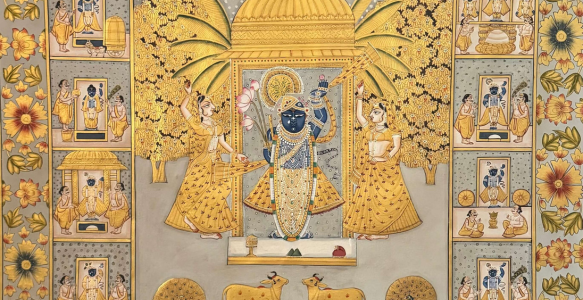
What is a Pichwai Painting?
A Pichwai painting is a traditional Indian devotional artwork, historically created as a cloth backdrop for the idol of Shrinathji in Nathdwara, Rajasthan. Rooted in ritual and storytelling, it blends sacred imagery with intricate craftsmanship to transform space into an act of worship.
In the twilight-lit sanctum of Nathdwara, a monumental cloth Pichwai hangs behind the idol of Shrinathji, its lotus medallions blazing like constellations and stories swirling in gold. For collectors, the allure is immediate - here, what is pichwai painting truly means inheriting cultural time, devotional intent, and the crafting of epic atmospheres. The surface shimmers, but wait look closer. One can almost smell the marigolds, feel the texture of handspun cotton, sense the weight of centuries. The appeal, especially for Indian and global collectors, lies in Pichwai’s ability to animate a space with ritual color and mythic resonance.
ArtFlute’s curated selection of pichwai paintings brings forth living tradition. These artists interpret what is Pichwai art as both relic and renewal. Under our curatorial lens, each canvas positions you in the studio - where pigment is measured not only by hue, but by faith and cultural significance.
Discover why contemporary and master Pichwai artists in the ArtFlute collection reinterpret centuries-old themes with innovative detail, authentic provenance, and impact.
History of Pichwai Paintings
1. Origin in Nathdwara, Rajasthan
Pichwai art’s history begins in 17th-century Nathdwara, where painted textiles became sacred backdrops for temple ritual and devotion.. Pichwai paintings' origins here are inseparable from the spiritual, as cloth replaces wall frescoes during the hot season. The earliest Pichwai art origin stories cite local artisans-sometimes generations in the same family-painting scenes of Shrinathji’s festivals. Noted historian Dr. B. N. Goswamy recounts a 1739 royal commission, where the intricacy of Pichwai was offered instead of jewels-a testament to its cultural value.
2. Evolution Over the Centuries
Pichwai painting history follows the migrations of artists displaced by wars and the changing patronage of Vaishnav collectors. During British Raj and afterwards, many Pichwai workshops innovated with imported pigments and European influences, yet retained the signature blend of miniature style and sumptuous scale. In one exhibition at the CSMVS Museum, a curator noticed subtle shifts-more abundant use of turquoise, more gestural lines-art evolving under collector eyes.
3. Influence of Rajasthani & Mughal Art
Pichwai art’s origin story is incomplete without acknowledging how Mughal and Rajput miniature traditions feed into traditional Nathdwara composition. Scholars like Milo Cleveland Beach contrast the vivid gold in Mughal manuscripts with Pichwai’s bold, devotional palette. Overseas exhibitions at The Met and Sotheby’s have drawn parallels, noting how competitive patronage elevated detail and opulence across both genres.
4. Cultural Significance of Pichwai Art
Pichwai paintings-once seen only during temple festivals-are now global. Contemporary collectors, including NRIs at Saffronart’s landmark auctions, appreciate not just the devotional cues, but also the visual drama and narrative clarity. In private homes, these works become immersive vignettes-each lotus, cow, and flute a recall of collective memory.
Together, the history, symbolism, and evolving techniques form a living continuum that defines the enduring legacy of the Pichwai art form.
Key Characteristics of Pichwai Art
Over time, distinct types of Pichwai paintings have emerged, from festival-specific compositions like Annakut and Sharad Purnima to seasonal, narrative, and ceremonial depictions, each shaped by ritual purpose and patronage.
1. Themes Around Shrinathji
Shrinathji, the child Krishna, stands as the heart and muse. Pichwai paintings orbit around his festivals, each a minutely articulated drama. The recurring appearance of night lotuses, cows, festival processions-these are not mere decoration, but visual prayers. Jennifer Howes, in Art India Magazine, describes how motif placement reflects ritual chronology.
2. Use of Symbolism
Symbolic language abounds: the lotus representing spiritual birth, the cow for abundance, flutes for divine play. Collectors note, in the best examples, an encrypted quality-the gentle nods, gestures, veiled layers.
3. Detailed Ornamentation & Miniature Style
Technique sets Pichwai apart. Compare a Nathdwara cloth panel from 1821 (CSMVS Museum) with a contemporary Kuldeepak Soni work: both ripple with fine brushwork, miniature-inspired rendering, and relief-like gold ornament. At ArtFlute, artists merge tradition with surprising scale, striking a balance between intimacy and grandeur.
4. Use of Natural Colors & Traditional Materials
Museums and collector guides (Tate, Lalit Kala Akademi) point out how original Pichwai art techniques relied on herbal and mineral pigments-turmeric, indigo, silver leaf. These legacy methods signal authenticity and durability, sought after by those who value rarity.
Collectors often share stories of placement - Pichwai above mantlepieces, in home shrines, displayed as art-history anchors. The visual and spiritual impact, documented in collection visits, enlivens spaces beyond mere decor.
Pichwai Art Techniques and Materials Used
1. Traditional Methods
Initially, Pichwai artists crafted their pigments from minerals, stones, and organic sources-lapis for blue, gold leaf for highlights. Techniques included layering with watery gum Arabic, fine miniaturist brushes, and resisted areas for intricate patterning. A 2019 NGMA workshop revealed that some master artisans still mix paints before dawn to preserve color luminosity.
2. Modern Techniques
A steady migration has occurred. Today, certain artists deploy imported acrylics for vibrancy, and even digital prints for studies-though masterworks are resolutely handmade. Collectors must distinguish genuine hand-painted works from prints, with assistance from provenance sheets and signed artist certificates.
3. Key Themes and Motifs
Across centuries and innovations, key themes persist: Krishna’s rituals, seasonal festivals, processions, and episodes from the Bhagavata Purana. Global exhibitions at MoMA and Tate juxtapose Pichwai with Persian and East Asian narrative panels, illuminating shared and divergent visual vocabularies.
Collectors weigh technical virtuosity and authenticity above surface beauty. What endures is the integrity of the process, from the first brushmark to the final signing.
Pichwai Painting Guide FAQs
Who Invented Pichwai Paintings?
Pichwai paintings were not created by a single artist but evolved in 17th-century Nathdwara through hereditary painter families serving the Shrinathji temple. The tradition grew through collective devotion, passed down via the guru–shishya lineage rather than individual authorship.
2. Where did Pichwai paintings originate?
Pichwai paintings originated in Nathdwara, Rajasthan, where painted cloths were used as sacred backdrops for temple rituals. Their form evolved to suit seasonal worship, replacing permanent frescoes with portable, narrative artworks.
3. How does Pichwai art relate to Krishna?
Pichwai art centers on Shrinathji, the child form of Krishna, depicting his daily rituals, festivals, and divine play. Each painting acts as a visual offering, aligning art, devotion, and seasonal worship into a single sacred narrative.
4. Which cloth is used for Pichwai painting?
Traditionally, Pichwai paintings are created on hand-prepared cotton cloth coated with natural primers. Contemporary artists may also use silk or canvas, but the essence lies in the layered pigments and meticulous handwork rather than the surface alone.
5. Who is the most famous Pichwai artist in India?
Pichwai has been shaped by generations of master artists rather than one figure. Renowned names include B.G. Sharma, Rajaram Sharma, Kalyanmal Sahu, and contemporary artists like Raghunandan Sharma and Kuldeepak Soni, whose works are exhibited internationally and collected by major institutions.
6. What is the meaning of Pichwai painting?
“Pichwai” means “that which hangs behind,” referring to the painted backdrops placed behind temple idols. Beyond function, it signifies devotional storytelling - art created to honour the divine and transform space into a site of reverence. Pichwai paintings are anchors of belief and imagination. For collectors, each acquisition is an immersion in cultural and artistic memory, and platforms like ArtFlute make it possible to buy paintings online while staying close to authentic Nathdwara traditions.
