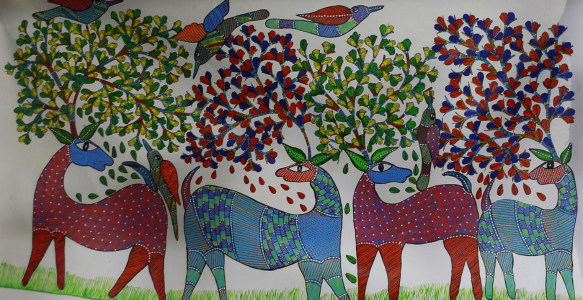
What Is Gond Painting?
To ask what is a Gond painting is to understand painting not as ornament, but as action. Gond painting, in its most elemental form, is storytelling through pattern and color. The art form emerges from the lived experience of the Gond tribe - their hunting grounds, their rituals, their mythologies, their intimacy with the forest.
What distinguishes this art from other folk traditions is not merely its aesthetic signature, though the delicate interplay of dots and lines is unmistakable. Rather, it's the philosophy embedded in every image: that seeing a good image brings good luck, that art is not decoration but protection, not luxury but necessity. In this sense, what is Gond art painting if not a visual system designed to safeguard life itself?
Traditionally created on the walls and floors of mud homes, Gond painting functions as a visual invocation - a way of inviting prosperity and warding off harm. The Gond tribe has historically been composed of farmers, hunters, and Pardhans - storytellers and singers who preserved tribal memory through oral tradition and music. What the Pardhan sang, the painter rendered in visual form. This symbiosis between voice and image explains why contemporary Gond paintings, even those on canvas in urban galleries, feel narrative-driven and ceremonial.
Origin and History of Gond Painting
1. Gond Tribe and Their Cultural Background
Any serious gond art information must begin with the people themselves. The Gond are one of India's largest tribal communities, with a population of approximately 12 million people. The word "Gond" derives from the Dravidian word Kond, meaning "green mountain" - a fitting etymology for a people whose entire culture has been shaped by forest and hill terrain. They inhabit the central Indian plateau, with the highest concentration in Madhya Pradesh's forested districts, though significant populations exist in Chhattisgarh, Maharashtra, Andhra Pradesh, and Odisha.
The tribe's recorded history stretches back to the 14th century, when Gond kingdoms established substantial rule across central India, renowned for their expertise in agriculture, hunting, and warfare. Yet the gond art origin extends much further into myth and practice. According to Gond belief, Lord Shiva created the Gonds, bestowing upon them their distinctive language, Gondi, and their cultural traditions. Whether mythological or historical, this narrative underscores something essential: Gond identity has always been inseparable from spirituality and an animistic worldview where gods inhabit mountains, forests, water, and air.
The tribe's relationship with their environment is not sentimental but existential. They live in dense forests, move with the seasons, depend on hunting and cultivation, celebrate harvests with music and dance. Their festivals - Diwali, Karva Chauth, Nag Panchami, births, marriages - are occasions not merely for joy but for ritual reaffirmation of kinship with nature and ancestors. Art, in this context, was always functional: a way to mark sacred time, to invite good fortune, to make the invisible visible.
2. How Gond Art Started as a Folk Tradition
The history of Gond art, lies in two traditional forms that remain foundational today: digna and bhittichitra.
Digna consists of geometric patterns - circles, triangles, dots, elaborate interlocking designs - applied to the floors and walls of Gond homes, typically by women. These patterns are made using a paste of lime and chalk, materials both humble and deliberately chosen. The circular and repeated motifs echo the Gond creation story, mirroring the mud that Bada Dev (the supreme creator) spread across water to birth the earth, along with all its trees, animals, and people. To paint digna is to reenact, in miniature, an act of cosmic creation.
Bhittichitra, painted on the walls of homes, depict animals, plants, trees, and mythological narratives. These are more figurative than digna, though equally ornate and detailed. Traditional bhittichitra used natural pigments - charcoal, colored soil, plant sap, cow dung, minerals like turmeric and indigo - mixed with water or gum to create a palette that was intimately connected to the surrounding landscape. Red came from hibiscus flowers, yellow from local gravel. The act of gathering, grinding, and mixing these materials was itself a form of knowledge, linking the artist to her environment.
For centuries, these art forms existed within the domestic sphere, created during festivals and rituals, evolving through oral transmission from mother to daughter. They were ephemeral by nature - painted on mud walls that weathered with rain and season, on floors that were swept and repainted. This impermanence was part of their function: Gond art was never meant to be preserved as museum objects. It existed in time, embedded in ritual, renewed annually or as occasion demanded. The tradition was alive precisely because it wasn't frozen.
3. Evolution of Gond Art into a Contemporary Art Form
The transition from folk practice to contemporary recognition marks a decisive chapter in gond art history. This shift is inseparable from Jangarh Singh Shyam. Born in 1962 in Patangarh village, in the Dindori district of Madhya Pradesh, Jangarh was a child of poverty and forest. He grazed buffaloes for income and would draw on their backs with charcoal while they grazed - the animals becoming his first canvas, their movement, his first audience of villagers.
In 1981, when Jangarh was seventeen years old, he drew an image of Lord Hanuman on the mud walls of his home. That same year, artist and curator Jagdish Swaminathan, who was establishing Bharat Bhavan - a landmark institution dedicated to tribal and contemporary Indian art in Bhopal - discovered Jangarh's work. Swaminathan saw not a folk artist locked in tradition, but a visionary voice. He offered Jangarh work at Bharat Bhavan and, critically, he introduced him to acrylic paints and canvas - new materials that would allow the art form to exist in new spaces without losing its soul.
This moment was revolutionary because Jangarh didn't abandon the visual language of Gond tradition. Instead, he transposed it: the dots, dashes, and dense linework that had lived on mud walls now lived on white canvas. The storytelling remained intact. The spiritual intention endured. What changed was the permanence, the reach, and the audience. By February 1982, Jangarh's work was exhibited at Bharat Bhavan's inaugural exhibition - a turning point from which there was no return.
The impact was swift and remarkable. Jangarh received the Shilpguru Award, India's highest honor for traditional artisans, at just twenty-six years old. His work traveled to Paris, Tokyo, New York, Delhi. In 1988, his painting Landscape with Spider was auctioned at Sotheby's in New York for $31,250 - a watershed moment, as it was the first work by an Adivasi artist to achieve such commercial recognition. Tragically, Jangarh died in 2001 at age thirty-nine, but by then, the path was irreversible. He had not invented contemporary Gond art; he had revealed it as always existing, waiting only for a stage.
In his wake came a cohort of artists from Patangarh and beyond - his family members, apprentices, and peers. Bhajju Shyam, born in 1971, apprenticed under Jangarh and emerged as a major voice in his own right. His illustrated book The London Jungle Book (2004), a visual travelogue of his visit to London filtered through a Gond sensibility, sold over 100,000 copies and won international acclaim. In 2018, Bhajju became the first Gond artist to receive the Padma Shri, one of India's highest civilian honors. Artists like Rajender Shyam, Venkat Raman Singh Shyam, and Japani Shyam each developed distinct voices while remaining rooted in Jangarh's foundational achievement.
This shift also explains why Gond now sits confidently alongside contemporary art paintings, without losing the ritual intelligence that formed it. The evolution of Gond art into a contemporary form represents something more complex than "modernization." It's a case of materials and spaces shifting, but cultural intention remaining constant. Contemporary Gond artists paint not to abandon tradition but to extend it - addressing climate change, deforestation, migration, urbanization, and social injustice with the same visual grammar their ancestors used for mythology and daily life. The form proved flexible enough to absorb the contemporary world without losing its roots. That flexibility is itself a kind of tradition.
Key Characteristics of Gond Painting Art Style
To understand gond art features, one must look beyond surface beauty to structural intent.
1. Use of Dots, Lines, and Patterns
Perhaps the most immediately recognizable feature of Gond art is its distinctive use of dots, dashes, lines, and geometric patterns. These are not decorative flourishes added after the primary forms are rendered. Rather, they are the primary means of creating texture, depth, and visual rhythm.
In a typical Gond painting, a deer, for instance, is not outlined and then filled with uniform color. Instead, the artist builds the animal through layers of pattern: concentric circles for the body, radiating lines for the legs, fine dashes for fur texture. A tree might be rendered through tight parallel lines, while a snake could be suggested through interlocking S-curves. These patterns serve dual functions - they're simultaneously decorative and symbolic. Closely packed straight lines might represent plowed fields; S-shaped curves suggest flowing water; a cluster of dots might evoke raindrops or seeds. The boundaries between representation and abstraction blur deliberately.
What's striking about these patterns is their precision and the physical discipline they require. Gond artists traditionally work with fine brushes or even fingers, applying pigment in controlled, repetitive gestures. The result feels both meditative and meticulous - each dot placed with intention. When this technique appears on canvas or paper in contemporary works, the scale and visibility increase, but the philosophy remains: fill no empty space; treat every inch as an opportunity for narrative detail.
2. Vibrant Colors and Natural Pigments
Gond art commands attention through color. The palette is bold, with particular affinity for reds, yellows, blues, and greens - colors drawn traditionally from the natural world surrounding the Gond communities. Red derived from hibiscus flowers or mineral ochre; yellow from local gravel or turmeric; blue from indigo; black from charcoal. The preparation of these pigments was labor-intensive knowledge - understanding which plants yielded which hues, how to harvest and grind them, how to bind them with water or gum for application.
This connection between pigment and place mattered philosophically. A Gond artist wasn't simply "using red paint"; she was using a red made from her environment, making the artwork inseparable from the landscape it depicted. When contemporary artists transitioned to acrylic paints and watercolors, something was gained in vibrancy and permanence, but something was also lost in that immediate, tactile relationship to place.youtube
Interestingly, many contemporary Gond artists remain aware of this tension. Some continue to experiment with traditional pigments alongside modern materials, creating hybrid works that honor both idioms. Others have embraced acrylics while maintaining the visual sensibility of traditional color relationships. The choice reflects a broader truth about Gond art: it's pragmatic, adaptive, willing to evolve materials while preserving values.
3. Storytelling Through Visual Symbols
Every element in a Gond painting carries narrative weight. This is perhaps the deepest characteristic, and what distinguishes Gond art from purely decorative traditions.
In Gond cosmology, certain animals carry specific spiritual significance. A deer represents grace and vulnerability; a snake, transformation and wisdom; a bird, communication between earthly and divine realms. Similarly, celestial bodies, geometric shapes, and plant forms all carry meaning rooted in Gond mythology and daily experience. An artist doesn't paint randomly but selects motifs that convey layered stories - personal, communal, spiritual.
Consider the Tree of Life, one of the most recurring motifs in Gond art. The tree is simultaneously a literal representation of the forest landscape, a symbol of sustenance and shelter, a spiritual axis connecting earth to sky, and in some interpretations, a genealogical marker representing family lineage. A single painted tree might tell multiple stories at once, legible to different viewers at different depths of cultural knowledge. This narrative density is what makes Gond paintings feel so populated despite often depicting simple subjects.
Contemporary Gond artists extend this symbolic vocabulary to include new symbols born from modern experience. Cars, airplanes, motorcycles, and even political symbols appear in recent works - not as departures from tradition but as expansions of it. The same storytelling instinct that rendered hunting scenes now renders scenes of migration, urbanization, and environmental crisis. The visual language remains Gond; the stories it tells have widened.
4. Absence of Empty Spaces
In Gond paintings, there is no concept of "negative space" in the Western compositional sense. Every area of the surface is activated - filled with pattern, color, or layered detail. This is sometimes called horror vacui (fear of emptiness), but that framing misses the point. The absence of empty space is not anxious but intentional: it reflects a worldview in which the universe is full, interconnected, abundant. Every atom of creation carries meaning.
This principle emerged from the tradition of painting on limited surfaces - mud walls and floors - where efficiency and maximum symbolic density were practical necessities. When this sensibility transfers to contemporary large-scale canvases, it creates a visual experience that feels simultaneously intimate (every detail rewards close looking) and overwhelming (the abundance of information, the refusal of rest). For collectors and viewers encountering Gond art for the first time, this density can feel overwhelming. But it's also what makes these paintings so visually compelling - they reward the kind of extended attention that feels increasingly rare.
That abundance is also why many collectors gravitate to Gond as living room paintings, the work holds attention.
Types of Gond Art
1. Traditional Gond Art
Traditional Gond art exists primarily as digna and bhittichitra - the wall and floor paintings that have been part of Gond domestic life for centuries. These continue to be practiced in villages, particularly by women, as part of seasonal rituals and festival celebrations.
Digna, the geometric floor paintings, are created with a lime-and-chalk paste and typically feature interlocking circular and angular patterns. The scale is intimate - usually contained within a courtyard or interior space. The practice is knowledge-intensive; the patterns are not freehand but guided by tradition, each generation learning from observation and practice. The impermanence of digna is essential to its meaning: these paintings are meant to be renewed, to mark time's passage, to be replaced seasonally with fresh designs.
Bhittichitra is more figurative and narrative. Painted on exterior and interior walls, these works depict animals, deities, scenes from folklore, and representations of daily life. The materials - mud, clay, natural pigments - bond with the wall surface itself, becoming part of the architecture rather than something applied to it. Over time, bhittichitra weather, fade, and erode, returning to the earth they emerged from. This cyclical impermanence was never a limitation but an inherent feature of the tradition.
The Gond believe that creating these images - whether digna or bhittichitra - invites blessings and good fortune. The art is functional in the most profound sense: it mediates between the material and spiritual worlds, makes the home a sacred space, protects and sanctifies the family dwelling.
2. Contemporary Gond Paintings
Contemporary Gond painting emerged when Jangarh Singh Shyam and subsequent artists began transposing the visual language of digna and bhittichitra onto paper and canvas using modern materials - acrylic paints, watercolors, sometimes ink.
The visual characteristics remain recognizably Gond - the dots, lines, dense patterning, vibrant colors, narrative density. But the context and scale have transformed. These works are created for exhibition, sale, and preservation. They exist in art galleries, museums, auction houses, and private collections worldwide. The permanence of paint on canvas means that a contemporary Gond work created in 1995 looks essentially the same today as it did thirty years ago - unlike a bhittichitra, which has evolved through weather and time.
Contemporary Gond artists have also begun to expand subject matter and technique. Where traditional art focused on animals, plants, deities, and village life, contemporary works engage with modern experiences: urban landscapes, political events, climate change, social movements. Some artists experiment with mixed media, layering collage with paint; others explore abstraction, pushing the geometric and patterned nature of Gond aesthetics toward pure form. Venkat Raman Singh Shyam, for instance, has created works addressing the 2008 Mumbai terror attacks and has explored animation as a medium for Gond visual language.
This expansion hasn't displaced traditional practice. Women in Gond villages continue to paint digna; bhittichitra still adorns house walls. But there's now a parallel ecosystem - contemporary Gond art as a recognized art historical movement, with market value, institutional recognition, and global audience.
Common Themes in Gond Paintings
For viewers drawn to indian mythology painting, Gond offers familiar deities, yet the worldview remains distinctly Gond, rooted in forest cosmology.
1. Nature and Wildlife
The forest is the Gond universe. Consequently, animals, plants, trees, and landscapes dominate Gond painting. These representations are not naturalistic in the Western sense - the animals aren't rendered with anatomical precision. Rather, they're stylized, exaggerated, imbued with spiritual or symbolic resonance. A deer appears graceful and vulnerable; a tiger, powerful and dangerous; birds, as messengers between worlds.
Trees hold particular significance. The Tree of Life - rendered with interlocking branches, dense foliage, often inhabited by animals - appears in countless works. Trees represent sustenance, shelter, lineage, spiritual ascendance. In contemporary Gond art, trees have become symbols of environmental concern as well, appearing in works addressing deforestation and ecological loss.
Landscapes are rarely depicted as empty vistas; they're populated, animated, filled with narrative elements. A forest is never just a forest but a place where gods dwell, where stories unfold, where human and animal lives intertwine.
2. Mythology and Folk Tales
Gond mythology draws heavily from Hindu traditions - figures like Hanuman, Shiva, Ganesha appear frequently. But there are also distinctly Gond mythological narratives and folk tales that reflect the tribe's specific experiences. Stories of creation, of the relationships between gods and nature, of local heroes and ancestral figures populate Gond art.
These aren't illustrative in a straightforward sense. A painting of Hanuman, for instance, isn't simply depicting the deity as a figure. The image might encode stories about courage, about the relationship between humans and divine forces, about spiritual transformation. The familiar symbolic vocabulary - weapons, poses, celestial markers - communicates across cultures, but the specific interpretation carries Gond cultural specificity.
Contemporary artists continue to draw on mythological material, but often with reinterpretation. Modern Gond art might reference traditional mythology while simultaneously commenting on contemporary social or environmental issues, layering historical and present-day narratives.
3. Daily Life and Tribal Beliefs
Hunting scenes, harvests, village celebrations, rituals - these domestic narratives form a substantial portion of Gond art. The paintings serve as visual ethnography, documenting the rhythms and practices of Gond life: how they work, what they eat, how they celebrate, what they fear, what they value.
Underlying these depictions are core Gond beliefs about the relationship between humans and nature, the importance of community, the presence of divine forces in the everyday world. Tribal beliefs are not presented as quaint or exotic but as the foundational logic by which existence is organized. A harvest isn't just a practical achievement; it's a moment of cosmic alignment, worthy of ritual and artistic commemoration.
This theme has expanded in contemporary practice. Modern Gond artists paint scenes of migration, wage labor, urbanization, and social displacement - the daily life of Gond communities navigating a rapidly changing world. The sensibility remains the same: bearing witness, documenting, honoring the experiences and struggles of their people.
Together, they form a comprehensive body of information about Gond art as lived philosophy rather than aesthetic category.
FAQs About Gond Art Information
1. What do you mean by Gond art?
Gond art is the tribal painting tradition of the Gond people, an Indigenous community primarily from Madhya Pradesh in central India. It encompasses both traditional forms - geometric floor and wall paintings called digna and bhittichitra - and contemporary works on canvas and paper. The art is characterized by intricate patterns of dots and lines, vibrant colors, and narratives drawn from nature, mythology, and daily tribal life. Historically created as part of domestic rituals to invite good fortune and protection, Gond art has evolved into a recognized contemporary art movement with global reach.
2. What makes Gond art painting unique?
The uniqueness of Gond art lies in its combination of visual distinctiveness and cultural intention. Visually, it's defined by meticulous dot-and-line patterns that create texture and depth, vibrant colors sourced traditionally from natural pigments, and an absence of empty space - every area of the painting is activated with meaning. Culturally, Gond art represents a worldview in which images are not decorative but functional: they protect, they tell stories, they mediate between material and spiritual worlds. The art form also demonstrates remarkable adaptability, evolving from mud walls to contemporary galleries while maintaining its essential visual and philosophical character.
3. Which color is used in Gond art?
Gond art employs a vibrant, bold color palette. Traditionally, artists used natural pigments derived from their environment: red from hibiscus flowers or mineral ochre; yellow from gravel or turmeric; blue from indigo; black from charcoal; green from plant matter. These natural pigments were mixed with water or gum to create paint. In contemporary practice, artists often use acrylic paints and watercolors, which offer broader color ranges and greater permanence, though some artists continue to honor traditional pigment-making practices. The colors are characteristically bright and striking, never muted, reflecting the vibrancy of the forest landscape.
4. Who is the most famous Gond painting artist?
Jangarh Singh Shyam (1962–2001) is considered the foundational figure in contemporary Gond art, the artist who transposed the tradition from village walls to canvas and acrylic, thereby launching what is now known as Jangarh Kalam. His work achieved international recognition during his lifetime and set the stage for subsequent Gond artists. Bhajju Shyam, his apprentice and relative, is arguably the most celebrated living Gond artist. Bhajju's illustrated book The London Jungle Book achieved global recognition and won multiple international awards. In 2018, Bhajju became the first Gond artist to receive India's Padma Shri award, one of the nation's highest civilian honors. Both artists exemplify how Gond art has moved from obscurity to international prominence.
5. Which state is famous for Gond painting?
Madhya Pradesh is the primary and most famous location for Gond painting and the Gond community. The state contains the historical heartland of Gond culture, with villages like Patangarh becoming iconic centers of contemporary Gond art. However, Gond communities and Gond art traditions are also found in significant numbers in Chhattisgarh, Maharashtra, Andhra Pradesh, and Odisha. Of these, Madhya Pradesh remains culturally and artistically dominant, and it's the state where the contemporary Gond art movement was catalyzed.
