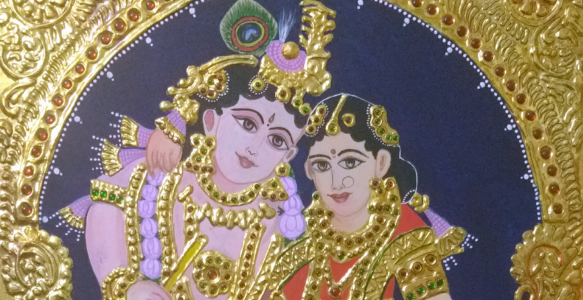
Tanjore Painting: History, Meaning, Styles and Famous Artworks
What are Tanjore (Thanjavur) Paintings?
Picture this: a Tanjore painting catches afternoon light. The gold foil - 22-carat, embedded into raised gesso - seems to breathe. The deity's ornaments gleam. Semi-precious stones (rubies, sapphires, emeralds) inlaid into the embossed work reflect your gaze back at you with an intimacy that photographs cannot capture. This is what Tanjore painting means in lived experience.
What distinguishes Tanjore works (also called Thanjavur paintings is how they unite material luxury with spiritual intention. The gold isn’t merely decorative here; it’s meant to stand in for divine radiance itself.
For readers looking for information about Tanjore painting, think of it as a sacred image-making tradition where gold, relief, and iconography combine to create a portable shrine. Originating from the temple city of Thanjavur inTamil Nadu, this classical art form represents a synthesis of South Indian temple aesthetics, court culture, and spiritual practice. The paintings are mounted on cotton cloth stretched across wooden boards and often depict Hindu deities, saints, and mythological narratives and are part of India’s broader lineage of handmade Indian paintings (link to https://www.artflute.com/artworks/originals) that translate spiritual iconography into enduring visual form..
But here's what arrests the uninitiated collector: the three-dimensional quality. Unlike most Indian painting traditions, a genuine Tanjore painting is almost sculptural. The core Tanjore painting techniques begin with mounting cotton cloth on a wooden board, then building relief using gesso (traditionally lime + tamarind seed paste). Once the raised areas are shaped, 22-carat gold foil is applied and burnished, and stones or glass beads are set into the adhesive. Finally, vivid pigments define the deity’s face, clothing, and surrounding narrative elements, sealing the work into a luminous, shrine-like presence.
What does encountering a Tanjore painting genuinely require of us? Presence. Patience. A willingness to sit with something that glows.
History and Origin of Tanjore Painting
To understand the Tanjore painting origin, you have to look at the long arc from Chola temple murals to Nayaka and Maratha court patronage.
1. Birth of Tanjore Painting in South India
The history of Tanjore painting begins not in the 17th century, when the art form took its recognizable shape, but centuries earlier, in temple walls. The Brihadeeswarar Temple in Thanjavur, built by Chola king Rajaraja I around 1010 CE, contains wall paintings that established the visual vocabulary of what would become Tanjore painting: the frontal deity, the hierarchical composition, the obsessive attention to divine majesty and ornamental detail.
The actual Tanjore painting style emerged later, during the Nayaka period of the 16th and 17th centuries, when Thanjavur was governed by feudatory chieftains under the Vijayanagara Empire. The Vijayanagara period (particularly under Krishnadevaraya, 1509-1529) fostered unprecedented artistic patronage. Nayaka rulers invited master craftsmen to their courts, encouraging innovations in sculpture, fresco work, and portable devotional objects. It was during this era that artists began translating the grand temple aesthetic onto movable cloth-mounted boards - a pragmatic shift that would allow sacred imagery to reach homes, courts, and smaller temples across South India.
Around the 16th century, the oldest Tanjore painting traditions emerged when artists combined Chola temple aesthetics with Nayaka court culture and a revolutionary material innovation. They discovered that gesso - a mixture of lime, tamarind seed powder, and adhesive - could be raised into relief, creating a three-dimensional surface on cloth. Gold foil adhered to this relief. Precious stones were inlaid. An invention born from necessity, experimentation, and genius.
Why does this matter? Because it shows how Tanjore painting of Tamil Nadu represents a dynamic response to specific cultural and spiritual demands of its moment.
2. Role of the Chola and Maratha Dynasties
The Cholas gave Tanjore painting its soul. The medieval Chola dynasty (particularly the later Cholas of the 11th-13th centuries) established the devotional intensity that permeates the tradition. Their monumental temple murals - inside the Brihadeeswarar Temple and other great Chola sanctuaries - created a visual language that said: the divine is majestic. The divine is ornate. The divine demands our complete attention. Chola artists understood that spiritual experience is, in part, a sensory experience. Color, material, light - these aren't secondary. When Nayaka-period painters encountered these ancient frescoes, they inherited a worldview.
Then came 1676 CE. Ekoji, the Maratha ruler and half-brother of Chatrapati Shivaji, seized Thanjavur from the Bijapur Sultanate and established the Maratha dominion. This was transformative.
The Marathas were patrons and aesthetic revolutionaries. Under their rule - particularly during Maharaja Serfoji II (1777-1832), one of history's most unusual rulers (simultaneously warrior, scholar, scientist, and art visionary) - the Tanjore painting tradition achieved its zenith. Serfoji II deliberately elevated the art form. He brought artisans from the Deccan sultanates who possessed techniques for gesso work, gold foil application, and precious stone inlay.
The gold foil application, once understated, became expansive and dominant. The gesso relief grew higher, more dramatic. Precious stone inlays multiplied. The color palette intensified. Paintings commissioned during Serfoji II's reign - including his own iconic durbar portrait - exemplified this opulent synthesis. They adorned palace walls and prestigious temples. They established Tanjore painting as the supreme expression of South Indian artistic ambition.
What transformed Tanjore painting was not just a new dynasty, but a new philosophy of beauty: opulence as spirituality, material luxury as devotional offering.
3. Evolution of Tanjore Painting Over the Years
The Tanjore painting history didn't end with Maratha rule. In fact, the evolution continued in unexpected directions.
By the early 19th century, as English East India Company influence permeated South India, a hybrid style emerged. English collectors wanted paintings depicting Indian subjects - festivals, ceremonies, occupations, flora - rendered in a manner appealing to European sensibilities. Tanjore incorporated Western compositional techniques: perspective, naturalistic representation, chiaroscuro effects. They painted secular subjects: Indian women at their toilet, festivals, botanical specimens. These "Company style" Tanjore paintings maintained the gold foil and the technical virtuosity but abandoned pure religious devotionalism.
After colonial rule retreated, regional merchant communities became the tradition's custodians. The Chettiar merchants of Thanjavur, particularly devoted to Shaivite practice, commissioned works depicting Lord Shiva and related themes. This regional patronage sustained the tradition through decades when many indigenous arts faced institutional collapse. Through the 20th century - even into the 21st - the form evolved again: glass painting variations emerged; synthetic materials supplemented traditional ingredients; contemporary artists experimented with secular subjects and modern iconography while preserving the essential technique.
Yet something essential persisted: the understanding that material and spirit are not opposites. This understanding has remained constant even as contexts shifted, patrons changed, and materials evolved.
Themes and Subjects of Tanjore Paintings
1. Hindu Gods and Goddesses
- Lord Krishna dominates Tanjore painting as Bala Krishna, the divine child, often playing his celestial flute, embodying beauty, play, and divine love. These krishna art paintings carry an intimacy. The viewer feels invited into Krishna's cosmic play, his leela. The artist renders him with dark blue skin (symbolizing cosmic infinity), adorned with peacock feathers, necklaces, and jewels. In several works, Krishna appears alongside Radha, representing divine love and spiritual union—a motif that also defines many classical radha and krishna paintings across Indian art traditions.
- Lord Shiva appears in varied iconographic forms. Sometimes, as the ascetic meditating in cosmic transcendence, matted hair, third eye, crescent moon adorning his brow, ash-smeared body. Sometimes, as Nataraja, the cosmic dancer whose movements create and destroy universes. Sometimes, as the householder with Parvati, suggesting that divine reality includes domestic intimacy. Sometimes, as Mahakaleshwara, the figure that transcends death itself. Each representation carries theological depth.
- Goddess Lakshmi - seated on her lotus throne, adorned with golden raiment, surrounded by elephants spraying her with water, representing the bestowal of blessing, prosperity, grace. The artist renders her with serene majesty.
- Goddess Saraswati, the veena in her hands, symbolizing knowledge and the arts. Her white form suggests purity; her seated posture suggests contemplative wisdom.
- Lord Ganesha with his elephant head and curved trunk - remover of obstacles, auspicious beginning.
- Lord Rama with Sita, Lakshmana, and the devoted Hanuman - representing the triumph of dharma.
- Goddess Durga vanquishing Mahishasura, the buffalo demon, representing the victory of good over evil.
- Lord Murugan, the six-headed deity of South Indian devotion, is particularly favored in Tamil Shaivism.
Many of these devotional themes, especially Krishna-centric compositions, also appear across curated collections of radha and krishna paintings, reflecting shared iconography and spiritual intimacy. As part of India’s broader tradition of handmade indian paintings, Tanjore works sit alongside other classical mythological paintings that translate epic narratives and divine symbolism into enduring visual form.
2. Saints and Mythological Scenes
Beyond the pantheon of major deities, Tanjore painters memorialize saints and sages embodying exemplary devotion. Saint Thyagaraja (1759-1847), the legendary composer and devotee of Rama, appears in compositions depicting him in states of ecstatic absorption. Saint Purandara Dasa, the medieval saint-poet, similarly rendered in devotional repose. These figures matter to Tanjore artists because they represent human beings transformed by love of God. They're relatable doorways into transcendence. Many famous Tanjore paintings draw from epic narratives such as the Ramayana, Mahabharata, and Bhagavata Purana, stories that continue to inspire a wide range of mythological paintings across India’s devotional art traditions.
The Thiruvilaiyadal Puranam - a collection of 64 devotional stories celebrating Lord Shiva's miracles and the lives of 63 Nayanmars (Shaivite saints) - has been extensively illustrated in Tanjore paintings. Monasteries and temples commissioned these series of paintings as both devotional and pedagogical objects, teaching spiritual narratives to the semi-literate. Famous Tanjore paintings often drew from epic narratives: the Ramayana's episodes of righteous struggle, the Mahabharata's moral complexity, the Bhagavata Purana's celestial dramas, and Krishna narratives. These paintings functioned as visual scripture - accessible, portable, devotionally potent.
Interestingly, though the tradition is predominantly Hindu, thanjavur art has accommodated Jain, Sikh, and Muslim subjects. This adaptive sophistication reflects the syncretic reality of South Indian culture. The form doesn't mandate Hindu iconography. It permits any sacred subject to be rendered through its material and compositional language.
3. Symbolism in Tanjore Art
Symbolism saturates every deliberate choice. The gold foil itself is the divine radiance made tangible. When you see that foil catching light, you're witnessing the eternal shining through the temporal. The central positioning of the deity within an architectural frame (the mantapa or prabhavali) transforms the painting into a shrine. Spiritually, it's equivalent to a temple sanctum. The frontal stance - the deity facing us directly - conveys immutability. The symmetrical composition speaks to the eternal, unchanging divine nature, beyond time's flux.
Colors like reds invoke vital divine energy, the shakti moving through creation. Blues are cosmic - the realm of infinite consciousness. Greens symbolize fertility, renewal, and life. Jewels and precious stones reference material splendor while simultaneously suggesting that divine reality exceeds and sanctifies material reality.
The entire composition functions as visual theology. The painting teaches what cannot be spoken.
Different Styles and Influences in Thanjavur Paintings
1. Deccani Style
The Deccani style represents one of several historical layers influencing Tanjore painting, particularly prominent during periods when Deccan sultanates held cultural sway over the region. This style brought courtly sophistication - intricate patterns, ornamental richness, a particular elegance to religious painting. Deccani influences emphasized elaborate ornamentation in clothing and architectural details. They introduced compositional techniques borrowed from Persian miniaturism: the careful spatial arrangement, the precise figure modeling, the attention to decorative surface. When Tanjore artists encountered these techniques, they absorbed them without losing their essential South Indian identity.
2. Vijayanagara Style
The Vijayanagara style is the closest ancestor to classical Tanjore painting. Vijayanagara aesthetics emphasized monumental religious subjects housed within temples, but also developed a sophisticated visual language of divine hierarchy and cosmic order. The Vijayanagara approach privileged bold central figures, ornamental mandapas as sacred framing devices, and a synthesis of South Indian temple traditions with courtly refinement. When Nayaka-period artists created early portable paintings, they drew directly from this vocabulary: the frontal positioning of deities, the ornamental borders creating sacred space, the hierarchical scaling of figures (deities larger than attendants).
3. Maratha Style
The Maratha style - this is the transformative moment. When Marathas assumed control in 1676, they brought artistic conventions from their Western Deccan territories and an unprecedented appetite for opulence and technical virtuosity. Maratha patronage elevated gesso work from subtle embellishment to dominant visual feature. The raised relief became higher, more dramatic. The gold foil expanded, becoming more expansive and luminous. Precious stone inlays grew more ambitious. The Maratha court's aesthetic preferences - favor for dramatic visual impact, richness of material, technical display as a form of devotion - permeate paintings commissioned under Serfoji II and his successors. A Maratha-period Tanjore painting announces itself. It demands your gaze.
4. European Style
By the late 18th and early 19th centuries, European (or "Company") influence began infiltrating Tanjore painting through the English East India Company's presence and collecting interests. They maintained gold foil and traditional iconography. And the paintings depicted Indian festivals, ceremonies, occupations, and flora - rendered to appeal to English aesthetic sensibilities. Purists sometimes regard them as departures from the art form's essential spirituality. Yet they represent proof that Tanjore painting could adapt, evolve, remain relevant to new patrons and new sensibilities without losing its fundamental identity.
Difference Between Tanjore Painting and Other Indian Art Forms
1. Tanjore Painting vs Mysore Painting
The distinction between Tanjore painting vs mysore painting runs deep, despite both being South Indian classical traditions celebrated for devotional intensity and gold foil use. Here's the fundamental difference: Tanjore paintings project divine opulence through high-relief gesso work and lavish gold application. The figure commands the composition with monumental presence - symmetrical, frontal, surrounded by ornamental elaboration that speaks majesty and transcendence.
Mysore paintings cultivate devotional subtlety. The gesso relief remains low; the gold foil is restrained, enhancing details like jewelry and architectural elements rather than dominating the surface. Stylistically, Tanjore figures are bold and iconic - designed to inspire awe. Mysore figures are slender, graceful, expressive - conveying divine presence through refined gesture and spiritual nuance.
Materially, Tanjore traditionally employed mixtures of gold and silver wafers; Mysore restricted itself to pure gold. Tanjore paintings mount cloth on wood; Mysore paintings often use paper or canvas on wood.
Tanjore visualizes the deity as an awe-inspiring presence commanding worship through visual majesty. Mysore frames the deity within an intimate dialogue of refined emotion and subtle spiritual communication.
2.Tanjore Painting vs Madhubani Painting
Tanjore painting vs Madhubani painting represents a contrast between court traditions and folk traditions. Madhubani art originates from rural Bihar and carries the aesthetic vocabulary of village life - hand-drawn geometric patterns, organic motifs, natural pigments derived from plants and minerals. The color palette remains subdued and earthy. Subjects range widely: mythology, daily life, nature.
Tanjore emerges from court sponsorship and temples; its aesthetic privileges, visual splendor, precious materials, devotional grandeur. Where Madhubani celebrates folk wisdom and organic simplicity, Tanjore celebrates material richness and technical virtuosity. The two traditions represent different social contexts and philosophical orientations - folk democratization versus court refinement. Both achieve profound spiritual and artistic dignity. Neither requires apology.
3. Tanjore Painting vs Pattachitra
The comparison between Tanjore painting and pattachitra hinges on compositional approach and narrative strategy. Pattachitra, originating from Odisha, traditionally employs cloth scrolls to unfold elaborate sequential narratives - stories playing out across multiple scenes designed for continuous viewing. The tradition privileged episodic storytelling, where religious narratives unfolded as visual dramas.
Tanjore paintings focus on individual, often iconic, scenes. A single deity or mythological moment occupies the composition; the painting functions as a self-contained devotional object rather than a narrative scroll. Pattachitra's aesthetic emphasizes the interplay of scenes and cumulative unfolding. Tanjore's aesthetic privileges the transcendent moment - the deity's presence rendered absolute and complete within its framed space. Both traditions employ fine detail and ornamental elaboration. Their narrative philosophies diverge fundamentally. And that matters.
Closing Meditation
Tanjore paintings represent a synthesis of Chola vision, Vijayanagara sophistication, Maratha opulence, and spiritual intention - connecting you to centuries of devotees who felt the same presence.
Whether you acquire a Tanjore painting as a collector seeking investment, a homeowner seeking visual splendor, or a devotee seeking a shrine within your private space, you're participating in an unbroken lineage. The gold catches light just as it did in Serfoji II's court. The colors speak just as they did to Chola devotees. The form persists because what it communicates - that spirit and matter are not opposites, that beauty is a path to transcendence - remains eternally true.
What would it mean to bring such an object into your life?
FAQs About What is Tanjavur Paintings
1. What is special about Tanjore painting?
Tanjore painting is known for its raised gesso relief, 22-carat gold foil, and gemstone inlays that create a distinctive three-dimensional surface. The works are traditionally devotional images of Hindu deities made as sacred objects rather than purely decorative art.
2. Is Tanjore painting made of gold?
Traditional Tanjore paintings use real 22-carat gold foil applied over embossed gesso work, especially on ornaments and decorative frames. Some modern versions may use imitation gold for affordability.
3. Which city is famous for Tanjore painting?
Thanjavur in Tamil Nadu is the historic center of Tanjore painting. The tradition developed there under Chola, Nayaka, and Maratha patronage and continues to be practiced by artisans in the region.
4. Which cloth is used for Tanjore painting?
Tanjore paintings are traditionally made on cotton cloth stretched over a wooden board. The cloth provides a stable surface for applying gesso relief, gold foil, and pigments.
5. Can Tanjore paintings be used for home décor?
Yes. Tanjore paintings are commonly displayed in living rooms, galleries, and pooja spaces, where their gold detailing and devotional imagery create a strong visual and spiritual focal point.
