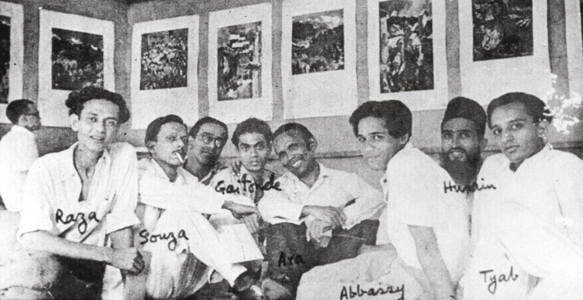
What is Bombay Progressive Artists Group?
The Bombay Progressive Artists Group - sometimes called the Progressive Artists Group or PAG - emerged as a deliberate challenge to the artistic establishment. Six founding members whose philosophy was clear enough: art should be free from arbitrary gatekeeping, and Indian artists had every right to engage with modernism on their own terms.
Unlike movements built around a single aesthetic, the PAG celebrated diversity. Expressionism rubbed shoulders with Cubism; geometric abstraction coexisted with lyrical figuration. What held them together wasn't visual consistency but something more fundamental: a conviction that Indian art could be modernist without ceasing to be Indian.
They borrowed the name from the Progressive Writers' Association, the literary movement that had challenged artistic orthodoxy in the 1930s.
Consider what was at stake. The Bengal School, which had served crucial functions in reclaiming Indian artistic dignity during colonial times, had hardened into something ossified. Romantic nationalism, even when well-intentioned, felt constraining. Meanwhile, the academic realism taught in colonial institutions was technically competent and spiritually empty. The bombay progressive group positioned itself against both: not rejecting Indian tradition but synthesizing it with global modernism in ways that felt vital.
History and Formation of Progressive Art Group
1. Founding of PAG in 1947
The dates matter less than the moment. In December 1947, independence was fresh, partition still bleeding, F.N. Souza - the catalyst, the agitator - had grown tired of fighting the system from inside. Instead of appealing their rejections, he and others simply built something new.
The formal inception is pinned to December 5 or 15, 1947 (sources vary, which is its own kind of historical messiness). Souza, S.H. Raza, K.H. Ara, and art critic Rashid Husain gathered first, then expanded to include M.F. Husain, H.A. Gade, and S.K. Bakre. Seven, then six - the exact number fluctuated during those early weeks. What mattered was the commitment: to reject gatekeeping, establish independent exhibitions, and insist that artistic quality should be judged by transparent criteria, not the whims of establishment committees.
Members came from different regions, different economic backgrounds, different religious traditions. Souza was a Goan Catholic. Raza was from Madhya Pradesh. Bakre came from Baroda. This plurality - the very thing that might fragment other movements - became their strength.
The immediate impulse was institutional reform: fix the exhibition process, create alternatives to the Bombay Art Society's arbitrary selections. But something larger crystallized as they worked together. They recognized that what needed changing wasn't just administrative but artistic. The bombay progressive artists group wasn't simply demanding fairer judging. It was asking: What should art look like in an independent India?
2. Early Years and Exhibitions
Their first exhibition opened in 1948 or 1949 - again, sources aren't entirely clean on this. The venue was the Bombay Art Society's Salon at Rampart Row in Kalaghoda. Mulk Raj Anand inaugurated it, who was a writer, a critic, a cultural figure with real standing. His presence at the opening conferred something: legitimacy, perhaps, but more than that - an intellectual framework for understanding what these young artists were attempting.
The works themselves were radical. Souza's paintings were sexually explicit and provocative. Nudes rendered with distorted forms. Husain's Cubist fragmentation deployed itself not as formal exercise but as a language for depicting Indian street life - the visual chaos of a modernizing city fractured across planes. Raza's expressionist landscapes. Ara's austere still-lifes. Gade's geometrically-structured spaces. Bakre's sculptures, distorted and powerful.
A second exhibition traveled to Kolkata in 1950. But by then the group wasn't just challenging the establishment; it was building an actual audience. Young artists noticed. Collectors began to pay attention. What had started as an act of institutional rebellion was becoming a movement with philosophical weight.
They exhibited in Baroda, in Ahmedabad. The progressive art group was establishing itself as a genuinely pan-Indian phenomenon, not merely a Bombay phenomenon. But there's something curious here: even as they expanded, the core was already fracturing.
3. Dissolution of the Progressive Artists Group
The group lasted as an organized entity - roughly speaking - from 1947 to 1956. Nine years. Not long. But the actual coherence began dissolving almost immediately.
By 1950, Souza had left for the United Kingdom. He understood that to become truly significant on the global stage, he needed to work internationally. Raza followed, eventually settling in Paris. Bakre emigrated to Britain in 1951. This wasn't a failure of the movement. It was, in a sense, its fulfillment: these artists had always imagined themselves as part of a global conversation, not merely a local assertion.
The group though lost its founding figures. The energy that had animated those early exhibitions dispersed. The last significant group exhibition took place in 1953, notably including Bhanu Rajopadhye Athaiya, the sole woman artist formally associated with the PAG.
Was this dissolution? Perhaps. Or perhaps it was transformation. The artists who remained - Husain, Ara, Gade - continued creating. Other artists absorbed the PAG's philosophical commitments and carried them forward. V.S. Gaitonde, Tyeb Mehta, Akbar Padamsee, Ram Kumar. The group's formal structure dissolved, but its intellectual and artistic legacy diffused throughout Indian modernism.
By 1956, the Progressive Artists Group had ceased functioning as an organized movement. What remained was influence - diffuse, pervasive, foundational. Less a group than a starting point.
Founding Members of the Progressive Artists Group
1. F. N. Souza
Francis Newton Souza. Born Goa, 1924. A Catholic boy raised in a Hindu-majority, Muslim-inflected, Christian-minority town. Already, multiple traditions were colliding inside him.
By the 1940s he'd become convinced that Indian art was suffocating. He painted expressionistically, with distorted forms and provocative subject matter. Religious themes - Christian, Hindu, Islamic - all filtered through his vision, which was neither reverent nor dismissive but intensely exploratory.
His palette was bold, sometimes clashing. His works like the Hindu Princess (1949), Birth and The Last Supper (1952) announced his interests. These weren't illustrations of religious narratives; they were interrogations. Souza had absorbed European Expressionism - Rouault, Soutine, the raw emotionality of painters who believed form should be distorted in service of feeling. But he wasn't imitating. He was translating, which is different. He was asking: How do these formal strategies allow me to explore Indian spirituality, Indian embodiment, Indian sexuality in ways that previous art traditions forbade?
After leaving India in the late 1950s, Souza's work evolved. But his catalytic role remains: he was the one who insisted that Indian art needed to shed its constraints, who demonstrated that modernism could be an instrument of cultural authenticity rather than cultural betrayal. He died in 2002, having spent most of his final decades in exile, occasionally speaking about the isolation of being a modernist Indian artist in the West.
2. S. H. Raza
Sayed Haider Raza came from Madhya Pradesh, born 1922. His early work was landscape painting - expressionist, deeply attentive to color and atmosphere. Rivers, forests, villages rendered with a kind of lyrical intensity. These paintings earned praise. They were accomplished. But they were a necessary beginning before the real investigations could commence.
In the 1950s and beyond, Raza's practice shifted dramatically toward abstraction rooted in Indian cosmology and philosophy. He developed what became his signature motif: the Bindu. A circle. A point. The visual representation of the cosmic seed from which all creation emerges.
Raza was exploring how geometric abstraction - cold, rational, European in origin - could become a vehicle for expressing spiritual and philosophical traditions that had nothing to do with Europe. The Bindu appeared in thousands of variations across his career. Sometimes standalone, sometimes nested within landscapes and at times surrounded by other geometric forms, often derived from Rajasthani miniature painting.
His use of color was crucial. Bright, intense, drawn from Indian visual traditions - folk art, textile design, miniature painting. Color, in Raza's work, refused to be subordinate to form. Instead, color and form entered into genuine dialogue, each challenging and enriching the other.
You can explore his artistic evolution and philosophy through his complete work at dedicated artist resources on ArtFlute, where S H Raza remains one of the most studied modernist painters.
He eventually settled in Paris, but remained engaged with India intellectually and spiritually. His later works, particularly those created in the final decades of his life (he died in 2016), achieve a kind of synthesis - European modernism fully absorbed and transformed into something that could only have emerged from an Indian sensibility engaging with the world as a cosmopolitan artist.
3. M. F. Husain
Maqbool Fida Husain was called the Picasso of India, though the comparison doesn't quite hold - Husain's work was far more rooted in specific social and cultural observation. Born 1915 in Madhya Pradesh, he came to art through a somewhat indirect route, apprenticing with theater set painters before developing his own vision.
His paintings are kinetic. The eye doesn't rest but travels across fragmented forms, angular perspectives, compressed narratives. He learned Cubism, but not as a merely formal system. For Husain, Cubism was a language for representing the actual visual experience of Indian urban life - the compression of bodies and objects in crowded streets, the multiple viewpoints from which a scene could be apprehended simultaneously.
Tonga (1950) - a horse-drawn cart, central to Indian street commerce was painted in fragmented planes, in bright, expressionist color. The painting manages to be both formally sophisticated and viscerally alive. You feel the movement, the urgency, the specificity of the Indian street.
What distinguishes Husain from many of his peers is his refusal of the romantic. He didn't idealize the poor or spiritualize folk traditions. He painted them as they were: complex, vital, contested, full of dignity and desperation simultaneously. His brushwork was always confident, sometimes wild. Color deployed with apparent spontaneity but careful intention.
Among the progressive artists group members, Husain remained longest in India, continuing to create and exhibit. He faced increasing public attacks in later decades as Hindu nationalism gained force, eventually moving into self-imposed exile. But his contribution to the PAG - demonstrating that Cubism could speak authentically about Indian social life - remains foundational.
4. K. H. Ara
Krishnaji Howlaji Ara was largely self-taught, which in itself was significant. He'd bypassed art school, avoiding both the Bengal School's romantic aesthetics and academic realism's technical protocols. This choice gave his work a peculiar freedom.
Ara painted still-lifes and nudes. Not a fashion among modernists. Still-life seemed reactionary; the nude seemed dated. But Ara approached both with genuine tenderness and intensity. His still-lifes - vases, bowls of fruit, flowers in windows - treated ordinary objects as if they possessed an almost moral weight. He layered white paint thickly, almost sculptural. White became paradoxical: both illuminating and obscuring, presence and absence.
His nudes were remarkable because they rejected spectacle. No eroticism. No idealization. The female figures in his paintings existed in their own interiority, absorbed in private moments. They were present, tactile, rendered with empathy.
What Ara demonstrated was that modernism wasn't monolithic. It could be quiet. It could work through restraint. It could operate through the careful handling of paint, the subtle modulation of color, the respectful rendering of subject matter. In a movement defined partly by its provocations, Ara's work offered something equally valuable: proof that modernism could be introspective, observational, and fundamentally respectful.
5. H. A. Gade
Hari Ambadas Gade possessed an unusual background for an artist: he'd studied science and mathematics at university before pursuing formal art training at the J.J. School of Art. This dual formation shaped everything. His work carries what you might call a scientific sensibility - an interest in proportion, geometry, systematic structure - but deployed not coldly but as a means of exploring emotional complexity.
His paintings are characterized by geometric composition influenced by Cubism, yet rendered in vivid, emotionally charged color. He was particularly interested in architectural subjects. The humble domestic spaces of Indian cities - Udaipur, Nasik, Omkareshwar. There's an obsessive quality to his return to these themes. As if he were interrogating something essential about modern Indian identity through the representation of built space.
Gade's paintings contain no human figures, yet they're saturated with human presence. The geometric division of surfaces seems to echo psychological complexity. The color - often bold, sometimes discordant - suggests emotional turbulence. What's remarkable is how Gade makes abstraction feel urgent, necessary, emotionally imperative.
His contribution to the progressive art group was specific: proof that modernism and emotional depth weren't opposites. Formal sophistication and human complexity could not just coexist but interpenetrate.
6. S. K. Bakre
Sadanand Kumara Bakre was the PAG's sculptor. Born Baroda, 1920 and trained in modelling and stone carving, later in painting. He studied the moderns - Picasso, Klee - and absorbed their lessons about distortion as a means of expressive intensity.
His sculptures, though modest in number, carry remarkable power. Mother's Pride. Acrobat. Horse. These works employ distortion not decoratively but as a method of expressing vulnerability, labor, human dignity. The forms are exaggerated, sometimes grotesque, but never unfeeling. There's tenderness beneath the formal violence.
When Bakre emigrated to Britain in 1951, he eventually abandoned sculpture, shifting his practice toward painting. Perhaps the isolation - artistic and cultural - made the shift necessary. Or perhaps he felt the moment for sculpture had passed. What matters is that his sculptures established a principle: that the PAG's commitment to modernism extended across all media, that sculpture could be as experimental and emotionally direct as painting.
His legacy, modest numerically, remains significant conceptually: he demonstrated that the progressive artists group wasn't merely a painters' collective but a genuine artistic movement encompassing multiple disciplines.
Artistic Style and Philosophy of PAG
1. Breaking from Tradition
Here's what's often missed: the PAG didn't reject tradition. They rejected traditionalism - the notion that Indian art should remain locked in historical forms, that modernization meant betrayal.
The Bengal School, in its moment, had been revolutionary. It reasserted the value of Indian artistic traditions - Mughal miniature painting, classical sculpture - against colonial dismissal. This was necessary. But by 1947, it had hardened into something else. The romance of the past. The notion that India's authenticity lay in precolonial forms. The conviction that modernity was inherently Western, that Indian artists choosing modernism were choosing cultural inauthenticity.
The bombay progressive artists group said something different. They said: We can engage with Indian traditions - miniature painting, folk art, spiritual philosophy - while simultaneously engaging with modernism. Not as a contradiction but as synthesis.
The academic realism inherited from colonial institutions they rejected more cleanly. It was technically competent but spiritually empty, designed to serve imperial power by representing colonial subjects in ways that affirmed colonial hierarchies. There was nothing to salvage there.
What they proposed instead was genuine fusion. Not appropriation. Not surface decoration. But deep engagement with both Indian traditions and global modernism, with each informing and challenging the other. This required intellectual sophistication. It required refusing easy answers.
2. Embracing Modernism
Modernism itself wasn't monolithic. The PAG engaged with multiple strands: Expressionism with its emphasis on emotional intensity and formal distortion; Cubism with its fragmentation of perspective; abstraction with its exploration of pure form; Post-Impressionism with its color theory.
What they didn't do was copy. Instead, they learned. They absorbed the formal innovations, but asked: How can these serve the investigation of specifically Indian concerns? How can Cubism speak about Indian street life? How can abstraction express Indian cosmology? How can Expressionism interrogate Indian spirituality?
This wasn't incidental. It was fundamental. It was the conviction that modernism was universal - that its formal innovations belonged to all cultures, could serve all cultures, could be refracted through all traditions.
Consider Raza's use of abstraction to explore Indian philosophy. Or Husain's deployment of Cubism to represent Indian social life. Or Souza's expressionist distortion to interrogate Indian religious tradition. In each case, the artistic strategy is modernist, but the content, the investigation, the ultimate meaning is irreducibly Indian.
The actual practice involved substantial intellectual work. Reading. Visiting exhibitions. Engaging with contemporary international art. Understanding what modernism had already achieved in Europe and beyond. Not to imitate, but to understand the formal possibilities available, and then to ask: Which of these possibilities serve my artistic concerns? How must I adapt them? What new possibilities emerge when I apply them to Indian content?
3. Individual Freedom and Experimentation
The PAG's foundational commitment was to individual artistic freedom. This wasn't a slogan. It was the organizing principle of everything they did.
They'd formed partly in reaction to institutional gatekeeping. But they understood something deeper: that genuine artistic innovation required freedom - freedom to experiment, to fail, to pursue individual vision without conforming to established taste. Whether established taste came from colonial institutions or from nationalist romantics, the problem was the same.
This explains why the PAG, despite its name and organizational structure, never developed a unified style. Souza's expressionist provocation. Raza's mystical abstraction. Husain's social observation. Ara's poetic restraint. Gade's scientific geometry. These weren't compromises or failures of coherence. They were proof of success: the group had created genuine space for artistic autonomy.
It's tempting to think that movements require stylistic consistency. But the PAG's model was different. What united them wasn't visual language but philosophical commitment - to liberation from constraint, to authentic self-expression, to the belief that artistic progress depended on freedom. This is the engine behind progressive artists group’s painting as a category: not a single look, but a shared refusal to be contained.
This meant they disagreed. Frequently. About aesthetics, about content, about methods. But this philosophical diversity became their strength. In an art world increasingly divided between those advocating abstract autonomy and those advocating social engagement, the PAG insisted: both. Neither. All of it. Whatever serves genuine artistic investigation.
Impact Progressive Art Group on Indian Art
The PAG's influence on modernism - Indian modernism specifically - was foundational. Not in the sense of providing a single model all subsequent artists followed. Rather, in the sense of establishing modernism itself as legitimate, necessary, and distinctly Indian.
Before the PAG, modernism was often perceived as a foreign import. Something imposed by colonial power. Or adopted by artists seeking international validation but thereby betraying their nation. The PAG insisted otherwise: modernism was a global language that Indians had every right to claim and reshape.
This reorientation had profound consequences. Younger artists - V.S. Gaitonde, Tyeb Mehta, Akbar Padamsee, and later generations - found in the PAG's example permission to experiment. To move beyond naturalism. To engage with abstraction, distortion, formal innovation.
Institutionally, the PAG's impact was equally significant. They demonstrated that artists could organize collectively, establish alternative exhibition spaces, and challenge gatekeeping structures. Later artist collectives would learn from this model. The PAG hadn't invented artist activism, but they'd proven its possibility within the Indian context.
The group members themselves went on to become some of the century's most celebrated Indian artists. Their work entered museum collections globally. Collectors and scholars recognized them as pioneers who'd brought Indian art into genuine dialogue with international modernism. The legacy they established continues to shape how contemporary artists understand their practice.
Bombay Progressive Artists Group FAQs
1. What was the main goal of the Progressive Artists Group?
At its core, the PAG aimed to dismantle gatekeeping within the Indian art establishment and to establish modernism as a legitimate artistic language for India. The group emerged partly from frustration with the Bombay Art Society's arbitrary judging processes, but the larger ambition was cultural: to demonstrate that Indian art could be fully modernist - employing abstraction, distortion, formal innovation - while remaining authentically Indian. They rejected both colonial academic realism and the romantic nationalism of the Bengal School.
2. Who is the woman member of Progressive artist Group?
Bhanu Rajopadhye Athaiya was the sole woman formally associated with the progressive artists group. A graduate of the Sir J.J. School of Art where she won the Gold Medal, Athaiya contributed paintings to the PAG's final group exhibition in 1953. Her mentor was V.S. Gaitonde, one of the era's most significant modernist painters. Though her career as a painter was relatively brief, Athaiya achieved broader recognition as a costume designer, winning the Academy Award for Best Costume Design for Gandhi (1982)
3. Which are some famous artworks by the Progressive Artists Group members?
The PAG produced works now canonical in modern Indian art. F.N. Souza's Birth, Hindu Princess (1949), and The Last Supper (1952) exemplify his bold expressionist style and willingness to explore transgressive themes. M.F. Husain's Tonga (1950), a Cubist rendering of a horse-drawn cart, captures the dynamism of Indian street life. You can explore the work of artist mf husain through his serigraphs and discover how his formal innovations addressed Indian social reality. S.H. Raza's development of the Bindu - a perfect circle representing cosmic creation - became his signature motif. K.H. Ara's still-life paintings demonstrate how restrained modernism could achieve profound emotional depth. H.A. Gade's geometrically-structured landscapes and cityscapes interrogate themes of modernization and loss. S.K. Bakre's sculptures, though limited in number, display powerful distortion and expressive intensity.
4. Where can I see Progressive Artists Group artworks?
Major museums worldwide house works by PAG members. Institutional collections across India - particularly in Delhi, Mumbai, and Kolkata - contain significant holdings. The Asia Society Museum in New York mounted a landmark exhibition titled The Progressive Revolution: Modern Art for a New India (2018–2019), which comprehensively surveyed the movement. Many works remain in private collections and circulate through auction houses and galleries specializing in Indian art. For those interested in exploring the broader context of Indian artistic achievement, famous indian artists and their complete oeuvres can be studied through indian paintings available across institutional and commercial venues.
5. What style of art did PAG promote?
Rather than promoting a single unified style, the bombay progressive art group members championed individual artistic freedom and experimentation within a modernist framework. Collectively, they engaged with Expressionism, Cubism, abstraction, and Post-Impressionism, synthesizing these with Indian classical traditions and spiritual philosophy.
