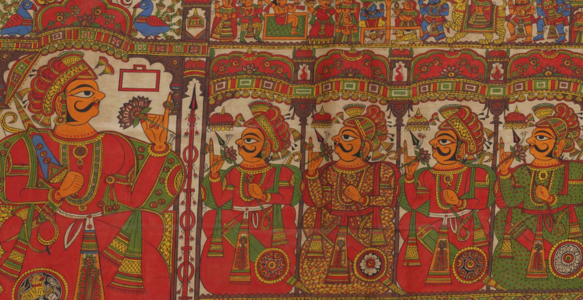
It's past sunset in a Rajasthani village. Dust settles. An old man - a Bhopa, a priest-singer of the Rabari caste - carries a rolled cloth across his shoulders. His wife follows, carrying an oil lamp. They reach a clearing. Word has spread; families gather. He unfolds the cloth slowly, deliberately, with hands that have done this a thousand times. The painted figures emerge: a warrior on a black horse, a woman in golden ornaments, celestial beings, armies, sacred cows. Light from the lamp catches the natural pigments and the figures shimmer. His voice begins, low and rhythmic, accompanying the ravanhatta, a two-stringed instrument. He's invoking Pabuji, the divine protector of herds. The performance will last through the night. This is the Phad, and it isn't hanging in a museum. It's alive, moving, breathing through human voice and ritual.
Phad paintings of Rajasthan are among India's oldest surviving art traditions, yet they have never stopped evolving. For centuries, painters have created scrolls for communities whose spiritual and social identity depends on these images. A phad art painting functions simultaneously as a devotional object, historical record, performance tool, and community asset.
What Is Phad Painting?
Phad paintings are religious scroll paintings created on hand-woven cloth, depicting elaborate narratives of local folk deities revered across Rajasthan. The term "Phad" derives from the Rajasthani word meaning "fold" - referencing how these scrolls are folded for transport and unfolded during performances.
What makes phad art unique is that it is made to be performed. A Phad functions as a mobile temple, ritual object, and communal anchor. In that sense, it sits within India’s wider tradition of spiritual paintings, where image-making is also a form of worship.
When a Phad is created, it undergoes ritual consecration. The most sacred moment comes when the eyes of the central deity are painted, awakening the divine presence within the cloth. When a Phad wears out after years of performance, it undergoes ritual immersion in water, a cooling ceremony called 'Thandi karni.'
This is what distinguishes phad folk art from folk painting more broadly: these scrolls are not merely decorative or illustrative, but active ritual objects.
Origin and History of Phad Paintings
1. Where Did Phad Painting Originate?
The phad painting history is often traced as early as the 10th century A.D., but the tradition as we recognize it crystallized around the 13th-14th century in Shahpura near Bhilwara in Mewar, Rajasthan. This is where the Joshi family - members of the Chipa caste (cloth-painters) - established themselves. And this is where they remained, exclusive custodians of phad art tradition, for nearly 700 years.
For centuries, knowledge passed strictly within the family. This exclusivity protected the tradition, but also made it vulnerable: if younger generations stopped pursuing the art, the legacy of phad paintings of Rajasthan could shrink rapidly.
Shahpura was a crossroads for pastoral communities who needed Phads for ritual performance, while the Joshi painters depended on those commissions. This mutuality sustained the tradition for centuries.
2. Historical Background of Rajasthan Phad Painting
The history of phad painting interweaves with Rajasthan's own fractured, contested history. "As Mughal power expanded across North India, pastoralist communities in Rajasthan retained distinct spiritual practices and allegiances. Folk deities emerged as figures who weren't pan-Indian gods from the great epics but belonged specifically to pastoral communities, encoding their values and struggles.
Pabuji, venerated by Rabaris, represented the archetypal protector - a Rajput hero who sacrificed his life defending cattle belonging to others. That story of duty beyond kinship meant everything to a community whose entire livelihood depended on animal herds. Devnarayan, revered by Gujars, embodied the divine warrior - an incarnation of Vishnu born to correct unjust rulers and establish righteous order. The Devnarayan Katha (legend) preserved collective memory of medieval Gujar-Pratihar conflicts, encoding history as mythology, as sacred narrative.
Over time, these figures moved from collective memory into ritual life, with Phad paintings preserving their stories and Bhopa performance keeping them alive.
3. Role of Bhopas in Phad Painting Tradition
The Bhopa - the priest-singer - stands at the living center of this tradition.
The performance, called 'Jagaran' or 'Phad Vanco,' begins after sunset in an open village space. Offerings are made, the community gathers, and the Bhopa unfolds the scroll while the Bhopi illuminates each episode with an oil lamp. Accompanied by the ravanhatta, the recitation follows patterns preserved through oral tradition.
The Bhopa's performance is a form of spiritual labor, invoking the deity and offering the community darshan. This is why it follows ritual rules and auspicious timing.
The economic dimension matters too. During the overnight performance, the Bhopa pauses to receive donations, reinforcing the mutual obligations that have sustained the tradition for centuries.
The Bhopa's relationship with the Joshi painters was symbiotic and sacred. The Bhopa would invoke blessings before commissioning a new Phad. The painter would work under ritual protocols, understanding that every brushstroke served a spiritual purpose. The completed Phad would be ritually transferred from artist to performer. Theirs was a partnership across castes, across regions sometimes, unified by shared belief in the power of the scrolls and the stories they contained.
4. Phad Painting in the Modern Era
By the mid-20th century, modernization threatened the survival of the tradition. Younger family members pursued other livelihoods, and fewer Bhopas commissioned new Phads.
In 1960, Shree Lal Joshi established Joshi Kala Kunj, the first formal school to teach phad paintings beyond the family. He recognized that exclusive transmission had preserved the art, but also limited its survival.
Over the following decades, hundreds of students learned phad art from Shree Lal Joshi. He later received major national recognition, including the Padma Shri and Shilpguru honors.
His son, Kalyan Joshi, extended that innovation by creating smaller Phads suited to contemporary homes and collectors, often focusing on single episodes rather than complete narratives. He also introduced written text and used the form to address present-day themes. This evolution connects Phad to the broader field of contemporary paintings in India today, while helping sustain a new generation of modern phad painting practitioners.
The tradition adapted to new contexts while maintaining spiritual and aesthetic integrity. Modern phad painting shows that tradition does not require stasis.
Major Themes in Rajasthani Phad Art Painting
1. Folk Deities and Legends
The thematic universe of phad art centers on folk deities - figures who occupy the boundary between history and mythology, between human hero and divine being. These are deities rooted in specific communities, whose stories encode the values, struggles, and spiritual aspirations of pastoral and warrior castes. That contrast matters: folk-deity scrolls like Phad belong to a different lineage than popular devotional iconography such as radha krishna paintings.
Each major Phad tradition connects to a particular community. The Rabari camel herders revere Pabuji as their ishta devata (chosen deity). The Gujar warrior communities worship Devnarayan. Meghwal and Regar leatherworking communities have Ramdevji. To paint and perform a Pabuji Phad is to invoke protection for herds and families.
2. Pabuji Phad Paintings
Pabuji emerges as a divine protector - an incarnation of Laksmana (Rama's brother), though he lived as a historical Rajput chief. His defining act: he sacrificed his life defending cattle belonging to a pastoralist widow against marauding armies. That sacrifice - duty to strangers over obligation to kin - made him divine in collective memory.
In the Pabuji Phad (traditionally about 13 armlengths, roughly 15 feet), Pabuji dominates the central axis, typically rendered riding his miraculous black mare Kesar Kalami. Around him appear companions, courtly scenes, animals, warriors, and sacred figures, creating a dense narrative field in which every inch carries visual weight.
The Pabuji Phad transmits history, theology, and social structure simultaneously. It shows community relationships. It demonstrates which figures possess power, which remain subordinate. It transmits theology, social memory, and community identity.
3. Devnarayan Phad Paintings
The Devnarayan Phad is among the most ambitious forms of the tradition, with traditional versions reaching 30 feet or more.
According to the Devnarayan Katha, Devnarayan emerged as a divine warrior figure associated with justice, protection, and the transformation of collective struggle into sacred memory.
In the painted Phad, Devnarayan sits centrally, often depicted on Basag Nag (the king of serpents), rendered with sharp features and golden ornaments reflecting Gujar aesthetic traditions. Around him unfold his genealogy, his battles, his divine companions. The painting preserves why the deity remains central to Gujar memory and devotion.
4. Folk Tales and Battle Stories in Phad Art
Beyond Pabuji and Devnarayan, Phad artists have also explored figures such as Maharana Pratap, Prithviraj Chauhan, Rani Padmini, and Dhola-Maru, expanding the form into broader regional memory.
These narratives anchor regional identity while creating spaces for moral reflection. They're a community wrestling with its own history, asking what sacrifice means, what loyalty demands, how dignity persists under oppression.
5. Daily Life and Social Scenes in Phad Paintings
The narrative density of Phad paintings means quotidian existence populates every margin. Daily life fills the painted world: farmers, artisans, women carrying water, decorated animals, and figures in traditional Rajasthani dress.
In recent decades, traditional phad art has also incorporated contemporary social themes, sometimes using text to clarify public messages.
This adaptation matters because it proves the Phad form remains functionally alive. It isn't frozen in historical amber. When communities face new crises, artists respond by painting new stories on ancient cloth, using phad paintings as social messaging, educational tools, and moral awakening.
Key Characteristics of Phad Art
1. Narrative Style and Composition
Episodes aren't arranged chronologically; they're distributed spatially - arranged according to where events occur rather than when. This means the same figure appears multiple times throughout the painting, each appearance representing a different moment but occupying simultaneous visual space. This reflects the logic of oral tradition, where narrative returns and repetition matter as much as sequence.
A thick red floral border frames the narrative, containing the story visually, inviting the eye inward. But within that frame, hierarchy dissolves. Figures, animals, architecture, and landscape elements weave together densely, creating visual rhythm rather than illusionistic depth. The composition pulls attention across the surface, echoing the movement of Bhopa performance.
The central deity typically occupies a privileged position, but the rest of the canvas resists hierarchy. Your eye never finds rest because the painter left no blank space - every area contains figure, pattern, narrative element.
2. Scroll Format and Horizontal Storytelling Style
A Phad isn't designed to be seen all at once. It unfolds gradually, revealing episodes sequentially as the performer moves along the cloth. Comprehension requires duration, attention, and participation. A Phad is meant to unfold over time rather than present itself all at once.
The unfolding creates narrative continuity without relying on linear perspective or illusionistic space. Scenes flow into one another. Characters recur. Comprehension emerges through performance - through the Bhopa's voice, through his companion's lamp, through song and gesture and the community's collective attention.
Yet even static in galleries & homes, a Phad's horizontal format suggests movement. Your eye travels left to right, top to bottom, following the Bhopa's path. The format whispers its intended performance, its intended social context.
3. Vibrant Natural Colors
The pigments come from stones, minerals, plants, and earth. Reds derive from iron oxides. Yellows emerge from earth pigments and plant-based sources. Greens come from minerals and vegetation. Blues derive from indigo. Blacks come from charcoal. The resulting hues possess a distinctive matte quality and durability - these colors remain fast and fresh for centuries because they're chemically stable, bonded through natural gum binders.
Color is applied in a prescribed sequence, with each layer drying before the next, ensuring stability and clarity.
Color encodes meaning. Yellow specifically marks ornaments and jewelry - a visual convention telling viewers: "This figure possesses wealth, status, power." Orange tones the limbs and torsos of figures. Green appears in foliage and dresses. Blue - most significantly - appears in water, curtains, and divine beings. Shiva appears in blue. Devnarayan appears in blue-tinged tones. Blue signals the transcendent, the divine, the otherworldly.
4. Distinctive Figurative Style
Figures are rendered in flat, two-dimensional construction rather than naturalistic depth. Humans typically appear in profile - a sharp nose line, exaggerated features that suggest character rather than photographic accuracy. Eyes are enlarged and expressive, with distinctive pupils suggesting alertness and spiritual presence. Emotion is conveyed more through posture and gesture than through facial expression.
Scale depends not on spatial distance but on narrative importance and social status. The central deity looms larger than attendants. Warriors appear larger than servants. Gods dwarf humans. Power manifests as size.
Crucially, figures don't face the viewer. They face each other. This inward orientation creates internal dialogue, suggesting relationships happening within the painted world rather than soliciting viewer identification. Women receive detailed attention - jewelry rendered precisely, textile patterns depicted with patient observation. Animals (horses, camels, peacocks, tigers) carry symbolic weight and distinctive features. Pabuji's black mare - Kesar Kalami remains instantly recognizable across multiple scenes through her color and form.
Famous Traditional Phad Painting Artists
The survival of phad art painting in the modern era owes much to artists who preserved the tradition while also reshaping its future.
1. Shree Lal Joshi
Shree Lal Joshi stands as the pivotal modern figure in the tradition. Trained within the family, he later recognized that traditional phad art painting could not survive through lineage alone. "With Joshi Kala Kunj in 1960, training moved beyond the family for the first time. Shree Lal introduced new subjects to traditional phad paintings - stories of Maharana Pratap, Prithvi Raj Chauhan, Rani Padmini, Dhola-Maru. He experimented with composition and technique. His distinctive style gained international recognition. His work later received major national and international recognition.
2. Kalyan Joshi
Kalyan Joshi (b. 1969), his son inherited technical mastery and his father's commitment to evolution. Where Shree Lal innovated through new subjects, Kalyan innovated through forms practical for contemporary collectors, he pioneered smaller Phads (2, 4, 6 feet) focusing on single episodes. He introduced written text - a heretical innovation that nevertheless expanded accessibility. Through Chitrashala, he helped train a new generation of artists and demonstrated that the tradition could remain economically viable and spiritually relevant in contemporary practice.
3. Pradip Mukherjee
Pradip Mukherjee, a student of Shree Lal Joshi, expanded the thematic range of the form by painting the Ramcharitmanas in Phad style.
4. Contemporary artists
Artists including Nand Kishor Joshi, Shanti Lal Joshi, Gopal Joshi, Prakash Joshi, and Vijay Joshi continue the tradition across contemporary contexts.
When a Phad wears out after years of performance, it undergoes ritual immersion in water. In that ritual lies a central truth about phad paintings of Rajasthan: they are not static artworks, but living spiritual and cultural forms.
The Joshi family’s example shows that preservation depends not on freezing tradition, but on keeping it teachable, viable, and open to change. Across centuries of transformation, that continuity makes Phad one of India’s most resilient artistic legacies.
For collectors interested in witnessing how traditional storytelling translates into contemporary art, the modernization of Phad into smaller formats and new subjects demonstrates dynamic cultural transmission. These smaller scrolls now fit into paintings for living room and office wall paintings, making sacred storytelling accessible to diverse spaces and audiences. For deeper engagement with India's visual heritage, explore indian art paintings to understand how Phad traditions continue inspiring artists across media and geographies today.
FAQs About Phad Art Paintings
How is Phad painting made?
Phad painting is made on hand-woven khadi cloth treated with starch, gum, and burnishing to create a smooth surface. The artist sketches freehand, applies natural pigments in sequence, and finishes by painting the deity’s eyes as the final sacred act.
Which district of Rajasthan is famous for Phad painting?
Bhilwara district, especially Shahpura in the Mewar region, is the historic center of Phad painting. It remains the most important place associated with the tradition and the Joshi family lineage.
What tools are used in Phad painting?
Rajasthan’s phad painting uses fine handmade brushes, natural pigments, gum, and water for painting. A stone burnishing tool called a Mohra is used to smooth the cloth before the painting begins.
How can I identify an original Phad painting?
An original Phad painting is usually made on hand-woven cloth with matte natural colors and visible hand brushwork. Look for dense narrative composition, stylized figures, traditional borders, and an overall finish that does not look printed or overly polished.
