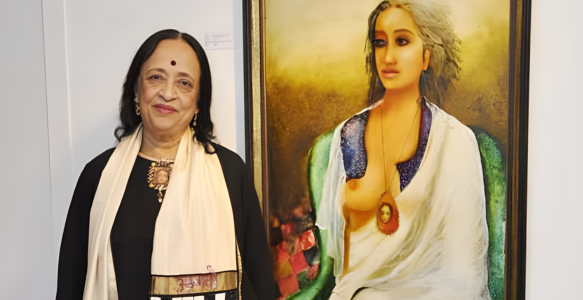
Anjolie Ela Menon - Biography, Art Style, Famous Paintings & Artworks
The woman in the painting holds your gaze. She sits in a room - domestic, intimate, the light catching her profile - and doesn't look back. Behind her, suggested through layers of burnished color, are windows, doorways, the architecture of interior space. She could be waiting. She could be remembering. The canvas gives nothing away. What it does offer is a kind of luminous silence, a space where time feels suspended, where the spiritual and the ordinary inhabit the same breath.
This is Anjolie Ela Menon's territory. For sixty years, she has inhabited this peculiar intersection - the place where medieval icon-painting meets contemporary consciousness, where Hindu mythology and Christian theology speak in the same visual language, where a woman in a room becomes a portal to something transcendent. In an era when Indian art was told to be either traditional or modern, she chose both. In a moment when abstraction was declared the inevitable future, she remained stubbornly, defiantly figurative. Her defiance proved prophetic.
Anjolie Ela Menon’s artwork radiates what collectors and critics describe as "enigmatic clarity" - a luminous quality achieved not through surface shine but through mastery of translucent technique. She builds her paintings in thin washes and glazes, layer upon layer, each transparent enough that you glimpse the layers beneath
She remains one of India's most influential living artists and for readers seeking a deeper understanding about Anjolie Ela Menon, her paintings are best approached not as isolated images but as a continuous inquiry into faith, female subjectivity, and the psychological weight of everyday rituals.
Who Is Anjolie Ela Menon?
Born July 17, 1940, in Burnpur, West Bengal - to mixed Bengali and American parentage - Anjolie Ela Menon emerged from a world already divided. This division, this hybridity, became productive: she would become an artist fluent in both Eastern and Western visual traditions, comfortable in neither completely, commanding both.
At eighteen, she held a solo exhibition with fifty-three paintings. M.F. Husain https://www.artflute.com/artists/m-f-husain designed the invitation. He would become mentor and advocate, recognizing in her work something rare: conviction without dogmatism, technical virtuosity without showing off, a visual voice unmistakably her own. From that beginning, Anjolie Ela Menon,the artist, has built a six-decade practice that defies easy categorization.
She was famous for refusing the modernist consensus. For insisting on the figure when figuration was supposedly exhausted. For creating a body of work in which a woman's face becomes a landscape, in which mythology meets modernity, in which color itself seems to carry spiritual significance. Indian paintings in her hands become instruments for exploring consciousness, spirituality, and the incalculable depths of human interiority.
Today she is recognized globally. Major retrospectives have toured internationally. Her triptych "Yatra" spent six months at the Asian Art Museum in San Francisco. Yet in India, particularly among collectors and curators, she occupies something closer to the position of a master - an elder voice who has shown what's possible when tradition and innovation genuinely meet.
Artistic Background of Anjolie Ela Menon
1. Educational & Early Influences
She grew up drawing. No formal training initially - just the vigor of youth, the confidence of inexperience. Her influences emerged early: Van Gogh's expressionism. Modigliani's elegant elongations. Amrita Sher-Gil and M.F. Husain, who showed that Indian artists could be contemporary without abandoning India, traditional without becoming nostalgic. These artists provided permission - the permission to be hybrid, to work at the intersection.
A degree in English literature from the University of Delhi came first. Literature shaped her as much as painting. Stories, narratives, the interior lives of characters - these remain central to how she constructs paintings. Then came the scholarship that changed everything.
2. Influence of Western Art and Paris Years
In 1959, the French Government awarded a scholarship to Anjolie for the École des Beaux-Arts. Paris. She was nineteen.
More than technique - though she learned that too, studying fresco at the École - she encountered medieval Europe at its source. Hitchhiking on weekends to Romanesque cathedrals. Hours spent before Byzantine frescoes. The formal language she discovered there - frontal figures, averted gazes, spiritual intensity communicated through elongation rather than naturalism - sank into her visual vocabulary.
She traveled through West Asia. Absorbed Islamic art. Studied Renaissance frescoes. Perhaps surprisingly, she remained somewhat unmoved by contemporary Paris, by the abstraction dominating Parisian galleries. "I was a rebel," she would later reflect, "who didn't adapt to the lines of modernism." She was learning a different language entirely. One spoken by Michelangelo and Byzantine icon-makers. One that valued spiritual depth over formal innovation, representation over abstraction.
A Madonna from 15th-century Florence and Yashoda nursing Krishna in Vrindavan weren't in opposition. They were having a conversation. Two visions of a maternal mystery, the same relationship between protection and transformation.
3. Symbolism and Narrative Stillness
What emerged from this synthesis - Eastern spirituality, Western medieval formalism, contemporary consciousness - was a practice rooted in what might be called narrative stillness. Her figures don't gesture dramatically. They inhabit spaces of contemplation.
Anjolie Ela Menon’s art style privileges these arrested moments. The glance that holds multiple truths. The posture that suggests inner turmoil. Color becomes language; composition becomes psychology. Her recurring motifs - crows (drawn from memory of her Mumbai apartment balcony), empty chairs, windows opening onto incalculable distance - all speak to loss, solitude, transcendence, the hidden presence of the spiritual within the everyday.
Anjolie Ela Menon Painting Style and Techniques
1. Use of Tempera Technique
Oil on masonite. This became her preferred medium. But the tempera technique she learned in Paris - demanding, unforgiving, requiring clarity of intention - infuses her entire practice, even when working in oil. Tempera permits no hesitation. No over-painting. No rubbing out. Every mark remains visible. This rigor disciplines artistic decision-making.
She gravitates toward what she calls "thinner paint and well-designed areas." A deliberate constraint. It forces intention to the fore. Limitation breeds authenticity. The result: paintings that achieve intensity through restraint. Her color palette is vibrant - emotionally saturated rather than naturalistic - yet applied with precision. Each form articulated. Each area considered. Nothing accidental.
2. Byzantine and Romanesque Influence
The formal devices of medieval art manifest throughout her work. Frontal figures. Averted or sideways gazes. Subtle body elongation suggesting spiritual rather than naturalistic proportion. These are living techniques through which she channels contemporary consciousness into timeless form. Her figures possess hieratic quality - the spiritual weightiness of medieval icons. Yet their subjects are entirely modern. A woman in contemporary dress. A child from Delhi. Figures drawn from immediate urban environment, translated into an aesthetic language of transcendence.
It bears noting that this synthesis - medieval formal language yoked to contemporary subject matter - creates productive tension. Neither nostalgic recovery nor dismissal of the past. Instead: a fierce argument that spirituality and figuration remain viable artistic languages. Contemporary languages.
3. Unique Figurative Style
Drawing on cubism's fractured perspectives. Pre-Raphaelite sensuality. Early modern portraiture's psychological intensity. Hindu and Christian mythology. She synthesizes these influences into something distinctly her own. The term "modern figurative" fails. Her style operates at a different register entirely.
She employs bold, decisive brushstrokes. Emphasizes volume and presence. Yet maintains emotional interiority. Her nudes are neither classical ideals nor contemporary abstractions. Sensual yet spiritual. Particular yet universal. Rooted in individual bodies, resonant with archetypal meaning. In the 1960s and 1970s, when modernist doctrine insisted representation was exhausted, she persisted. Decades later, when figuration returned to critical favor, her work - created in relative isolation - seemed prophetic. She had preserved a language others abandoned.
4. Fresco Technique
Fresco remains peripheral to her primary practice, yet profoundly shaped her thinking. It demands commitment. Mistakes cannot be corrected. Pigment applied to wet plaster before it dries. This enforces artistic honesty. Every mark reflects genuine intention, not revision or second-guessing. The fresco principle - whether applied to medieval walls or contemporary canvas - speaks to acceptance, to consequence, to the impossibility of return.
Famous Paintings by Anjolie Ela Menon
Anjolie Ela Menon’s famous paintings trace a singular artistic journey that moves effortlessly between myth and modernity, devotion and doubt, intimacy and public ritual. Any serious reading of these works is inseparable from Anjolie Ela Menon’s biography, which spans classical training, sustained engagement with medieval iconography, and decades of disciplined figurative practice. Her life and education inform the material choices, frontality, and spiritual restraint that define her most recognisable paintings.
1. "Vrindavan" Series
In Oil on masonite and in various dimensions, Menon depicts Vrindavan - the legendary landscape where Krishna played his flute - as a space of layered reality. Contemporary pilgrims and priests rendered with archaeological particularity, yet suffused with mythic resonance. Works include "Yashoda," "Namboodri," "Parvati," "Nizamuddin Basti." Later additions: "Vrindavan-II" (2015), "Sabarimala Yatra" (2015). In these canvases, she captures the texture of daily devotion - a woman grinding grain, a child at play - invested with the significance of ritual. The sacred and mundane become indistinguishable.
2. The Triptych "Yatra"
Created in oil and glitter on masonite in monumental scale, this series was created in 2004. Her meditation on pilgrimage - specifically the annual kavadi procession to the Ganges during Shravan month, when millions walk barefoot carrying decorated wooden arches. The three panels depict pilgrims in various stages of devotion, their makeshift shrines adorned with plastic ornaments, tinsel, and aluminum foil. She renders the convergence of tradition and modernity, of spiritual aspiration meeting consumer culture, as genuine alchemy. "I was moved by the pilgrims' devotion," she has said, "by how they access mystical heights that defy the tawdriness of outer forms." Featured in a six-month solo exhibition at Asian Art Museum, San Francisco.
3. Mother and Child
These were created as multiple iterations across decades and created from 1970 to 2010s on oil on masonite and canvas. The motif bridges divine and human, eternal and temporal. Early versions present serene rural women cradling children, compositions echoing centuries of Madonna imagery while remaining distinctly Indian. Later versions explore psychological terrain with greater acuity. She captures tenderness mixed with anxiety, devotion entangled with ambivalence. Bodies rendered with anatomical specificity - actual mothers and children, not abstractions.
4. Woman in Red
Red recurs throughout her oeuvre as a chromatic signature. In paintings where women inhabit red, the color radiates rebelliousness, longing, vitality. Red becomes a statement of agency, refusal of invisibility. These works explore female interiority and resistance, juxtaposing warmth against cooler, somber tones. Visual drama mirrors psychological complexity. The woman in red is neither a passive object nor decorative element. She is subject of irreducible depth.
5. Three Women
This was a figurative study exploring bonds and tensions between women. Mothers, daughters, sisters, rivals. Menon's approach resists sentimentality but brings in psychological complexity. The three women occupy shared space yet remain fundamentally alone, each inhabiting a private interior world. Composition and color suggest invisible currents of emotion and history flowing between figures who appear to share a moment yet experience entirely different realities.
6. The Station
An urban series of the Railway station - Mumbai or Delhi rendered with documentary precision yet suffused with psychological intensity. Travelers wait, embrace, depart. The station becomes a threshold space where multiple narratives intersect. Menon captures liminal quality. How strangers' lives briefly converge before diverging. The paintings observe complex emotional choreography of a public space.
7. Unseen Presence
The figures here are suggested rather than explicitly rendered. Invisible presences are more palpable than visible forms. Emerges from deep engagement with spiritual traditions - Hindu, Christian, Islamic, Buddhist - all exploring the paradox of encountering the divine through emptiness. The paintings honor this paradox. Creating visual languages through which the immaterial becomes tangible.
8. Interior with Figures
Domestic spaces rendered psychologically significant. Windows, doors, thresholds. Architecture itself becomes meaningful. A window framing distant landscape suggests longing and confinement. An empty chair implies absence. Light through interior spaces creates zones of illumination and shadow corresponding to emotional states. Figures engaged in quiet domestic rituals or lost in reverie.
9. Mutations Series
Part of her exploration in the mid-1990s these were parts of her experiment with computer graphics, photography, and digital collage. Figures undergoing strange transformations - bodies fragmenting, merging with animals, becoming unrecognizable. Nude, serpent, boy, reptile remaking themselves repeatedly, giving birth to forms that claim "a life and pedigree of their own." Perhaps surprisingly, the series represents a logical extension of her earlier practice. If medieval iconography expresses spiritual truth through formal constraint and frontality, could digital mutation and fragmentation express contemporary anxieties about identity, embodiment, selfhood?
What collectors often overlook is that Anjolie Ela Menon's spiritual dimension isn't separate from her technical mastery - it's the very foundation of it.
Her paintings remain invitations. Invitations to sit with a figure in quiet space. To consider what lies beneath the surface of a glance. To recognize that the sacred inhabits the everyday, that the figure - rendered with honesty and reverence - remains among art's most profound languages. In encountering her work, you see something rarer: an artist's sustained meditation on consciousness, spirituality, and what it means to render the human form with both technical precision and genuine reverence.
To experience an Anjolie Ela Menon painting is to pause. To look longer. To recognize, perhaps, that some truths require the language of figuration, the luminosity of burnished color, the quiet intensity of a face that refuses to be fully transparent. What will you discover when you pause before one of her paintings? What hidden presence will reveal itself in the silence she creates?
FAQs About Anjolie Ela Menon
1. What is Anjolie Ela Menon famous for?
Anjolie Ela Menon is famous for her deeply figurative paintings that merge medieval iconography with modern psychological and spiritual concerns. At a time when abstraction dominated Indian modernism, she remained committed to the human figure, especially the female form, rendering it with emotional depth and contemplative intensity. Her six-decade career has earned her the Padma Shri (2000) and placement in major collections including the National Gallery of Modern Art and the Asian Art Museum, San Francisco.
2. What painting style does Anjolie Ela Menon use?
Anjolie Ela Menon’s art is primarily figurative and executed in oil on masonite, using thin, translucent layers that are burnished to create a luminous surface. Her style draws from Byzantine and Romanesque iconography, marked by frontality, elongated forms, and inward-looking figures, while incorporating elements of Cubism, Expressionism, and Pre-Raphaelite sensibility. Rather than naturalism, her paintings prioritize emotional and spiritual truth, often exploring mythological and devotional themes through contemporary figuration.
3. What are Anjolie Ela Menon's paintings worth?
Anjolie Ela Menon’s paintings typically range in value from ₹3–4 lakhs for smaller oil works to ₹19 lakhs or more for significant pieces, depending on size, period, subject, and provenance. Larger or historically important works command higher prices, while internationally her paintings are often valued at $20,000–$30,000 USD or above. Works from her earlier decades and museum-exhibited pieces tend to appreciate steadily.
4. What awards has Anjolie Ela Menon received?
Anjolie Ela Menon has received the Padma Shri (2000), one of India’s highest civilian honours, in recognition of her contribution to modern Indian art. In addition to this national award, her work has been featured in major international biennials and museums, including the Paris Biennale, São Paulo Biennale, National Gallery of Modern Art, and the Asian Art Museum, San Francisco - affirming her global artistic stature.
