Who Was Amrita Sher-Gil?
Amrita Sher-Gil was born on January 30, 1913, in Budapest, Hungary, to an unusual family. Her father, Umrao Singh Sher-Gil Majithia, was a Punjabi Jat Sikh aristocrat and scholar of Sanskrit and Persian. Her mother, Marie Antoinette Gottesman, was a Hungarian-Jewish opera singer from an affluent bourgeois family - the two had met in Lahore in 1912 and married against considerable cultural odds. The family remained in Budapest until after World War I, then moved to Shimla, India, where young Amrita would spend her formative years. For many readers searching for who is Amrita Sher Gil, this early movement between Europe and India is the key to understanding her hybrid sensibility.
From age eight, she received formal art lessons. Her uncle, Ervin Baktay, an indologist who visited Shimla in 1926, recognized her exceptional talent immediately and became her earliest mentor. He encouraged her to observe reality closely and transfer it faithfully to canvas, using live models - a methodology that would shape her entire career. By 1929, at her uncle's suggestion, the family relocated to Paris so that Amrita could study at the most prestigious art academies in Europe.
Between 1930 and 1932, working at the École des Beaux-Arts and the Académie de la Grande Chaumière, she produced over 60 oil paintings in a remarkably short time. In 1932, at just 19 years old, she painted Young Girls, a portrait of two women in an affluent interior - one dark-skinned and upright, the other light-skinned and slouched. This painting earned her a gold medal at the Paris Grand Salon in 1933, making her the youngest artist ever to receive this honor and the first Asian. She was immediately elected an associate member of the Société Nationale des Beaux-Arts, again as the youngest ever appointed.
Yet success in Paris felt hollow to her. In 1933, after visiting the National Gallery in London and encountering Paul Gauguin's work directly, something shifted. She began feeling what she described as an "intense longing to return to India," sensing in her bones that her destiny as an artist lay not in the studios of the West but in her Indian heritage. By late 1934, she had packed her work and returned to India - carrying with her 60 paintings and a resolute conviction that, as she would later write, "India belongs only to me." This turning point is central to Amrita Sher Gil’s life story - a homecoming that reshaped her subjects, palette, and purpose.
Artistic Style and Influences of Amrita Sher Gil
To understand Sher-Gil's art style, one must recognize her as a painter caught between two worlds, refusing to choose between them. Instead, she created a third path - a synthesis that honored both her European training and her Indian soul. This synthesis is often described directly as Amrita Sher Gil art style, because it is distinct enough to name and recognize across periods.
1. The European Influence
Sher-Gil's early years in Paris exposed her to the full spectrum of European modernism: Post-Impressionism, Cubism, Fauvism, and Surrealism. She studied the works of Paul Cézanne, Vincent Van Gogh, and above all, Paul Gauguin, whose bold simplifications of form and flattening of pictorial space would echo throughout her career. She worked from live models obsessively, creating portraits and self-portraits that experimented with form, color, and psychological depth. The works were grounded in observation in a way that still resonates with collectors drawn to realistic paintings today. Her early European work was often sensual - particularly her paintings of nudes - reflecting her interest in exploring femininity and the body in modernist terms.
What distinguished her European work, however, was that it never felt entirely Western. Even in Paris, surrounded by the avant-garde, her paintings retained a warmth, a richness of color, and an emotional intensity that her professors noted did not belong in "the grey studios of the West." One of her instructors observed that her use of color suggested she would find her true element in the color and light of the East.
2. Use of Bold Colour and Form
Throughout her career, Sher-Gil employed color as an emotional and formal language. Her palette shifted dramatically over time, yet bold expressiveness remained constant. In her European works, she used rich, jewel-like tones. But after returning to India, her color shifted toward what might be called an "earthy modernism" - deep reds, burnt siennas, ochres, yellows, and greens inspired by classical Indian painting traditions.
She simplified her forms dramatically, reducing figures to their essential geometric shapes and emphasizing line and contour over atmospheric detail. This flattening of space - influenced equally by Gauguin and by Indian miniature painting - created an intimate immediacy. Her subjects, whether peasant women or aristocratic relatives, were rendered with monumentality, a sense that these ordinary moments contained profound human truths.
3. Transition from Western to Indian Themes
The pivot from European to Indian subject matter was not a sudden break but a gradual and deliberate evolution. Even in Paris, she had painted self-portraits exploring themes of cultural hybridity. Self-Portrait as a Tahitian (1934), completed just before her return to India, imagines Amrita Sher Gil’s self portrait of her face and body in Tahitian dress - a meditation on otherness, displacement, and the artist's desire to inhabit multiple identities simultaneously. This work becomes a hinge between her European training and her Indian awakening.
When she returned to India in late 1934, she initially painted her immediate surroundings: family members, acquaintances, the spaces of her daily life. But in 1937, she undertook a transformative three-month journey through South India, visiting Madurai, and crucially, the ancient cave temples at Ajanta and Ellora. Standing before frescoes painted over a thousand years earlier, she experienced a profound artistic awakening. The simplification of form, the emotional intensity, the flattening of space - everything she had intuited in European modernism, she now recognized in the visual language of her own heritage.
From this journey emerged her most celebrated works: the "South Indian Trilogy" (Bride's Toilet, Brahmacharis, and South Indian Villagers Going to Market), each representing a new synthesis of influences. The Ajanta caves had shown her that modernism and tradition were not opposites; they were expressions of the same human impulse toward essential form and emotional truth. She would later tell art critic Karl Khandalavala that her artistic mission had crystallized: "to interpret the life of Indians and particularly the poor Indians pictorially; to paint those silent images of infinite submission and patience, to reproduce on canvas the impression their sad eyes created on me."
Famous Paintings by Amrita Sher-Gil
Below are a few Amrita Sher Gil’s famous paintings that map her evolution.
1. Young Girls (1932)
Young Girls, painted when Sher-Gil was just 19, remains her most iconic work from the European period. The oil painting depicts two women in an affluent interior - one positioned upright with darker skin, the other slouched with lighter skin and blonde hair partially covering her breast. The composition suggests intimacy and perhaps tension; the spatial relationship invites interpretation without insisting on a single meaning.
Commentators have long noted that both women seem to reflect different aspects of Sher-Gil herself - the Indian and European halves of her identity. The painting won the gold medal at the Paris Salon and established her as an international talent at an age when most artists are still finding their voice.
2. Three Girls (1935)
Created shortly after her return to India, Three Girls (also known as Group of Young Girls) depicts three cousins - Nirveer, Beant, and Harbhajan Kaur - seated closely together in traditional Indian dress. Their expressions are contemplative, almost solemn. What matters is the psychological register of the moment. The girls face "a destiny they are unable to change," in the words of one art historian, yet they possess a quiet dignity that no hardship can diminish.
There is virtually no background, no context clues. The focus is entirely on the figures themselves, rendered in flattened forms with expressive line and rich, muted color. Sher-Gil's famous statement appears in her notes on this work: "I realized my real artistic mission, to interpret the life of Indians and particularly the poor Indians pictorially."
The painting won the Gold Medal at the Bombay Art Society's annual exhibition in 1937 and now resides in the National Gallery of Modern Art, New Delhi.
3. Bride's Toilet
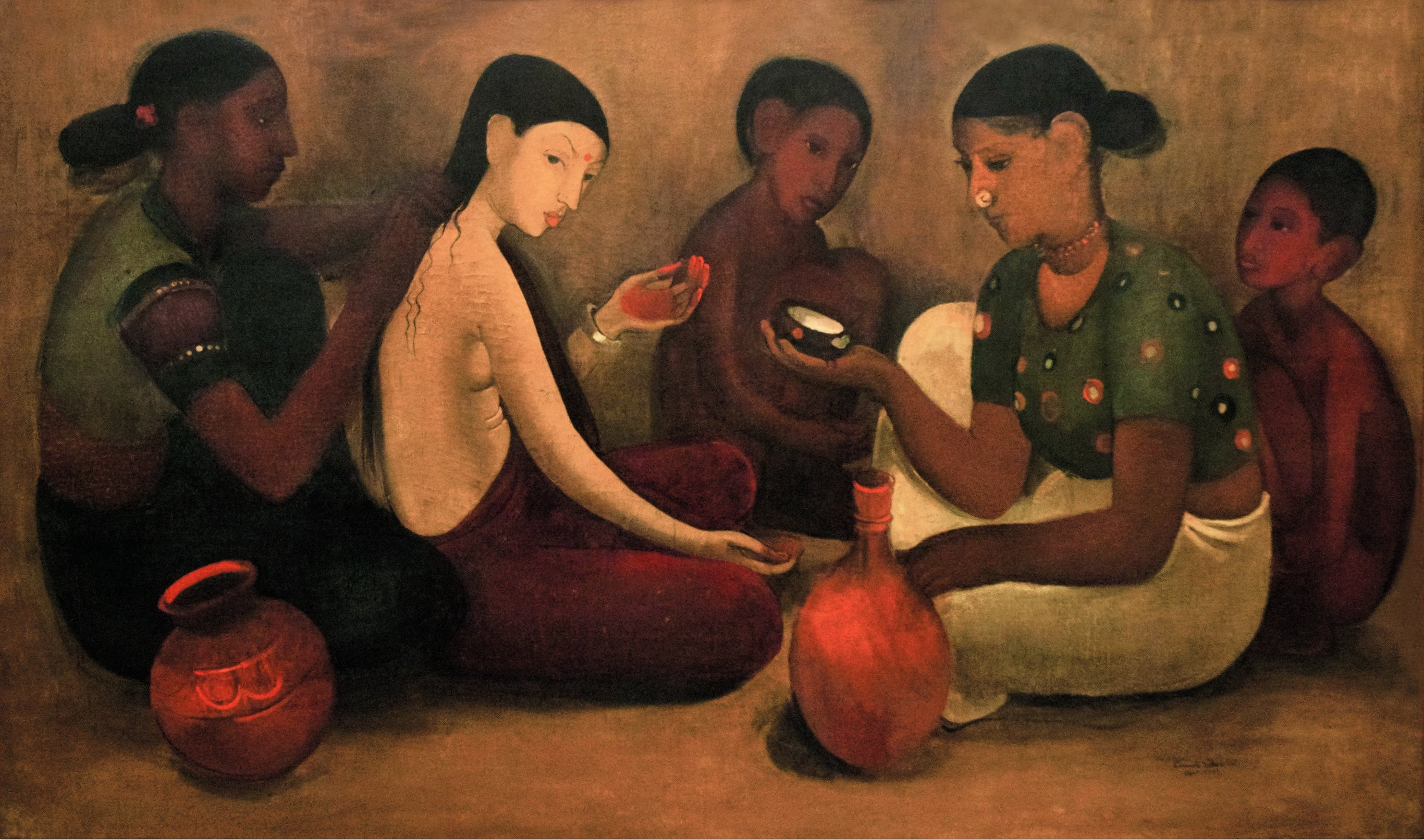
Bride's Toilet (1937), part of the South Indian Trilogy, is perhaps Sher-Gil's most psychologically penetrating work. It depicts a young bride, partially nude with mehndi-stained palms, being prepared for her wedding by attendants and observed by two children. The scene is domestic, intimate, yet profoundly unsettling.
Unlike idealized depictions of marriage rituals, Sher-Gil offers no sentimentality. The bride's expression is resignation, contemplation, or probably quiet endurance - the precise emotion is deliberately ambiguous. The attendants' faces are expressionless. The color is subdued: red ochres, burnt siennas, muted greens - reminiscent of Ajanta frescoes and Rajput miniatures. The painting declares, through every formal choice, that marriage is not a moment of joy but of profound social and personal complexity.
The work exemplifies Sher-Gil's mature synthesis: the flattened pictorial space and bold form recall Gauguin and European modernism, while the use of earth tones and the reference to classical Indian painting techniques root it firmly in Indian tradition. The painting was exhibited at her solo show at Faletti's Hotel in Lahore in November 1937.
4. Self-Portrait as a Tahitian
Painted in 1934, just before her return to India, this remarkable work shows Sher-Gil's face and upper body dressed in Tahitian costume and pose, with a monochromatic terracotta palette. The painting engages directly with Gauguin's work (particularly Where Do We Come From? What Are We? Where Are We Going?), but Sher-Gil recasts the question: What does it mean for an Indian woman to inhabit Tahitian identity? To "put on" the otherness that fascinated European painters?
The work reveals Sher-Gil's sophisticated understanding of how identity, representation, and artistic tradition intersect. In this work she is interrogating the colonial dynamics embedded in Western primitivism, asking who has the right to represent whom, and what happens when the colonized subject seizes the brush.
5. Brahmacharis
Brahmacharis (1937–1941), part of the South Indian Trilogy, portrays dark-skinned young men with bare torsos, wearing stark white dhotis. The figures possess an austere monumentality, their bodies rendered in simplified geometric forms. The palette is saturated with reds, ochres, browns, yellows, and greens - colors drawn directly from Ajanta frescoes.
The work exemplifies Sher-Gil's mature approach to representing Indian masculinity and spirituality. The ascetic brahmacharis (celibate students of philosophy) are not exoticized but presented with dignity and psychological depth, their spiritual seeking evident in their formal postures and contemplative gazes.
6. Little Girl In Blue
Also known as Girl in Blue, this 1935 work was painted in Amritsar and represents perhaps the last strong manifestation of Parisian influence in her work. The color - blues and greens dominating the composition - suggests her lingering engagement with European Post-Impressionism, yet the figure's specificity and the emerging simplification of form announce her transition toward her Indian period.
7. Hill Women
Painted during her later period, Hill Women offers a tender, intimate portrait of women in the Himalayan foothills. The work reflects her deepening engagement with rural and traditional life, rendering her female subjects with quiet strength and psychological interiority.
8. Sleeping Woman
Completed in 1933, Sleeping Woman is a bold oil painting depicting a reclining female nude rendered in Post-Impressionist style. The model was her own sister, Indira. The work was daring for its time - a female artist presenting female nudity on her own terms, with sensuality and formal sophistication. It remains a touchstone work for understanding the complexity of her engagement with femininity and the body.
9. Hungarian Gypsy Girl
Painted in 1932 during a summer visit to Zebegény, Hungary, Hungarian Gypsy Girl depicts a charming, vivacious young woman with a direct gaze. The portrait demonstrates Sher-Gil's mastery of oil technique, the face built up with thick layers of pigment to create a sense of immediacy and presence. The work is housed in the National Gallery of Modern Art in New Delhi.
10. Siesta
Also titled Afternoon Siesta, this work captures a domestic moment: a man sleeping in the center, surrounded by women of the household engaged in their afternoon chores. The composition suggests the rhythms of daily life, the interlocking patterns of rest and labor, solitude and community.
11. Village Scene
Painted in 1938, Village Scene (also called Village Group) depicts a group of women in a melancholic mood. The painting became historically significant in 2006 when it sold for Rs. 6.9 crore at auction in New Delhi - at that time, the highest price ever paid for a work by an Indian woman artist. The record was later surpassed, but the sale marked a turning point in the recognition of Sher-Gil's market value and artistic importance.
Across her short career, Amrita Sher Gil’s paintings returned again and again to dignity, restraint, and interiority
Key Characteristics of Amrita Sher Gill Artwork
1. Fusion of Styles
Perhaps the most defining characteristic of Amrita Sher-Gil's artwork is her seamless fusion of Eastern and Western visual languages. From European modernism, she took the emphasis on essential form, bold color, and psychological depth. From Indian traditions - particularly Ajanta frescoes, Mughal and Rajput miniatures, and folk art - she drew compositional strategies, color palettes, and a philosophy of representation that honored rather than exoticized her subjects.
This fusion emerged from lived experience: she was genuinely caught between cultures, and her art reflected that reality with honesty. She transformed personal struggle into creating a visual language that transcended geographical and cultural boundaries.
2. Feminine Focus
The overwhelming majority of Sher-Gil's subjects were women. Her contribution reshaped the emotional vocabulary of Indian figurative paintings, centering interiority over spectacle. She painted women at work, at rest, in ritual, in solitude. Her engagement with female subjects was psychologically sophisticated and politically aware. She was not interested in beauty or idealization; she was interested in consciousness, in the inner life of women navigating social constraints, tradition, family obligation, and personal desire.
In Three Girls, we see young women facing a destiny they cannot alter. In Bride's Toilet, we see a woman at a threshold moment, her emotions unknowable. In Hill Women and South Indian Villagers Going to Market, we see women at work, engaged in the practical and spiritual labor of sustaining community life. Throughout, Sher-Gil's women possess dignity, interiority, and complexity. Even in stillness, they are subjects of their own experience.
This focus on female psychology and social position makes her work a precursor to feminist art practice, though she would not have used that terminology. Her commitment was simpler and more fundamental: to paint women as fully human.
3. Intimate Realism
Sher-Gil's approach combined modernist formal innovation with a commitment to psychological and social realism. Her figures are rendered with formal sophistication - simplified shapes, bold colors, expressive lines - yet they remain deeply specific. You can sense the particular person behind each painted face, the particular weight of their situation.
This intimate realism distinguishes her work from purely abstract modernism on one hand and from sentimental social realism on the other. She achieved what might be called "psychological modernism" - a style that uses formal abstraction not to escape emotion but to concentrate it, to make feeling visible through form.
The quiet power of her paintings comes from this refusal to flatten her subjects into symbols or types, even as she simplifies their forms toward essential humanity.
It is tempting to think of Amrita Sher-Gil as a tragic figure - a brilliant artist whose life was cut short at 28, who never saw her work gain widespread recognition, who died in mysterious circumstances just days before her first major solo exhibition. But this framing diminishes her achievement. She completed 172 paintings in her lifetime, produced 150 of them in just seven years, and fundamentally changed what modern Indian art could express. Many readers come looking for a biography of amrita shergill precisely because her output feels impossible for such a short life; her discipline and urgency are part of the story.
FAQs About Amrita Sher Gill
1. Why is Amrita Sher-Gill called the Indian Frida Kahlo?
Amrita Sher-Gil and Frida Kahlo were contemporaries who never met, yet their lives and art revealed striking parallels. Both were women artists working in male-dominated fields; both created intensely personal, psychologically complex work rooted in their cultural heritage; both experienced turbulent romantic lives; both explored identity, gender, and cultural belonging through self-portraiture; and both achieved posthumous fame far exceeding the recognition they received during their lifetime. The comparison, while understandable, can sometimes overshadow her unique contribution to modernism and Indian art.
2. Which awards did Amrita Sher-Gil receive?
During her lifetime, Sher-Gil received the most prestigious honor of her career in 1933: a gold medal at the Paris Grand Salon for her painting Young Girls, making her the youngest recipient of this award and the first Asian ever to be so honored. She was also elected an associate member of the Société Nationale des Beaux-Arts, again as the youngest ever appointed. In India, her painting Three Girls won the Gold Medal at the Bombay Art Society's annual exhibition in 1937. Following her death, her works have been designated National Art Treasures by the Government of India, protected under the Antiquities and Art Treasures Act, 1972. In recent decades, her paintings have achieved extraordinary market recognition, with her work The Story Teller selling for Rs. 61.8 crore at SaffronArt in September 2023 - the highest price ever paid for any Indian artist at auction worldwide.
3. What influenced Amrita Sher-Gill's art style?
Sher-Gil's art style emerged from a rich synthesis of influences. In Europe, she was shaped by Post-Impressionism, particularly Paul Gauguin's bold simplifications and flattening of pictorial space; by the formal innovations of Cubism and early Modernism; and by her rigorous academic training in life drawing at the École des Beaux-Arts. In India, she drew inspiration from the frescoes of Ajanta and Ellora caves; from Mughal and Rajput miniature paintings; from Indian folk art and sculpture; and from her direct engagement with Indian social life and landscape. Perhaps most importantly, she was influenced by her own sense of cultural displacement and hybridity - the lived experience of belonging fully to no single tradition gave her the perspective to synthesize multiple traditions with integrity and originality.
4. What was the theme of the paintings of Amrita Sher-Gil?
The primary themes of Sher-Gil's work were human dignity, psychological complexity, and social observation. She was committed to depicting the lives of ordinary people, particularly the poor and marginalized of India, with the same formal sophistication and emotional depth that European painters reserved for aristocratic or mythological subjects. Her focus on women - their inner lives, their social constraints, their labor, their rituals - runs throughout her work. She was also intensely interested in cultural identity and hybridity, exploring through self-portraiture and figural painting the question of how identity is constructed across cultural boundaries. Her paintings often carry undertones of melancholy or quiet resignation, reflecting her empathy for the human struggle against circumstance and tradition.
5. Where can I see Amrita Sher-Gil's paintings in India?
The primary repository of the famous paintings of Amrita Sher-Gil's work in India is the National Gallery of Modern Art (NGMA) in New Delhi, which holds a substantial permanent collection of her paintings. Several of her most important works are displayed there, including Young Girls (at Jaipur House), Three Girls, South Indian Villagers Going to Market, and Hungarian Gypsy Girl. The NGMA's collection includes 95 of her 172 documented paintings. Individual museums and cultural institutions across India also hold her work, and her paintings regularly appear in major exhibitions. For those unable to visit in person, the NGMA maintains online collections and exhibition catalogs that provide high-resolution images and detailed information about specific works. If you need a compact, beginner-friendly overview about amrita shergill, this museum trail is one of the most reliable ways to encounter her oeuvre in person and connect it back to her broader story. Works by artists like Amrita Sher Gil and M. F Husain have a timeless appeal and they make a great sophisticated choice as office paintings and living room paintings.
