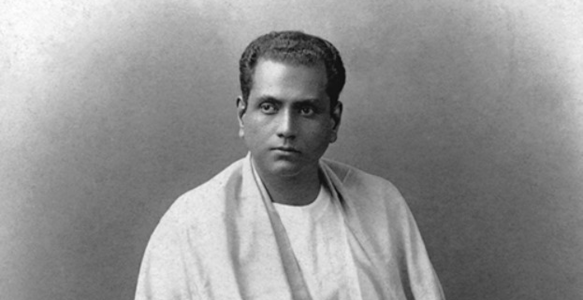
Who Was Abanindranath Tagore?
Ask most people what they know about Abanindranath, and they'll mention Abanindranath Tagore’s Bharat Mata - that iconic four-armed goddess in saffron that became synonymous with Indian independence. Fair enough. But that's like knowing Rabindranath only through "Jana Gana Mana" and missing the rest of his work.
Abanindranath was a cultural architect operating at multiple registers simultaneously. He was a painter, yes. But also a children's author - Khirer Putul, Rajkahini - a body of work that shaped how generations of Bengalis understood storytelling. He was an institutional builder, restructuring the Government School of Art's curriculum. He was a theorist, though he rarely wrote theory in the formal sense. He was Uncle Aban to a circle of artists who treated him as the philosophical center of their practice.
What unified these roles was a consistent conviction: that Indian art had been systematically diminished by colonial education, that this diminishment was recent (not ancient), and that it could be reversed through patient, serious work. Through something harder - the creation of genuinely modern forms that drew from Indian precedent without being imprisoned by it.
Early Life and Background of Abanindranath Tagore
A short biography of Abanindranath Tagore below should walk you through his journey and his influences.
1. Exposure to Western Art Styles
The Tagore family didn't produce artists by accident. Abanindranath's father, Gunendranath Tagore, was himself a painter - trained in oils, working in a semi-European mode. So as a boy he grew up surrounded by art, but art filtered through colonial lenses. The family was wealthy, cosmopolitan, and invested in education.
In 1890, at nineteen, Abanindranath enrolled at the Calcutta School of Art. The curriculum was straightforward: European academic realism. Still life. Anatomical studies. Perspective. Oil and pastel. His teachers were British or British-trained. They taught him to see like a European painter - to render three-dimensional space according to Renaissance principles, to value finish and naturalism above all else.
He was good at it. Competent, even. That's the thing people sometimes miss about Abanindranath. He mastered it first, then rejected it. It means his rejection wasn't born from inability but from conviction.
2. Shift Towards Indian Artistic Traditions
Around 1897, something shifted. The precise moment is hard to pinpoint - history rarely announces itself with clarity. But scholars generally point to his encounter with E.B. Havell, an Englishman who had become Principal of the Government School of Art and who held what were then considered radical ideas: namely, that Indian art had value, that colonial institutions were actively destroying Indian aesthetic traditions. That that the solution wasn't to import more European training but to recover and reinterpret Indian forms.
Havell saw potential in this young painter. More importantly, he saw Abanindranath's restlessness - his sense that European academic training, however competent he'd become in it, was somehow wrong for him and wrong as a path forward.
Together they began studying manuscripts. Mughal miniatures from the collections at the Victoria Memorial. Reproductions of Ajanta frescoes - 2nd-century Buddhist cave paintings that seemed to offer proof that India had once possessed sophisticated visual traditions entirely independent of European development. Rajput paintings, with their brilliant colors and flattened space.
It's tempting to imagine this as a sudden conversion. In truth, it was gradual. But by 1895-97, when Abanindranath painted his Krishna Lila series - 23 miniature watercolors depicting episodes from Krishna's divine play - something fundamental had changed. The figures were stiff, almost typological. The space was compressed, medieval. The line work delicate, almost skeletal. Nothing like the naturalism he'd been trained in. Everything like the miniature traditions he'd begun to study.
3. Development of the Wash Painting Technique
Abanindranath didn't invent the wash technique - it has roots in Japanese painting, in Mughal practice, in centuries of Asian art-making. But he systematized it, made it his signature, turned it into something that felt entirely new precisely because it was so deliberately historical.
The basic idea: apply pigment to dampened paper. Let water and color behave according to their own logic. When pigment reaches the edge of wet paper, it blooms, softens, diffuses. You can't control it entirely. You have to collaborate with the medium. This is radically different from oil painting, where you're building surfaces methodically, where control is paramount.
Whatman paper. Transparent pigments - indigo, chrome yellow, mauve, carmine. Fine brushes. The materials themselves mattered. Better paper than anything locally produced, but deployed in service of non-Western aesthetics.
The wash technique produced a distinctive visual atmosphere. Not fully detailed, but not abstract either. Suggestive. Luminous. There's something almost monastic about looking at these paintings - a sense of restraint, of striving toward clarity through subtraction rather than accumulation. Students who studied with Abanindranath noted that he was obsessive about this restraint. "Don't explain," he'd tell them. "Let the viewer complete the image."
4. Establishment of the Bengal School of Art
By 1905-1915, Abanindranath had become the center of a genuine movement. He wasn't its sole creator - there were other painters, other teachers, other forces at work. But he was its philosophical center, its most accomplished practitioner, the person others orbited around.
The "Bengal School of Art" wasn't formally established, exactly. No date of founding. Instead, it was a shared sensibility among teachers and students: a conviction that Indian art should draw from Indian sources, that the wash technique and miniature traditions offered viable paths for modern work, that spiritual content mattered as much as technical skill.
His students became the movement's embodiment. Nandalal Bose, who would later illustrate the Indian Constitution and become principal of Kala Bhavana at Shantiniketan - perhaps the single most influential art educator in post-independence India. Jamini Roy, whose folk-inflected approach would create an alternative modernism. Asit Haldar and others. What they inherited wasn't a style but a way of thinking about the relationship between tradition and innovation.
In 1907, Abanindranath and his brother Gaganendranath founded the Indian Society of Oriental Art. This institutional move was significant. It wasn't enough to make beautiful paintings - you had to give them infrastructure, exhibition venues, printed reproductions circulating through the market. The society held annual exhibitions and distributed high-quality reproductions, making the Bengal School visible and legitimate in ways isolated studio practice could never achieve.
Famous Paintings by Abanindranath Tagore
Featured below are some of Abanindranath Tagore’s paintings that explore their individual impact and their uniqueness.
1. Bharat Mata (1905)
1905 was a terrible year for Bengal. The British Viceroy, Lord Curzon, announced the partition of the province - dividing it along religious lines, ostensibly for administrative efficiency, actually to weaken the growing nationalist movement. The response was swift and fierce: the Swadeshi movement, which called for boycotting British goods and institutions, recovering indigenous economic and cultural systems.
In this context, Abanindranath painted Bharat Mata - a four-armed female figure in luminous saffron, standing in a landscape where earth and sky blur together. In her four hands: a book (knowledge), sheaves of paddy (agricultural abundance), white cloth (khadi), and a rudraksha garland (spirituality). The figure is simultaneously a Hindu goddess and an abstraction - the nation itself rendered as divine feminine.
The imagery draws from Hindu iconography, obviously. But the timing, the political resonance - that came from Swadeshi. This wasn't a historical painting. It was a nationalist image for the present moment. And it worked. Bharat Mata became perhaps the single most reproduced image of the independence movement. You saw it on the walls. In pamphlets. In nationalist publications. It became shorthand for India itself.
2. The Passing of Shah Jahan (1902)
Three years before Bharat Mata, Abanindranath created a work of intimate tragedy. The Passing of Shah Jahan depicts the Mughal emperor's final moment: an old man lying on his deathbed within the Shah Burj at Agra Fort, gazing across dark water toward the Taj Mahal - the monument he'd built for his beloved Mumtaz Mahal. Beside him, his devoted daughter Jahanara grieves, the Quran nearby.
The painting is a masterclass in miniature composition. The architectural precision - the marble inlay patterns, the intricate railings, the complex spatial relationships - all rendered with meticulous care. And the painting's power is in the emotional stillness. The emperor looking toward the monument. The impossible distance between desire and its object. The weight of memory in an aging body.
It won a medal at the 1902-1903 Delhi Durbar exhibition. That British institutions recognized and rewarded it was important - it suggested that Indian tradition, properly executed, could meet international aesthetic standards. Not through imitation but through its own logic.
3. Journey's End (1913)
The painting shows two camels at the threshold of collapse. The foreground camel kneels, head thrown back, mouth open as if gasping. Blood trickles from its mouth. Behind it, a second camel bows, nearly swooning. The color palette - dusty browns, muted tans, a sun-scorched background - conveys unbearable heat and exhaustion.
Painted during the height of the Raj, interpretations proliferated. Some read the collapsing camel as colonial India itself - a beast of burden driven beyond its limits, indifferent suffering rendered with formal beauty. Others saw something more universal: the question of endurance, of what happens when a journey continues past the point of survival. The painting refuses to resolve the ambiguity.
4. The Banished Yaksha (1904)
Based on Kalidasa's Sanskrit lyric poem Meghaduta, The Banished Yaksha depicts a divine being exiled from paradise, yearning for his lost love. The work demonstrates Abanindranath's method of working from classical Indian literature - treating Sanskrit texts not as museum pieces but as sources for contemporary visual creation. The painting was published in The Studio and other journals, establishing his reputation internationally.
5. Ganesh Janani (1908)
The goddess Parvati stands with hands raised toward the infant Ganesha, who appears suspended before her as if emanating from her own being. A serene mountain landscape surrounds them. Soft blues, greens, earth tones. The line work remains characteristically delicate. The painting draws from Puranic narrative while achieving something more abstract - a meditation on motherhood and divinity, rendered through miniature technique.
6. Buddha and Sujata (1901)
The Buddhist narrative of Sujata's offering of khir (rice pudding) to Prince Siddhartha after his ascetic fasting. Rendered in wash technique with characteristic restraint. The painting conveys spiritual transformation not through dramatic gesture but through subtle modulation of color and line.
7. Tales of Arabian Nights (1928)
Late career, around 1928-1930, Abanindranath created something genuinely experimental: paintings based on The Thousand and One Nights. Rather than illustrating the tales literally, he used them as a framework for exploring colonial Calcutta's emerging cosmopolitanism. Works like Finding of the Ninth Doll blur the boundary between the fantastical and the real. You can't always tell if a figure is a character from the text or a product of imagination. The series represents something like Abanindranath's final statement - a meditation on how stories shape identity, how fantasy and reality interpenetrate.
8. Krishna Lila Series
The series that changed everything. Twenty-three miniature watercolors, roughly 5" x 8", depicting episodes from Krishna's divine play. Drawn from Vaishnavic texts and the Geeta Govinda. The figures are rendered in stiff, typological forms - closer to medieval manuscripts than to naturalism. Sanskrit and medieval Bengali inscriptions position the work within Indian literary traditions rather than as European art objects.
This series announced something: that you could be modern and Indian simultaneously, that you didn't have to choose between contemporary technique and indigenous subject matter.
Style and Techniques Used by Abanindranath Tagore
1. Use of Indian Themes and Mythology
Abanindranath Tagore’s painting is unmistakably Indian in subject. Hindu mythology (Krishna, Ganesha, Durga), Buddhist narratives, Mughal history and classical Sanskrit literature. He illustrated his own children's books, embedding images and narrative in ways that recalled Indian manuscript traditions.
This was radical not because Indian subjects were new - colonial artists had been painting Indian subjects forever. But they'd been painting them as exotica, objects of European interest. Abanindranath treated them as the living center of his practice. Not as decoration. As the primary material.
2. Influence of Mughal and Rajput Miniatures
The DNA of Abanindranath Tagore’s art includes centuries of miniature tradition - Mughal courts, Rajput kingdoms. From these he inherited practices: delicate line work, jewel-like colors, the integration of text and image, the importance of decorative detail. But also philosophical orientations: the value of restraint, spirituality over naturalism, the power of suggestion.
He didn't simply copy these traditions. He asked: how can these principles speak to contemporary concerns? How can medieval miniature technique address early 20th-century colonial anxiety?
3. Use of Wash Technique
The wash technique became the signature method of an Abanindranath Tagore artwork. Water and pigment were allowed to behave according to their own logic. Whatman paper. Transparent pigments. Fine brushes. The process demands acceptance of the medium's spontaneity - you collaborate with water and pigment rather than commanding them. The technique produces a distinctive visual atmosphere: luminous, restrained, suggestive. Not fully detailed but not abstract. A space where viewers complete the image through their own imagination.
Here's what people sometimes miss: the Bengal School's influence didn't expand indefinitely. By the 1920s, modernist movements in Europe and America began challenging the very ideals of tradition that had seemed revolutionary in 1905. What had felt like recovery started to feel like revivalism. The movement became localized to Bengal, then compressed further into a historical period. It took decades for art historians to recognize what had actually occurred: that Abanindranath hadn't simply preserved the past but had created something genuinely new.
When contemporary collectors consider buying paintings online, many encounter works continuing the traditions Abanindranath established - whether directly or through the artists his teaching influenced. You see his imprint in galleries devoted to buddha paintings and radha krishna paintings, where the wash technique and spiritual subject matter he pioneered remain visible. For those designing living room paintings that honor Indian heritage without falling into nostalgia, his aesthetic - intimate, contemplative, spiritually resonant - remains a model. And in collections of indian mythological paintings, his presence is unavoidable: nearly every delicate rendering of Hindu or Buddhist narrative owes something to the revolutionary gesture he made in 1897, when he decided that Indian traditions were not museum pieces but living sources.
FAQs About Artist Abanindranath Tagore Paintings
1. What is Abanindranath Tagore famous for?
Abanindranath Tagore is celebrated as the founder of the Bengal School of Art - the first major movement to systematically revive and reinterpret Indian artistic traditions in response to colonial academic dominance. He's famous for creating iconic nationalist imagery like Bharat Mata, which became the visual symbol of Indian independence.
2. Which painting made Abanindranath Tagore famous?
The most famous painting of Abanindranath Tagore is the Bharat Mata- both nationally and internationally. Painted during the Swadeshi movement and Bengal's partition, the image of a four-armed goddess holding symbols of knowledge, agriculture, spirituality, and self-sufficiency became the visual embodiment of Indian nationalism.
3. What inspired Abanindranath Tagore's artistic vision?
Abanindranath Tagore's artistic vision was shaped by his encounter with E.B. Havell, who argued that Indian art had been systematically diminished by colonial institutions. More fundamentally, he was inspired by his own study of pre-colonial Indian traditions - Mughal miniatures, Rajput paintings, Ajanta frescoes - and by his family's intellectual climate (his uncle was Rabindranath Tagore, the Nobel laureate poet). But the deepest inspiration was perhaps the conviction that India needed to recover its own visual voice without waiting for Western permission.
4. Which mediums did Abanindranath Tagore commonly use?
Abanindranath Tagore primarily worked in watercolor and tempera, employing the wash technique as his signature method. He painted on high-quality Whatman paper and used transparent pigments like indigo, chrome yellow, mauve, and carmine. He also created illustrations, often integrating image and text in the manner of traditional Indian manuscripts, which became defining features of his illustrated children's books.
5. What art style did Abanindranath Tagore follow?
Abanindranath Tagore pioneered the Bengal School of Art, also called the Neo-Indian School. The Abanindranath Tagore art style rejected Western academic realism in favor of revived and reinterpreted Mughal, Rajput, and classical Indian traditions. It emphasized spirituality over materialism, suggestion over explicit detail, and Indian themes and iconography over European subjects. The style was distinctly modern in spirit - addressing contemporary political anxieties - yet rooted in indigenous traditions, creating what might be called a living synthesis rather than a nostalgic revival.
